
Imagine walking into a large factory during the summer season. Heavy machines are running, workers are operating equipment, and the environment becomes very hot and uncomfortable. Without proper ventilation, heat, dust, and fumes can quickly build up inside the building. In such situations, industrial fans play a critical role in maintaining airflow and improving the working environment.
Industrial fans are powerful air-moving devices designed for large spaces such as factories, warehouses, workshops, and commercial buildings. They help remove heat, circulate fresh air, control humidity, and maintain proper ventilation. Without these fans, industrial environments would become unsafe and inefficient for workers and equipment.
For electrical students, engineers, and technicians, understanding how industrial fans work is important because these systems combine electric motors, airflow mechanics, ventilation principles, and energy efficiency. They are widely used in HVAC systems, industrial cooling systems, and ventilation networks.
In this article, we will explore the industrial fans working principle, types, main components, advantages, disadvantages, and industrial fans applications. We will also explain the difference between axial fan and centrifugal fan, which are two common fan designs used in industry. By the end of this guide, beginners will gain a clear understanding of how industrial fans operate and how to select the right one.
What are Industrial Fans?
Industrial fans are mechanical devices designed to move large volumes of air for ventilation, cooling, exhaust, or drying purposes in industrial and commercial environments.
They use an electric motor to rotate blades or impellers that push or pull air through a system. The airflow generated by these fans helps maintain proper air circulation and removes heat, smoke, dust, or harmful gases.
Simple Explanation
An industrial fan works like a very powerful household fan, but it is designed for larger spaces and heavier workloads. It moves a greater volume of air and operates continuously in demanding environments.
Practical Example
For example, in a large manufacturing plant, industrial fans are installed to circulate air across the entire facility. This helps reduce heat buildup from machines and keeps workers comfortable and safe.
Because of their strength and durability, industrial fans are essential equipment in many industrial systems.
Industrial Fans Working Principle
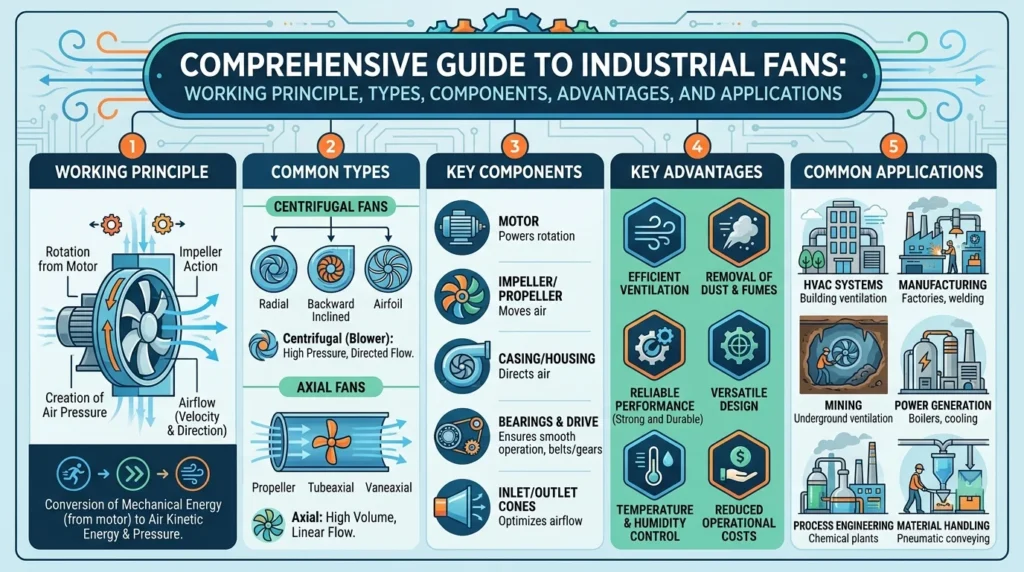
The industrial fans working principle is based on air movement created by rotating blades powered by an electric motor.
When the motor rotates the fan blades or impeller, the blades push air forward and create a pressure difference. This pressure difference forces air to move from one area to another.
Step-by-Step Working Process
- Electric motor starts rotating
The fan motor receives electrical power and begins to rotate the fan shaft.
- Blades rotate at high speed
The fan blades or impeller rotate and interact with surrounding air.
- Air pressure difference forms
The rotating blades create low pressure behind them and higher pressure in front.
- Air begins to move
Air flows from the low-pressure area to the high-pressure area.
- Air circulation occurs
The moving air helps cool equipment, remove heat, and improve ventilation.
Simple Analogy
Think about waving a piece of cardboard quickly in front of your face. You feel air moving toward you. Industrial fans perform the same action, but with more power and continuous airflow.
Types of Industrial Fans
Industrial fans are available in several designs depending on airflow direction and application.
Axial Fans
Axial fans move air parallel to the fan shaft.
Key features:
- High airflow volume
- Low pressure generation
- Simple design
They are commonly used in ventilation systems and cooling applications.
Centrifugal Fans
Centrifugal fans move air perpendicular to the fan shaft using an impeller.
Features include:
- Higher pressure capability
- Strong airflow control
- Suitable for duct systems
These fans are widely used in HVAC systems and dust collection systems.
Exhaust Fans
Industrial exhaust fans remove contaminated air, smoke, or heat from enclosed spaces.
Applications include:
- Factories
- Kitchens
- Chemical plants
They improve indoor air quality and safety.
Inline Fans
Inline fans are installed directly inside duct systems.
Benefits include:
- Compact design
- Efficient airflow control
- Suitable for ventilation networks
High Volume Low Speed (HVLS) Fans
HVLS fans are very large ceiling fans used in warehouses and large facilities.
Characteristics:
- Large diameter blades
- Slow rotation speed
- Wide airflow coverage
They provide efficient air circulation in large spaces.
Main Components of Industrial Fans
Industrial fans consist of several important mechanical and electrical components.
Electric Motor
The electric motor provides the mechanical power required to rotate the fan blades.
Industrial fans typically use AC induction motors.
Fan Blades or Impeller
Fan blades or impellers move the air when they rotate.
Their shape determines airflow efficiency and direction.
Fan Housing
The housing protects internal components and guides airflow through the fan system.
Shaft
The shaft connects the motor to the fan blades and transmits rotational motion.
Bearings
Bearings support the rotating shaft and reduce friction.
They ensure smooth and stable operation.
Mounting Structure
The mounting frame holds the fan securely in position.
It may be wall-mounted, ceiling-mounted, or floor-mounted.
Control System
The control system allows operators to adjust:
- Fan speed
- Direction of airflow
- Operating mode
Advanced systems may use variable frequency drives (VFDs) for speed control.
Industrial Fans Advantages
Understanding industrial fans advantages and disadvantages helps engineers choose the right system.
Key Advantages
- Efficient air circulation for large spaces
- Helps remove heat, smoke, and fumes
- Improves workplace safety and comfort
- Reduces humidity and moisture buildup
- Supports ventilation systems
- Energy-efficient compared to air conditioning
- Durable and designed for heavy-duty operation
Real-World Benefits
Industrial fans increase productivity by creating comfortable working conditions in factories and warehouses.
Disadvantages / Limitations
Despite their benefits, industrial fans also have some limitations.
Common Limitations
- Cannot significantly reduce temperature like air conditioners
- May produce noise at high speeds
- Large fans require strong mounting structures
- Dust accumulation may affect performance
- Regular maintenance is required
Understanding these limitations helps ensure proper installation and operation.
Industrial Fans Applications
The industrial fans applications cover a wide range of industries and environments.
Manufacturing Industry
Industrial fans are used to:
- Remove heat from machinery
- Improve air circulation
- Ventilate production areas
Warehouses and Storage Facilities
Large fans help maintain air circulation and prevent heat buildup.
HVAC Systems
Industrial fans are essential components of heating, ventilation, and air conditioning systems.
Agricultural Applications
Fans are used in:
- Poultry farms
- Greenhouses
- Livestock buildings
They improve ventilation and temperature control.
Commercial Buildings
Industrial fans are also used in:
- Shopping malls
- Airports
- Gymnasiums
- Parking garages
They provide air movement and ventilation.
Difference Between Axial Fan and Centrifugal Fan
Understanding the difference between axial fan and centrifugal fan is important for proper system selection.
| Feature | Axial Fan | Centrifugal Fan |
|---|---|---|
| Airflow Direction | Parallel to shaft | Perpendicular to shaft |
| Air Pressure | Low pressure | High pressure |
| Airflow Volume | High airflow | Moderate airflow |
| Efficiency in Ducts | Lower | Higher |
| Typical Use | Ventilation | HVAC and industrial systems |
Axial fans are best for large open areas, while centrifugal fans are better for ducted ventilation systems.
Selection Guide
Choosing the right industrial fan requires careful evaluation of several factors.
Airflow Requirement
Airflow capacity is usually measured in CFM (Cubic Feet per Minute).
Higher CFM means greater airflow.
Static Pressure
If the system includes ducts or filters, select a fan capable of producing higher pressure.
Motor Power
The motor must provide enough power for the required airflow.
Installation Location
Consider whether the fan will be installed on:
- Walls
- Ceilings
- Duct systems
Energy Efficiency
Energy-efficient fans reduce electricity costs and improve system performance.
Common Problems and Solutions
Industrial fans may face operational problems during long-term use.
Why is the industrial fan vibrating?
Possible cause:
Loose mounting bolts or worn bearings.
Solution:
Inspect and tighten mounting hardware and replace damaged bearings.
Why is airflow weak?
Possible causes:
Blocked air intake or damaged fan blades.
Solution:
Clean the fan and inspect blade condition.
Why is the fan motor overheating?
Cause:
Overload, poor ventilation, or electrical faults.
Solution:
Check electrical connections and ensure proper cooling.
Why is the fan producing unusual noise?
Cause:
Loose components or misalignment.
Solution:
Inspect internal components and perform maintenance.
Future Trends
Industrial fan technology is continuously evolving.
Smart Fan Systems
Modern fans now include smart sensors that monitor:
- Temperature
- Airflow
- Energy consumption
Energy-Efficient Motors
New motor technologies improve efficiency and reduce electricity consumption.
Variable Speed Control
Variable frequency drives allow precise airflow control.
This improves energy efficiency and system flexibility.
Advanced Blade Designs
New aerodynamic blade designs improve airflow while reducing noise.
These improvements will make industrial fans more efficient and reliable in the future.
Conclusion
Industrial fans are essential devices used to maintain proper ventilation, cooling, and airflow in large environments. Their simple yet powerful design allows them to move large volumes of air efficiently.
In this article, we discussed the industrial fans working principle, types, components, advantages, disadvantages, and industrial fans applications. We also explored the difference between axial fan and centrifugal fan, which are widely used in ventilation and HVAC systems.
For electrical students, engineers, and technicians, understanding industrial fans provides valuable knowledge about electric motors, airflow mechanics, and industrial ventilation systems.
As technology continues to evolve, industrial fans will become more energy-efficient, intelligent, and reliable. Learning about these systems helps engineers design better ventilation solutions for modern industries.