
Imagine you are watching television at home and suddenly the picture becomes blurry or the signal disappears. In many cases, the problem is not the television itself but the cable carrying the signal. One of the most commonly used cables for transmitting television, internet, and radio signals is the Coaxial Cable.
Coaxial cables have been used for many decades in communication systems. They are specially designed to carry high-frequency signals with minimal loss and interference. Because of their strong shielding and reliable signal transmission, coaxial cables are widely used in homes, industries, and telecommunications networks.
For electrical students, engineers, and technicians, understanding coaxial cables is very important. These cables play a major role in modern communication systems such as cable television, broadband internet, surveillance cameras, and radio frequency equipment.
In this article, you will learn the coaxial cable working principle, its structure, types, advantages and disadvantages, and real-world applications. The goal is to explain the topic in simple language so beginners can easily understand how this important communication cable works.
What is Coaxial Cable?
A Coaxial Cable is a type of electrical cable designed to transmit high-frequency signals. It consists of a central conductor surrounded by an insulating layer, a metallic shield, and an outer protective jacket.
The word “coaxial” means that the cable has two conductors sharing the same axis. The inner conductor carries the signal, while the outer conductor acts as a shield to protect the signal from electromagnetic interference.
Simple Explanation
In simple terms, a coaxial cable works like a protected tunnel for electrical signals. The inner wire carries the signal, and the outer shield protects it from external noise and interference.
Practical Example
You can easily find coaxial cables connected to:
- Cable TV systems
- Internet modems
- Satellite receivers
- CCTV camera installations
These cables ensure that signals travel smoothly without distortion.
Coaxial Cable Working Principle
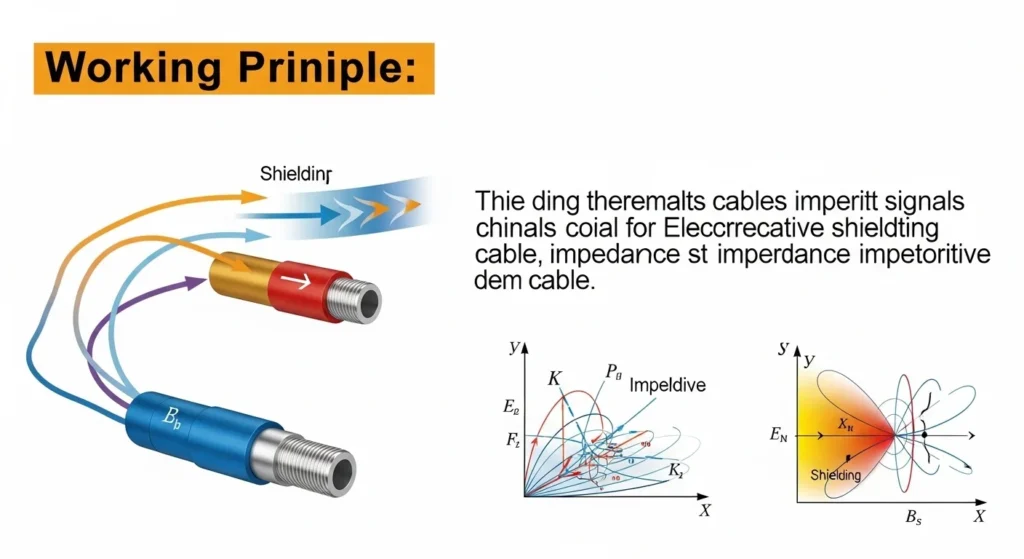
The coaxial cable working principle is based on transmitting electrical signals through a central conductor while preventing interference using a surrounding shield.
Step-by-Step Working
- Signal Transmission
- The electrical signal travels through the inner copper conductor.
- Insulation Layer
- A dielectric insulating material separates the inner conductor from the outer shield.
- Shield Protection
- The outer metallic shield blocks external electromagnetic signals.
- Grounding Function
- The outer shield also acts as a ground path.
- Signal Stability
- Because of this structure, the signal remains stable even over long distances.
Simple Analogy
Think of coaxial cable like a water pipe inside a protective metal pipe. The inner pipe carries water (signal), while the outer pipe protects it from contamination (interference).
This design allows coaxial cables to carry radio frequency (RF) signals efficiently.
Types / Classification of Coaxial Cable
Coaxial cables are classified based on impedance, size, and application.
Hardline Coaxial Cable
Hardline coaxial cables are thick and rigid cables used for high-power transmission.
Features:
- High signal capacity
- Strong shielding
- Used in broadcasting systems
Applications:
- Radio transmitters
- Television broadcasting stations
Flexible Coaxial Cable
Flexible coaxial cables are the most common type used in homes and small networks.
Features:
- Easy to install
- Lightweight
- Affordable
Applications:
- Cable TV
- Internet connections
Semi-Rigid Coaxial Cable
Semi-rigid coaxial cables have a solid metal outer conductor.
Features:
- Excellent shielding
- High performance
- Used in precision systems
Applications:
- Aerospace systems
- Military communication equipment
RG Coaxial Cables
RG stands for Radio Guide. These cables are standardized types used in many systems.
Common types include:
- RG-6 – Cable TV and internet
- RG-59 – CCTV cameras
- RG-11 – Long-distance transmission
Main Components of Coaxial Cable
Understanding the structure of coaxial cable helps in understanding its performance.
1. Inner Conductor
The inner conductor is usually made of copper or copper-coated steel.
Function:
- Carries the electrical signal.
2. Dielectric Insulator
This layer separates the inner conductor from the outer shield.
Function:
- Maintains spacing
- Prevents electrical short circuits
Common materials include:
- Foam polyethylene
- Plastic insulation
3. Metallic Shield
The shield is made of braided copper or aluminum foil.
Function:
- Protects the signal from interference
- Prevents signal leakage
4. Outer Jacket
The outer jacket is the protective plastic covering.
Function:
- Protects the cable from moisture, heat, and physical damage.
Coaxial Cable Advantages and Disadvantages
Understanding coaxial cable advantages and disadvantages helps engineers choose the right communication medium.
Advantages
- Excellent noise immunity due to strong shielding
- High bandwidth capability for RF signals
- Reliable signal transmission over long distances
- Durable and strong construction
- Less signal interference compared to many cables
- Widely available and easy to install
Disadvantages / Limitations
- More expensive than twisted pair cables
- Thicker and heavier than many data cables
- Limited flexibility in tight spaces
- Installation requires special connectors
- Signal loss can occur over extremely long distances
Coaxial Cable Applications
There are many important coaxial cable applications in modern communication systems.
Home Applications
- Cable television connections
- Internet broadband systems
- Satellite TV receivers
Industrial Applications
- Radio frequency transmission
- Communication networks
- Monitoring systems
Security Systems
- CCTV camera installations
- Video surveillance systems
Telecommunications
- Broadband internet distribution
- RF communication equipment
Broadcasting
- Radio transmission systems
- Television broadcast networks
Because of their reliability, coaxial cables are still widely used even with modern fiber technology.
Comparison: Coaxial Cable vs Twisted Pair Cable
Understanding the difference between coaxial cable and twisted pair cable helps in selecting the right cable.
| Feature | Coaxial Cable | Twisted Pair Cable |
|---|---|---|
| Structure | Single conductor with shield | Two insulated wires twisted together |
| Interference Protection | Very high | Moderate |
| Bandwidth | Higher | Lower |
| Cost | Higher | Lower |
| Applications | TV, RF signals | Ethernet networks |
| Durability | Strong | Less robust |
Coaxial cables are better for high-frequency signals, while twisted pair cables are commonly used in computer networks.
Selection Guide: How to Choose the Right Coaxial Cable
Selecting the right coaxial cable depends on several factors.
1. Impedance
Common impedance values include:
- 50 ohms – used in radio systems
- 75 ohms – used in television and internet
2. Cable Type
Choose the cable type based on the application.
Examples:
- RG-6 for TV systems
- RG-59 for CCTV cameras
3. Shielding Quality
Better shielding reduces interference.
Look for:
- Double shield
- Quad shield cables
4. Cable Length
Longer cables require better signal protection to reduce signal loss.
5. Environment
For outdoor installations choose cables with:
- Weather-resistant jackets
- UV protection
Common Problems & Solutions
Technicians often face practical issues when working with coaxial cables.
Why is the TV signal weak?
Possible causes:
- Damaged cable
- Loose connectors
- Excessive cable length
Solution: Replace damaged sections and tighten connectors.
Why is there signal interference?
Possible reasons:
- Poor shielding
- Nearby electrical equipment
Solution: Use higher-quality shielded cables.
Why does the internet connection drop?
Possible causes:
- Faulty cable connectors
- Cable bending or damage
Solution: Inspect and replace faulty connectors.
How to test a coaxial cable?
Technicians can test coaxial cables using:
- Multimeter
- Cable tester
- Signal analyzer
Future Trends in Coaxial Cable Technology
Although fiber optics are becoming popular, coaxial cables still have an important role in communication systems.
Hybrid Fiber-Coaxial Networks
Modern networks combine:
- Fiber optic backbone
- Coaxial cable distribution
This technology is widely used in cable internet systems.
Improved Shielding Technology
New designs use:
- Quad shielding
- Advanced insulation materials
This improves signal reliability.
Smart Communication Systems
Coaxial cables are still used in:
- RF communication devices
- Broadcast systems
- Surveillance technology
Because of their durability and performance, they remain valuable in many industries.
Conclusion
Coaxial cables are one of the most important components in modern communication systems. Their unique structure, consisting of a central conductor, dielectric insulation, metallic shield, and protective jacket, allows them to transmit high-frequency signals with minimal interference.
Understanding the coaxial cable working principle, types, components, and coaxial cable applications is essential for electrical students, engineers, and technicians. These cables are widely used in television systems, internet networks, broadcasting, and security installations.
While newer technologies like fiber optics are expanding, coaxial cables still offer strong advantages such as durability, reliable signal transmission, and excellent shielding. Knowing the coaxial cable advantages and disadvantages helps professionals choose the right cable for different applications.
For beginners entering the electrical or communication field, mastering the fundamentals of coaxial cables provides a strong foundation for understanding modern communication infrastructure.