
You switch on a ceiling fan after coming home from a long, hot day. Within seconds, cool air starts flowing, and you feel comfortable. Have you ever thought about what makes that fan rotate? The answer is an AC machine working quietly inside it.
From water pumps and washing machines to factory equipment and power plants, AC machines are everywhere. They are the backbone of modern electrical systems. Without them, most of our daily and industrial activities would stop.
For electrical students, technicians, and engineers, understanding AC machines is very important. These machines are studied in basic courses and used in real-life projects. Strong knowledge of this topic helps in installation, maintenance, and troubleshooting.
In this article, you will learn what AC machines are, their working principle, main types, components, advantages and disadvantages, applications, and future trends. This guide is written in simple English, just like a senior engineer explaining things clearly to a junior.
2. What Are AC Machines?
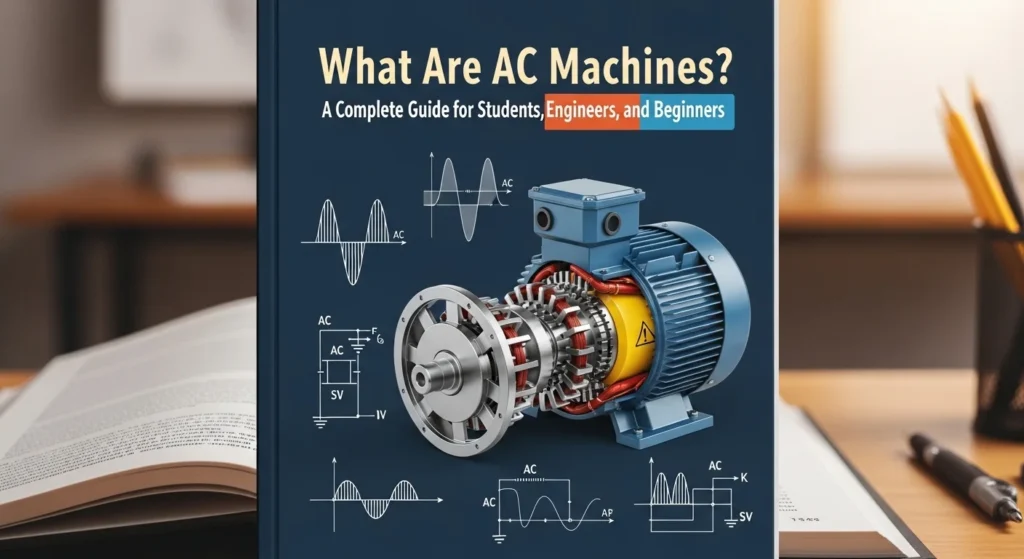
Clear Definition
AC machines are electrical machines that operate using alternating current (AC) and convert electrical energy into mechanical energy or mechanical energy into electrical energy.
In simple words, they are machines that work on AC power to produce motion or electricity.
Simple Explanation
Alternating current changes its direction again and again. AC machines are designed to use this changing current to create a magnetic field. This magnetic field produces movement inside the machine.
Some AC machines work as motors, while others work as generators.
Practical Example
A ceiling fan uses an AC motor to rotate its blades. A power station uses an AC generator to produce electricity. Both are common examples of AC machines.
3. AC Machines Working Principle
Understanding the AC machines working principle helps you know how these machines actually work.
Basic Principle
AC machines work on the principle of electromagnetic induction and magnetic interaction.
When current flows through a wire, it creates a magnetic field. When magnetic fields interact, force is produced. This force causes rotation.
Step-by-Step Working
- AC supply is given to the stator.
- Current flows through stator windings.
- A rotating magnetic field is produced.
- This field cuts the rotor conductors.
- Current is induced in the rotor.
- Magnetic interaction creates torque.
- The rotor starts rotating.
Easy Analogy
Think of pushing a round object with moving hands. Your hands keep moving, and the object keeps rotating. In AC machines, the magnetic field acts like those moving hands.
Key Points
- AC supply creates rotating field
- Rotor current is induced
- Interaction produces force
- Force creates rotation
4. Types / Classification of AC Machines
AC machines are mainly divided into two major types.
4.1 Synchronous Machines
Synchronous machines rotate at the same speed as the rotating magnetic field.
Features
- Constant speed operation
- High efficiency
- Requires external excitation
Types
- Synchronous Motor
- Synchronous Generator (Alternator)
Uses
- Power plants
- Power factor improvement
- Large industrial drives
4.2 Induction Machines (Asynchronous Machines)
Induction machines are the most commonly used AC machines.
Features
- Rotor speed is less than magnetic field speed
- Simple design
- Low cost
- High reliability
Types
a) Squirrel Cage Induction Motor
- Most popular type
- Strong and durable
- Low maintenance
b) Slip Ring Induction Motor
- High starting torque
- Suitable for heavy loads
- Needs more maintenance
Uses
- Fans
- Pumps
- Compressors
- Conveyors
5. Main Components of AC Machines
AC machines have several important parts that work together.
5.1 Stator
The stator is the fixed part of the machine.
Function:
- Holds windings
- Produces magnetic field
- Receives AC supply
5.2 Rotor
The rotor is the rotating part.
Function:
- Rotates with field
- Produces mechanical output
- Transfers power to load
5.3 Air Gap
The small space between stator and rotor.
Function:
- Allows smooth rotation
- Maintains magnetic connection
5.4 Shaft
The shaft connects the rotor to the load.
Function:
- Transfers mechanical power
- Supports rotation
5.5 Bearings
Bearings support the shaft.
Function:
- Reduce friction
- Ensure smooth movement
5.6 Cooling System
Cooling system removes heat.
Function:
- Prevents overheating
- Increases machine life
6. Advantages of AC Machines
Here are the main AC machines advantages and disadvantages. Let us first discuss the advantages.
Advantages
- Simple construction
- Low maintenance cost
- High efficiency
- Long service life
- Easily available
- Reliable operation
- Works on standard AC supply
- Suitable for continuous use
Real-World Benefits
- Lower repair cost
- Less machine downtime
- Better productivity
- Energy savings
7. Disadvantages / Limitations
Despite many benefits, AC machines also have some limitations.
Disadvantages
- Speed control is difficult
- High starting current
- Power factor may be low
- Sensitive to voltage changes
- Synchronous motors need extra equipment
- Requires skilled installation
Practical Impact
In areas with unstable power supply, performance may reduce. Extra devices like drives may be needed.
8. Applications of AC Machines
AC machines applications cover almost every sector.
Home Applications
- Ceiling fans
- Washing machines
- Refrigerators
- Air conditioners
- Water pumps
Industrial Applications
- Conveyor systems
- Cranes
- Elevators
- Rolling mills
- Machine tools
Commercial Uses
- Escalators
- HVAC systems
- Printing machines
- Packaging systems
Modern Technology
- Electric vehicles
- Wind turbines
- Robotics
- Automation plants
- Smart factories
9. Comparison: AC Machines vs DC Machines
To understand better, let us see the difference between AC machines and DC machines.
| Feature | AC Machines | DC Machines |
| Power Supply | Alternating Current | Direct Current |
| Construction | Simple | Complex |
| Maintenance | Low | High |
| Cost | Low | High |
| Speed Control | Difficult | Easy |
| Efficiency | High | Moderate |
| Reliability | High | Medium |
| Usage | Very Common | Limited |
Summary
AC machines are preferred in most applications because they are more reliable, cheaper, and easier to maintain than DC machines.
10. Selection Guide: How to Choose the Right AC Machine
Choosing the correct machine ensures good performance and long life.
Step 1: Understand Your Application
Ask yourself:
- Is it for home or industry?
- Is continuous operation required?
Step 2: Select Power Rating
- Calculate load
- Add 10–20% safety margin
Step 3: Check Speed Requirement
- Fixed speed → Induction motor
- Constant speed → Synchronous motor
- Variable speed → Motor with VFD
Step 4: Consider Environment
- Dusty area → Enclosed motor
- Wet area → Waterproof motor
- Hot area → High insulation class
Step 5: Budget and Quality
- Avoid very cheap products
- Choose trusted brands
Tips for Beginners
- Start with squirrel cage motors
- Read nameplate carefully
- Follow safety standards
- Learn basic maintenance
11. Common Problems & Solutions (FAQs)
Q1: Why does my AC motor not start?
Cause:
- No supply
- Blown fuse
- Loose wiring
Solution:
- Check voltage
- Replace fuse
- Tighten connections
Q2: Why does the motor overheat?
Cause:
- Overload
- Poor ventilation
- Low voltage
Solution:
- Reduce load
- Clean air passages
- Check supply
Q3: Why is there unusual noise?
Cause:
- Bearing damage
- Misalignment
- Loose parts
Solution:
- Replace bearings
- Align shaft
- Tighten bolts
Q4: Why is motor speed low?
Cause:
- Voltage drop
- Overloading
- Drive fault
Solution:
- Improve supply
- Reduce load
- Check controller
Q5: Why does protection trip frequently?
Cause:
- Short circuit
- Overcurrent
- Earth fault
Solution:
- Inspect wiring
- Test insulation
- Repair fault
Regular inspection reduces most problems.
12. Future Trends in AC Machines
AC machine technology is improving rapidly.
High-Efficiency Motors
- IE3, IE4, IE5 standards
- Lower energy loss
- Reduced electricity cost
Smart Motors
- Built-in sensors
- Temperature monitoring
- Remote control
Advanced Drives
- Better speed control
- Energy saving
- Smooth operation
Renewable Energy Integration
- Wind generators
- Hybrid systems
- Green power solutions
Predictive Maintenance
- Fault detection
- Data analysis
- Reduced breakdowns
Future AC machines will be smarter, safer, and more energy-efficient.
13. Conclusion
AC machines are the foundation of modern electrical and industrial systems. From simple household devices to large manufacturing plants, they perform essential functions every day.
In this article, we discussed what AC machines are, their working principle, types, main components, advantages and disadvantages, applications, and future trends. We also compared them with DC machines and explained how to select the right one.
For students and beginners, learning about AC machines builds strong technical confidence. For engineers and technicians, it improves practical skills and troubleshooting ability.
With continuous study and hands-on practice, you can master AC machines and grow professionally in the electrical field. Keep learning, stay updated, and apply your knowledge wisely.