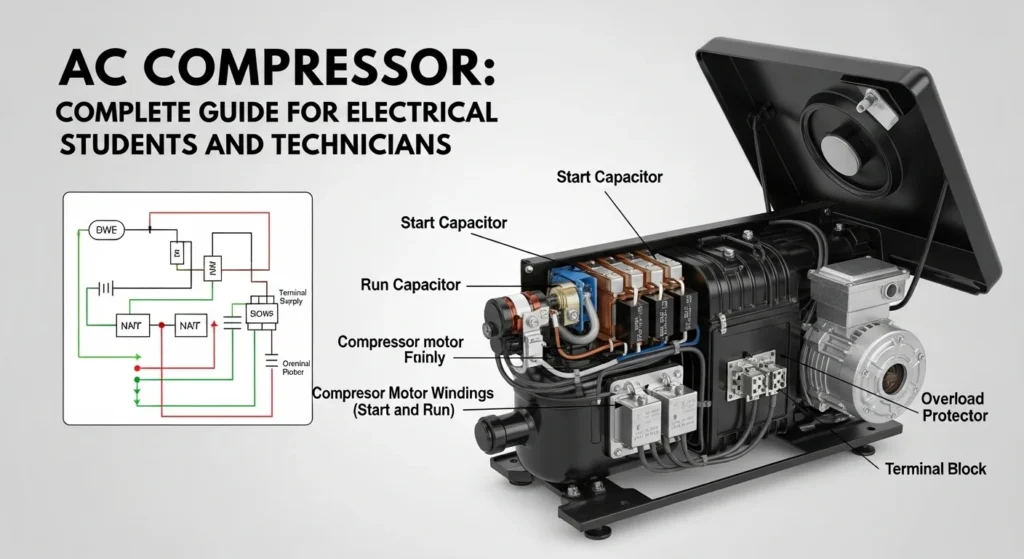

Imagine turning on your air conditioner during a hot summer afternoon. Within minutes, the room starts cooling down. While many components work together, the AC compressor is the main part responsible for making this cooling possible.
The compressor is often called the “heart” of an air conditioning system. It circulates refrigerant and helps remove heat from indoor air. Without it, the entire cooling process would stop.
Understanding the AC compressor working principle is very important for electrical students, technicians, and engineers. It helps in installation, maintenance, troubleshooting, and improving system performance.
In this article, you will learn everything about an AC compressor, including its definition, working process, types, components, advantages, disadvantages, and applications. By the end, you will have a clear and practical understanding of how compressors operate in real-world systems.
2. What is AC Compressor?
An AC compressor is a mechanical device used in air conditioning systems to compress refrigerant gas and circulate it through the system.
Simple Explanation
It increases the pressure and temperature of the refrigerant, allowing heat to be removed from indoor air and released outside.
Practical Example
In a split AC system:
- The compressor takes low-pressure refrigerant gas
- It compresses it into high-pressure gas
- This gas moves to the condenser for heat release
3. Working Principle of AC Compressor
The AC compressor working principle is based on compression and circulation of refrigerant.
Step-by-Step Working
- Refrigerant enters the compressor as low-pressure gas
- The compressor compresses the gas
- Pressure and temperature increase
- High-pressure gas moves to the condenser
- Heat is released outside
- Refrigerant returns to repeat the cycle
Key Points
- Compression increases energy level of refrigerant
- Continuous circulation ensures cooling
Easy Analogy
Think of a bicycle pump:
- When you press it, air gets compressed
- Pressure increases
Similarly, the compressor compresses refrigerant to make cooling possible.
4. Types / Classification of AC Compressor
Different types of compressors are used based on application and design.
1. Reciprocating Compressor
- Uses piston and cylinder
- Common in small systems
Features:
- Strong and reliable
- Suitable for domestic AC
2. Rotary Compressor
- Uses rotating mechanism
- Compact design
Features:
- Smooth operation
- Low noise
3. Scroll Compressor
- Uses two spiral-shaped scrolls
- One fixed, one moving
Features:
- High efficiency
- Low vibration
4. Screw Compressor
- Uses two rotating screws
- Used in large systems
Features:
- Continuous operation
- High capacity
5. Centrifugal Compressor
- Uses high-speed rotating impeller
- Used in industrial plants
Features:
- Very high capacity
- Suitable for large cooling systems
5. Main Components of AC Compressor
1. Motor
- Drives the compressor
- Provides mechanical power
2. Cylinder / Compression Chamber
- Where refrigerant is compressed
3. Piston or Rotating Element
- Performs compression action
4. Valves
- Control refrigerant flow
5. Lubrication System
- Reduces friction
- Improves lifespan
6. Advantages of AC Compressor
The AC compressor advantages and disadvantages are important for understanding performance.
Advantages
- Essential for cooling process
- Improves system efficiency
- Works in different environments
- Reliable and durable
- Supports various AC systems
- Provides continuous operation
7. Disadvantages / Limitations
Disadvantages
- High energy consumption
- Requires regular maintenance
- Can be expensive to repair
- Noise in some types
- Performance affected by improper use
8. Applications of AC Compressor
The AC compressor applications are widely used in different fields.
Home Applications
- Air conditioners
- Refrigerators
Industrial Applications
- Cold storage systems
- Food processing units
- Large HVAC systems
Modern Applications
- Data center cooling
- Automotive air conditioning
- Smart buildings
9. Comparison Section
Difference Between Reciprocating and Rotary Compressor
| Feature | Reciprocating Compressor | Rotary Compressor |
|---|---|---|
| Mechanism | Piston-based | Rotating mechanism |
| Noise Level | Higher | Lower |
| Efficiency | Moderate | High |
| Size | Larger | Compact |
| Maintenance | More | Less |
This shows the difference between reciprocating and rotary compressor clearly.
10. Selection Guide
Choosing the right compressor is important.
For Beginners
- Choose based on room size
- Prefer energy-efficient models
- Check compatibility
For Professionals
- Match system capacity
- Consider load requirements
- Check efficiency ratings
Key Tips
- Choose trusted brands
- Ensure proper installation
- Maintain regularly
11. Common Problems & Solutions
Compressor Not Starting
Solution:
- Check power supply
- Inspect motor
Poor Cooling
Solution:
- Check refrigerant level
- Inspect compressor performance
Overheating
Solution:
- Improve ventilation
- Check load conditions
Noise Issue
Solution:
- Tighten components
- Check internal parts
12. Future Trends
AC compressors are improving with new technology.
Innovations
- Inverter compressors
- Energy-efficient designs
- Smart control systems
Industry Direction
- Eco-friendly refrigerants
- Low power consumption
- Advanced automation
13. Conclusion
The AC compressor is a vital component of any air conditioning system. It compresses refrigerant and ensures proper heat transfer, making cooling possible. Understanding the AC compressor working principle helps in maintaining system efficiency and solving technical problems.
Although it requires maintenance and consumes energy, its importance in modern cooling systems cannot be ignored. With proper knowledge and handling, compressors can provide long-lasting and efficient performance.
For students and technicians, mastering this topic is essential for building strong skills in HVAC and electrical systems.