
Walk into any factory, water pumping station, or large building and you will find machines running continuously—fans spinning, pumps moving water, compressors producing air pressure, and conveyor belts moving products. Behind many of these machines is one of the most reliable electric motors ever built: the Squirrel Cage Induction Motor.
This motor is extremely popular in the electrical and industrial world because of its simple design, durability, and low maintenance requirements. Engineers prefer it because it can operate for long hours without complex control systems. In fact, a large percentage of industrial motors installed around the world are squirrel cage induction motors.
For electrical students, engineers, and technicians, understanding the Squirrel Cage Induction Motor is essential. It is one of the most common machines you will encounter in real electrical systems, industrial plants, and mechanical equipment.
In this guide, you will learn the Squirrel Cage Induction Motor working principle, its classification, main components, advantages and disadvantages, applications, and common troubleshooting techniques. By the end of this article, you will clearly understand how this motor works and why it is so widely used in modern electrical engineering.
2. What is a Squirrel Cage Induction Motor?
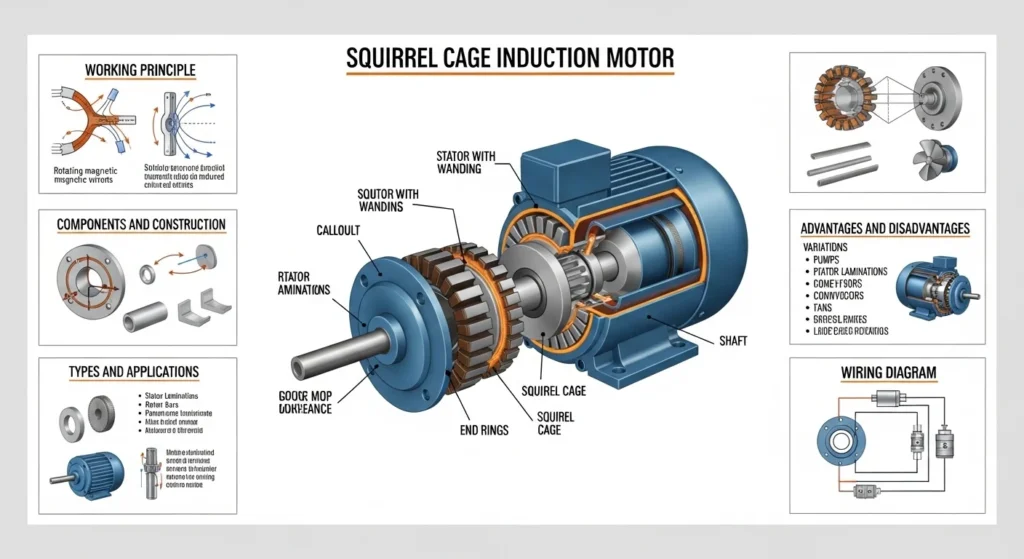
A Squirrel Cage Induction Motor is a type of three-phase induction motor in which the rotor consists of conductive bars arranged in a shape similar to a squirrel cage.
These rotor bars are usually made of aluminum or copper and are connected by rings at both ends. This design forms a closed circuit where current can flow when electromagnetic induction occurs.
In simple words, the motor works without direct electrical connection to the rotor. Instead, current is induced in the rotor by the rotating magnetic field produced by the stator.
Simple Practical Example
Consider a water pump used in a building. When electricity is supplied to the motor, the rotor begins to rotate and drives the pump impeller. This allows water to be pushed through pipes and delivered to different floors.
This type of motor is commonly used because it is strong, efficient, and easy to maintain.
3. Squirrel Cage Induction Motor Working Principle
The Squirrel Cage Induction Motor working principle is based on electromagnetic induction and the concept of a rotating magnetic field.
When alternating current flows through the stator windings, it creates a rotating magnetic field. This magnetic field cuts through the rotor bars and induces current in them.
The interaction between the stator magnetic field and the induced rotor current produces torque, causing the rotor to rotate.
Step-by-Step Working Process
- AC Power Supply Applied
Three-phase AC supply is given to the stator windings. - Rotating Magnetic Field Created
The stator generates a magnetic field that rotates at synchronous speed. - Induced Current in Rotor Bars
The rotating magnetic field cuts the rotor conductors and induces current in them. - Electromagnetic Force Produced
The interaction between magnetic fields produces torque. - Rotor Begins to Rotate
The rotor starts spinning in the same direction as the magnetic field.
Simple Analogy
Imagine a magnet moving near a metal loop. The movement of the magnetic field induces current in the loop. Similarly, the rotating magnetic field of the stator induces current in the rotor bars.
This principle allows the motor to operate without direct electrical connection to the rotor.
4. Types / Classification of Squirrel Cage Induction Motors
Although the squirrel cage induction motor has a simple design, it can be classified into different types based on rotor design and performance characteristics.
Standard Squirrel Cage Motor
This is the most common type used in industrial and commercial applications.
Characteristics
- Simple rotor structure
- Low maintenance
- Moderate starting torque
- High efficiency
Used in pumps, fans, and conveyors.
Deep Bar Squirrel Cage Motor
In this design, the rotor bars are made deeper to improve starting performance.
Features
- Higher starting torque
- Improved starting characteristics
- Better performance under heavy loads
Used in compressors and industrial machines.
Double Cage Induction Motor
This motor has two layers of rotor bars—an outer cage and an inner cage.
Advantages
- High starting torque
- Better efficiency during normal operation
Used in heavy-duty industrial equipment such as crushers and presses.
5. Main Components
A Squirrel Cage Induction Motor consists of several key components that work together to produce mechanical rotation.
Stator
The stator is the stationary part of the motor. It contains windings connected to the AC power supply.
Its main function is to produce a rotating magnetic field.
Rotor
The rotor is the rotating component placed inside the stator.
It consists of aluminum or copper bars connected by end rings, forming the squirrel cage structure.
Air Gap
The air gap is the small space between the stator and rotor.
It allows the rotor to rotate freely while magnetic fields interact.
Shaft
The shaft transfers mechanical power from the motor to the connected machine.
Bearings
Bearings support the rotor shaft and allow smooth rotation with minimal friction.
Motor Frame
The frame protects internal components and supports the motor structure.
6. Advantages
The Squirrel Cage Induction Motor advantages and disadvantages must be clearly understood by engineers.
Advantages
- Simple and rugged construction
- Low maintenance requirements
- High reliability
- Long operating life
- Low cost compared to other motors
- No brushes or slip rings
- High efficiency for industrial applications
- Suitable for continuous operation
Because of these benefits, squirrel cage motors are widely used in industrial systems.
7. Disadvantages / Limitations
Although highly reliable, squirrel cage motors also have some limitations.
- Lower starting torque compared to slip ring motors
- Speed control can be difficult without special controllers
- High starting current
- Limited flexibility for certain applications
However, modern motor control systems such as variable frequency drives have reduced many of these limitations.
8. Squirrel Cage Induction Motor Applications
The Squirrel Cage Induction Motor applications are extremely widespread in modern electrical systems.
Home Applications
- Water pumps
- Air conditioners
- Washing machines
- Refrigeration systems
Industrial Applications
- Conveyor systems
- Compressors
- Crushers
- Machine tools
- Industrial fans
Commercial Applications
- Elevators
- HVAC systems
- Cooling towers
- Escalators
Modern Technology Applications
- Automated factories
- Robotics equipment
- Electric vehicle components
- Renewable energy systems
Because of its reliability, this motor remains the backbone of industrial automation.
9. Comparison Section
Difference Between Squirrel Cage Motor and Slip Ring Motor
| Feature | Squirrel Cage Motor | Slip Ring Motor |
|---|---|---|
| Rotor Design | Bars and end rings | Wound rotor with slip rings |
| Maintenance | Very low | Higher maintenance |
| Starting Torque | Moderate | High |
| Cost | Lower | Higher |
| Efficiency | High | Moderate |
| Applications | Pumps, fans, compressors | Cranes, elevators |
Understanding the difference between squirrel cage motor and slip ring motor helps engineers select the appropriate motor for different industrial applications.
10. Selection Guide
Choosing the correct squirrel cage induction motor requires careful consideration.
Load Requirements
Determine the mechanical load and torque requirements of the machine.
Power Rating
Select a motor with the correct power rating for the application.
Operating Environment
Consider temperature, humidity, dust, and vibration conditions.
Efficiency
Choose energy-efficient motors for long-term cost savings.
Speed Requirements
If adjustable speed is required, use a variable frequency drive.
For beginners, standard squirrel cage motors are usually the best starting point because of their simplicity and reliability.
11. Common Problems & Solutions
Why does the motor overheat?
Possible causes:
- Overloading
- Poor ventilation
- Voltage imbalance
Solution: Reduce load and improve cooling.
Why does the motor make abnormal noise?
Possible causes:
- Worn bearings
- Misalignment
- Loose parts
Solution: Inspect bearings and tighten components.
Why does the motor fail to start?
Possible reasons:
- Faulty power supply
- Damaged windings
- Excessive load
Solution: Check electrical connections and reduce load.
12. Future Trends
Motor technology continues to evolve to meet modern industrial needs.
High Efficiency Motors
New designs focus on reducing energy consumption and improving performance.
Smart Motor Monitoring
Sensors and monitoring systems allow predictive maintenance.
Variable Frequency Drive Integration
VFD technology enables precise speed control and energy savings.
Automation and Industry 4.0
Motors are now integrated into smart factory systems.
Electric Transportation
Advanced induction motors are being used in electric vehicles and modern transport systems.
These innovations will make squirrel cage induction motors even more efficient and intelligent.
13. Conclusion
The Squirrel Cage Induction Motor is one of the most important and widely used machines in electrical engineering. Its simple design, durability, and efficiency make it the preferred choice for many industrial and commercial applications.
In this article, we explored the Squirrel Cage Induction Motor working principle, classification, main components, advantages and disadvantages, and real-world applications. We also examined the difference between squirrel cage motor and slip ring motor, which helps engineers choose the correct motor for specific tasks.
For electrical students and technicians, mastering this motor is essential because it forms the foundation of many industrial drive systems.
As technology continues to advance, squirrel cage induction motors will remain a key part of modern industry, powering machines, factories, and infrastructure around the world.