
Imagine you are running an air conditioner at home. You notice that even though it consumes a certain amount of electrical power, not all of that power is actually used to cool the room. Some energy is lost or stored temporarily in the system. This is a common situation in AC electrical systems.
To understand this behavior clearly, engineers use a simple yet powerful concept called the power triangle. It helps explain how electrical power is divided into different components and how efficiently energy is used.
Understanding the power triangle working principle is very important for students, technicians, and engineers. It is widely used in power systems, electrical machines, and industrial installations.
In this article, you will learn what a power triangle is, how it works, its components, types, applications, advantages, and practical use in real-life systems. By the end, you will be able to analyze electrical power like a professional.
2. What is Power Triangle?
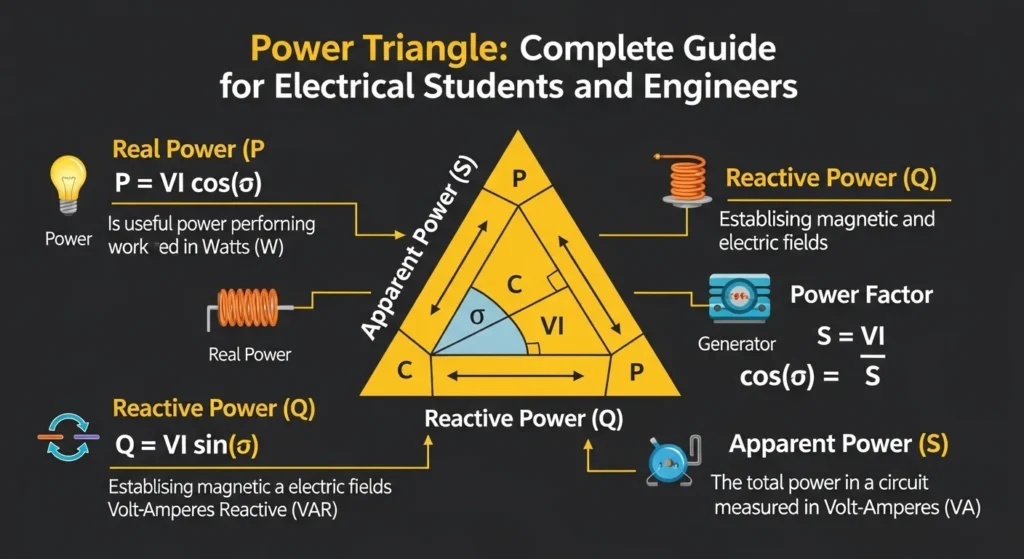
The power triangle is a graphical representation that shows the relationship between three types of electrical power in an AC circuit:
- Active Power (P)
- Reactive Power (Q)
- Apparent Power (S)
Simple Definition
It is a right-angled triangle that helps us understand how power is used and lost in an electrical system.
Practical Example
In a motor:
- Some power is used to do useful work (rotation) → Active Power
- Some power is stored and released (magnetic field) → Reactive Power
- Total supplied power → Apparent Power
The power triangle helps visualize this relationship.
3. Working Principle of Power Triangle
The power triangle working principle is based on the relationship between voltage, current, and phase angle in AC circuits.
S^2 = P^2 + Q^2
This is similar to the Pythagorean theorem.
Step-by-Step Explanation
- Voltage and current in AC circuits are not always in phase.
- The phase difference creates reactive power.
- Active and reactive powers form two sides of a triangle.
- Apparent power is the hypotenuse.
Key Relationships
- P = S × cos(θ) (Active Power)
- Q = S × sin(θ) (Reactive Power)
- Power Factor = cos(θ)
Easy Analogy
Think of walking:
- Walking forward → useful work (Active Power)
- Moving sideways → wasted effort (Reactive Power)
- Total movement → Apparent Power
4. Types / Classification
The power triangle varies depending on the type of load.
1. Lagging Power Triangle (Inductive Load)
- Current lags voltage
- Found in motors, transformers
Characteristics:
- Positive reactive power
- Low power factor
2. Leading Power Triangle (Capacitive Load)
- Current leads voltage
- Found in capacitors
Characteristics:
- Negative reactive power
- Used for power factor correction
3. Unity Power Factor Triangle
- No phase difference
- Only active power exists
Characteristics:
- Ideal condition
- Maximum efficiency
5. Main Components of Power Triangle
1. Active Power (P)
- Measured in watts (W)
- Does useful work
2. Reactive Power (Q)
- Measured in VAR (Volt-Ampere Reactive)
- Stored and returned energy
3. Apparent Power (S)
- Measured in VA (Volt-Ampere)
- Total supplied power
4. Power Factor (cosθ)
- Indicates efficiency
- Ratio of active to apparent power
6. Advantages of Power Triangle
The power triangle advantages and disadvantages help understand its importance.
Advantages
- Easy visualization of power relationship
- Helps calculate power factor
- Useful in system design
- Improves efficiency analysis
- Essential for electrical engineering studies
- Helps reduce energy losses
7. Disadvantages / Limitations
Disadvantages
- Applicable only to steady AC conditions
- Not suitable for complex waveforms
- Requires basic knowledge of trigonometry
- Simplified model (real systems may vary)
8. Applications of Power Triangle
The power triangle applications are widely seen in electrical systems.
Home Applications
- Understanding appliance efficiency
- Reducing electricity bills
Industrial Applications
- Power factor correction
- Motor and transformer design
- Energy management
Modern Technology
- Smart grid systems
- Renewable energy systems
- Electrical monitoring systems
9. Comparison Section
Difference Between Active, Reactive, and Apparent Power
| Feature | Active Power (P) | Reactive Power (Q) | Apparent Power (S) |
|---|---|---|---|
| Unit | Watts (W) | VAR | VA |
| Function | Useful work | Stored energy | Total power |
| Direction | Real | Imaginary | Combined |
| Importance | High | Medium | High |
This table explains the difference between active and reactive power clearly.
10. Selection Guide
Understanding how to use the power triangle is important.
For Beginners
- Focus on basic relationships (P, Q, S)
- Learn power factor concept
- Practice simple calculations
For Professionals
- Use power analyzers
- Apply in real systems
- Optimize power factor
Key Tips
- Always calculate power factor
- Reduce reactive power
- Improve system efficiency
11. Common Problems & Solutions
Q1: Low power factor?
Solution:
- Use capacitors
- Improve load conditions
Q2: High electricity bills?
Solution:
- Reduce reactive power
- Improve efficiency
Q3: System overheating?
Solution:
- Check power losses
- Improve power factor
Q4: Incorrect calculations?
Solution:
- Verify formulas
- Use correct units
12. Future Trends
The power triangle concept is evolving with modern technology.
Innovations
- Smart meters for real-time monitoring
- AI-based energy optimization
- Advanced power analyzers
Industry Direction
- Energy-efficient systems
- Renewable integration
- Automated power management
13. Conclusion
The power triangle is a fundamental concept in electrical engineering that helps explain how power behaves in AC circuits. It clearly shows the relationship between active, reactive, and apparent power, making it easier to analyze system performance.
By understanding the power triangle working principle, students and professionals can improve efficiency, reduce energy losses, and design better electrical systems. Although it is a simplified model, it provides a strong foundation for advanced power system analysis.
Mastering this concept is essential for anyone working in electrical engineering, from beginners to experienced professionals. Practice regularly, apply it in real scenarios, and you will gain strong control over power system calculations.