
Imagine sitting in your home during a warm evening with the lights on. Within a few minutes, mosquitoes and flying insects start gathering around the light. Not only are these insects annoying, but they can also spread diseases such as malaria, dengue, and other infections. To solve this problem, many homes, restaurants, and industries use an insect killer device.
An insect killer is a simple but effective electrical device designed to attract and eliminate flying insects. These devices are commonly used in homes, offices, hospitals, food processing areas, and outdoor environments. For electrical students and technicians, understanding how insect killers work is useful because they combine basic electrical components with practical applications.
From an engineering perspective, insect killers demonstrate how electrical circuits, high-voltage grids, and light attraction technology work together to solve a real-world problem.
In this article, you will learn the insect killer working principle, its types, components, advantages and disadvantages, and various insect killer applications. The goal is to explain the technology in simple language so that beginners, technicians, and engineering students can clearly understand how these devices function.
What is Insect Killer?
An insect killer is an electrical device designed to attract, trap, and eliminate flying insects such as mosquitoes, flies, moths, and other small pests. Most insect killers use ultraviolet (UV) light to attract insects and an electric grid to destroy them instantly.
Simple Explanation
In simple words, an insect killer is a device that uses light to attract insects and electricity to kill them.
When insects move toward the light source, they touch a high-voltage metal grid inside the device. This grid produces an electric shock that kills the insect immediately.
Practical Example
You can commonly see insect killers in:
- Restaurants and kitchens
- Hospitals and clinics
- Food processing factories
- Homes and offices
These devices help maintain hygiene by controlling flying insect populations.
Insect Killer Working Principle
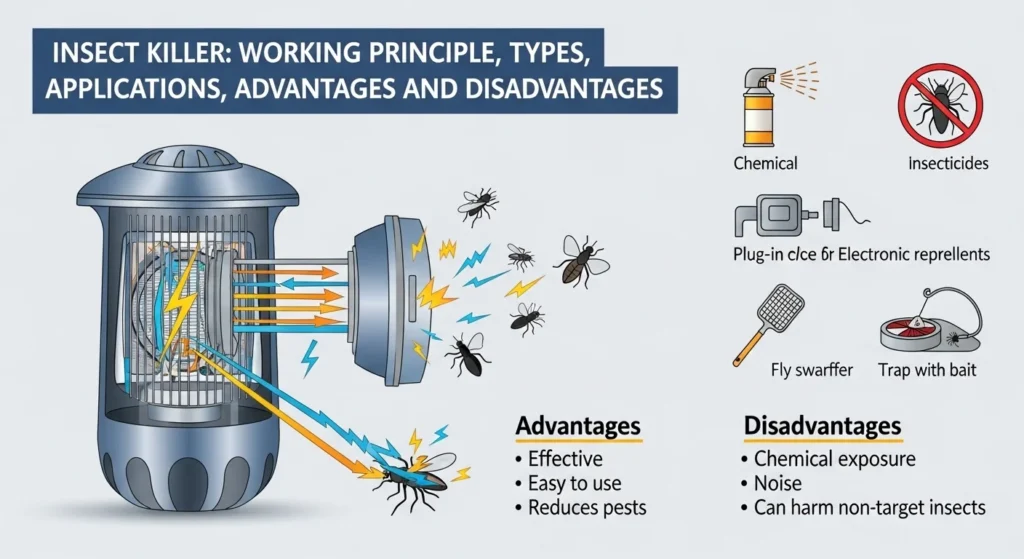
The insect killer working principle is based on two main concepts: light attraction and high-voltage electric discharge.
Many flying insects are naturally attracted to ultraviolet light. Insect killers use this behavior to draw insects toward the device.
Step-by-Step Working Process
- UV Light Attraction
- The device emits ultraviolet light.
- Flying insects are attracted to this light source.
- Approach to the Grid
- The insects move toward the UV lamp.
- Electric Grid Contact
- The device contains two metal grids with high voltage between them.
- Electric Shock
- When the insect touches both grids, it completes the circuit.
- Instant Elimination
- A high-voltage electric discharge kills the insect instantly.
Simple Analogy
Think of an insect killer like a light trap with an electric fence. The light attracts insects, and the electric fence eliminates them when they come too close.
This combination of attraction and elimination makes insect killers very effective in controlling flying pests.
Types / Classification of Insect Killers
Insect killers are available in several types depending on their design and working method.
Electric Grid Insect Killer
This is the most common type of insect killer used in homes and commercial areas.
Features
- Uses UV light to attract insects
- Contains a high-voltage electric grid
- Produces a small spark when insects touch the grid
Applications
- Restaurants
- Homes
- Food processing units
Sticky Trap Insect Killer
Instead of electric shock, this type uses adhesive surfaces to trap insects.
Features
- UV light attraction
- Sticky glue board
- Silent operation
Applications
- Hospitals
- Laboratories
- Clean environments
Bug Zapper
Bug zappers are powerful outdoor insect killers designed for large areas.
Features
- Strong UV light
- High-voltage grid
- Wide coverage area
Applications
- Gardens
- Parks
- Outdoor restaurants
Solar Insect Killer
Solar insect killers use solar panels to power the device.
Features
- Energy-efficient
- Eco-friendly
- Works without electricity grid
Applications
- Outdoor areas
- Farms
- Remote locations
Main Components of an Insect Killer
Understanding the internal components helps technicians repair and maintain the device.
1. Ultraviolet (UV) Lamp
The UV lamp is the main attraction source.
Function:
- Emits ultraviolet light
- Attracts flying insects
2. High Voltage Transformer
The transformer increases voltage from the power supply.
Function:
- Converts low voltage into high voltage
- Supplies power to the electric grid
3. Electric Grid
The grid consists of two metal mesh layers.
Function:
- Produces electric shock
- Eliminates insects instantly
4. Protective Outer Cage
The outer cage prevents humans or animals from touching the electric grid.
Function:
- Ensures user safety
- Protects internal components
5. Collection Tray
Many insect killers have a tray at the bottom.
Function:
- Collects dead insects
- Makes cleaning easier
Insect Killer Advantages and Disadvantages
Understanding insect killer advantages and disadvantages helps users choose the right device.
Advantages
- Effective control of flying insects
- Chemical-free insect control
- Easy to operate
- Low maintenance requirements
- Suitable for indoor and outdoor use
- Improves hygiene in food environments
Disadvantages / Limitations
- Limited effectiveness for crawling insects
- Requires electricity to operate
- UV lamps need periodic replacement
- Some devices produce noise when insects are killed
- May attract non-target insects
Insect Killer Applications
There are many important insect killer applications in residential, commercial, and industrial environments.
Home Applications
- Bedrooms
- Living rooms
- Kitchens
These devices help reduce mosquitoes and flies.
Commercial Applications
Many businesses rely on insect killers for hygiene.
Examples include:
- Restaurants
- Hotels
- Supermarkets
Industrial Applications
Industries must maintain strict cleanliness standards.
Common uses include:
- Food processing plants
- Pharmaceutical factories
- Packaging units
Outdoor Applications
Outdoor insect killers are used in:
- Gardens
- Parks
- Farms
- Camping areas
Comparison: Insect Killer vs Mosquito Repellent
Understanding the difference between insect killer and mosquito repellent helps users choose the right solution.
| Feature | Insect Killer | Mosquito Repellent |
|---|---|---|
| Method | Electric shock | Chemical or fragrance |
| Target | Flying insects | Mostly mosquitoes |
| Maintenance | Requires cleaning | Replace liquid or mat |
| Coverage | Larger area | Limited area |
| Safety | Chemical-free | Contains chemicals |
Insect killers are better for long-term insect control, while repellents are mainly used for temporary mosquito protection.
Selection Guide: How to Choose the Right Insect Killer
Choosing the correct insect killer depends on several factors.
1. Area Coverage
Select a device suitable for the size of the room or outdoor space.
2. Power Consumption
Energy-efficient models reduce electricity usage.
3. Safety Design
Look for devices with protective grills and insulated housing.
4. UV Lamp Quality
High-quality UV lamps attract more insects.
5. Maintenance Requirements
Choose devices with removable trays for easy cleaning.
Common Problems & Solutions
Technicians often encounter simple issues when maintaining insect killers.
Why is the insect killer not attracting insects?
Possible causes:
- UV lamp failure
- Dirty lamp surface
Solution:
- Replace or clean the UV lamp.
Why is there no electric spark?
Possible causes:
- Transformer failure
- Broken grid wires
Solution:
- Inspect transformer and grid connections.
Why does the device produce weak performance?
Possible causes:
- Dust buildup
- Low voltage supply
Solution:
- Clean the device and check power supply.
How often should the UV lamp be replaced?
Typically every 6–12 months, depending on usage.
Future Trends in Insect Killer Technology
Modern insect control technology is evolving quickly.
Smart Insect Killers
New devices include:
- Smart sensors
- Automatic operation
- Energy-saving modes
LED-Based Insect Attraction
Advanced insect killers now use LED UV light instead of traditional lamps.
Benefits include:
- Longer lifespan
- Lower power consumption
Eco-Friendly Designs
Manufacturers are developing environmentally friendly devices that:
- Use less electricity
- Reduce non-target insect deaths
Conclusion
Insect killers are practical and efficient devices used to control flying insect populations in homes, businesses, and industrial environments. By combining ultraviolet light attraction with high-voltage electric grids, these devices provide a chemical-free method of insect control.
Understanding the insect killer working principle, internal components, and insect killer applications is useful for electrical students, technicians, and engineers. These devices demonstrate how basic electrical circuits, transformers, and high-voltage systems can be applied in everyday life.
While insect killers have some limitations, their advantages such as easy operation, hygienic insect control, and wide area coverage make them an important tool for maintaining clean environments.
For beginners entering the electrical field, studying insect killer technology offers valuable insight into practical electrical device design and maintenance.