
Imagine switching ON a heavy motor. You may notice a spark or a small delay before the motor runs smoothly. This happens because of a property called inductance. It controls how current changes in electrical circuits and plays a key role in protecting equipment.
Inductance is one of the most important concepts in electrical engineering, especially in transformers, motors, and power systems. Without understanding inductance, it becomes difficult to design safe and efficient electrical circuits.
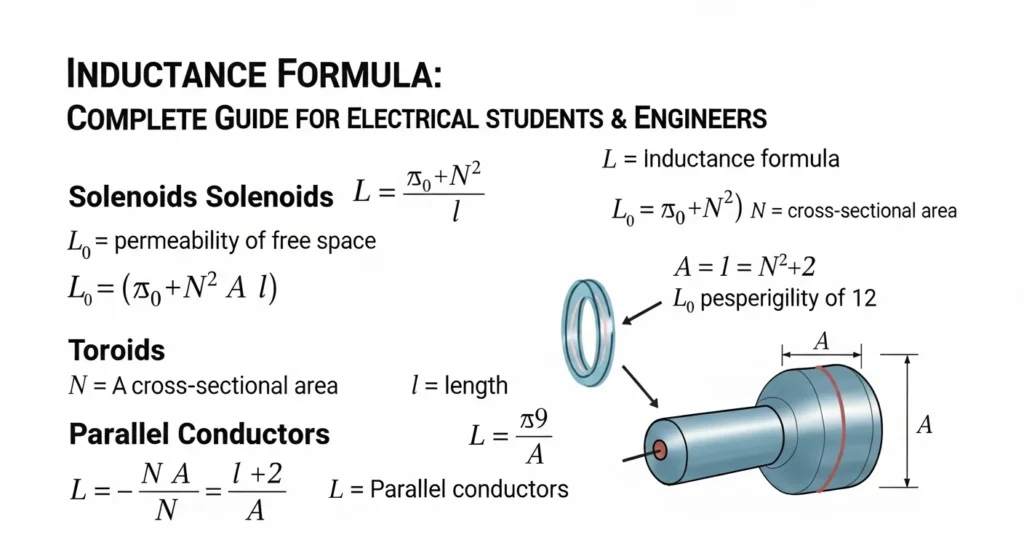
The Inductance Formula helps engineers calculate how much voltage is produced when current changes in a coil. It also explains how energy is stored in a magnetic field.
In this article, you will learn:
- What inductance means in simple terms
- The inductance formula and its detailed explanation
- Working principle with easy examples
- Types of inductors and their uses
- Advantages, disadvantages, and real-world applications
By the end, you will have a strong understanding of inductance and how it is used in practical electrical systems.
2. What is Inductance?
Definition:
Inductance is the property of a conductor or coil that opposes changes in current by producing a voltage.
Simple Explanation:
When current flows through a wire coil, it creates a magnetic field. If the current changes, the magnetic field also changes, producing a voltage that resists the change.
Inductance (Basic Definition Formula)
L=INΦ
Where:
- L = Inductance (Henry, H)
- N = Number of turns in coil
- Φ = Magnetic flux (Weber)
- I = Current (Ampere)
Induced Voltage (Practical Inductance Formula)
V=LdtdI
Where:
- V = Induced voltage (Volts)
- L = Inductance (Henry)
- fracdIdt = Rate of change of current
Energy Stored in Inductor (Important)
W=21LI2
V = L \frac{dI}{dt}
Where:
- V = Induced voltage (Volts)
- L = Inductance (Henry)
- dI/dt = Rate of change of current
Practical Example:
If current in a coil changes quickly:
- A higher voltage is generated
- This can affect circuit performance
This is the core idea of the Inductance Formula.
3. Working Principle of Inductance
The working principle is based on electromagnetic induction.
Step-by-Step Explanation:
- Current flows through a coil
- A magnetic field is created around it
- If current changes, magnetic field changes
- This changing field induces a voltage
- The induced voltage opposes the change in current
Simple Analogy:
Think of a heavy wheel:
- It resists sudden changes in motion
- Similarly, an inductor resists sudden changes in current
Key Points:
- Faster current change → higher induced voltage
- More turns in coil → higher inductance
- Strong magnetic field → more energy stored
This explains the inductance formula working principle.
4. Types / Classification of Inductors
4.1 Air Core Inductor
- No magnetic core
- Low inductance value
- Used in high-frequency circuits
4.2 Iron Core Inductor
- Uses iron core
- High inductance
- Used in power systems
4.3 Ferrite Core Inductor
- Made from ferrite material
- Good for high-frequency applications
- Used in electronics
4.4 Variable Inductor
- Inductance can be adjusted
- Used in tuning circuits
5. Main Components of an Inductor
5.1 Coil (Wire)
- Conductive wire wound in loops
- Produces magnetic field
5.2 Core Material
- Enhances magnetic field
- Types: air, iron, ferrite
5.3 Terminals
- Connect inductor to circuit
5.4 Insulation
- Prevents short circuits
- Ensures safety
6. Advantages of Inductance
- Controls current changes smoothly
- Stores energy in magnetic field
- Protects circuits from sudden surges
- Useful in filters and power supplies
- Improves system stability
These show the inductance formula advantages and disadvantages in practical use.
7. Disadvantages / Limitations
- Energy loss due to resistance
- Can generate heat
- Bulky for high inductance values
- Not suitable for high-frequency in some cases
- Magnetic interference issues
8. Applications of Inductance
The inductance formula applications are widely used in electrical systems.
8.1 Home Applications
- Fans and motors
- Power adapters
- TVs and radios
8.2 Industrial Applications
- Transformers
- Motor drives
- Power systems
8.3 Electronics
- Filters (low-pass, high-pass)
- Signal processing
- Oscillators
8.4 Modern Technology
- Electric vehicles
- Renewable energy systems
- Wireless charging
9. Comparison Section
Inductor vs Capacitor
| Feature | Inductor | Capacitor |
|---|---|---|
| Energy Storage | Magnetic field | Electric field |
| Opposes | Change in current | Change in voltage |
| Unit | Henry | Farad |
| Usage | Filters, motors | Timing, storage |
Key Difference:
- Inductor resists current change
- Capacitor resists voltage change
This is the difference between inductor and capacitor.
10. Selection Guide
When choosing an inductor:
- Check inductance value (Henry)
- Choose correct core material
- Consider current rating
- Check size and design
- Match frequency requirements
Beginner Tip:
Start with standard inductors and gradually learn advanced selection.
11. Common Problems & Solutions
Problem 1: Inductor overheating
- Cause: Excess current
- Solution: Use higher-rated inductor
Problem 2: Noise in circuit
- Cause: Magnetic interference
- Solution: Use shielding
Problem 3: Low performance
- Cause: Wrong inductance value
- Solution: Replace with correct value
Problem 4: Coil damage
- Cause: Overheating or aging
- Solution: Replace inductor
12. Future Trends in Inductance
New Technologies:
- High-efficiency compact inductors
- Nano-core materials
- Smart inductive components
- Wireless power transfer systems
Industry Direction:
- Smaller and more efficient devices
- Integration in microelectronics
- Improved energy storage systems
13. Conclusion
The Inductance Formula is a fundamental concept in electrical engineering. It explains how voltage is generated when current changes in a circuit. This property is essential for designing safe and efficient electrical systems.
We explored the formula, working principle, types of inductors, components, applications, and troubleshooting methods. We also discussed advantages, limitations, and future developments in inductive technology.
For students and engineers, understanding inductance is critical for working with motors, transformers, and electronic circuits. It builds a strong foundation for advanced topics in power systems and electronics.
In simple terms, inductance is not just a theory—it is a powerful principle that controls energy flow in modern electrical systems.