
Imagine sitting in a living room on a hot summer afternoon. The windows are open, but the air inside the room feels heavy and uncomfortable. As soon as the ceiling fan is switched on, the blades start rotating and a gentle breeze spreads across the entire room. Within seconds, the environment becomes more comfortable without using expensive air conditioning.
This simple example shows why ceiling fans are one of the most widely used electrical appliances in homes and buildings. They provide efficient air circulation, improve comfort, and consume far less electricity than air conditioners.
For electrical students, technicians, and engineers, ceiling fans are an excellent example of how electrical energy is converted into mechanical motion using electric motors. Understanding how they work helps beginners learn basic motor operation, airflow principles, and practical electrical installation.
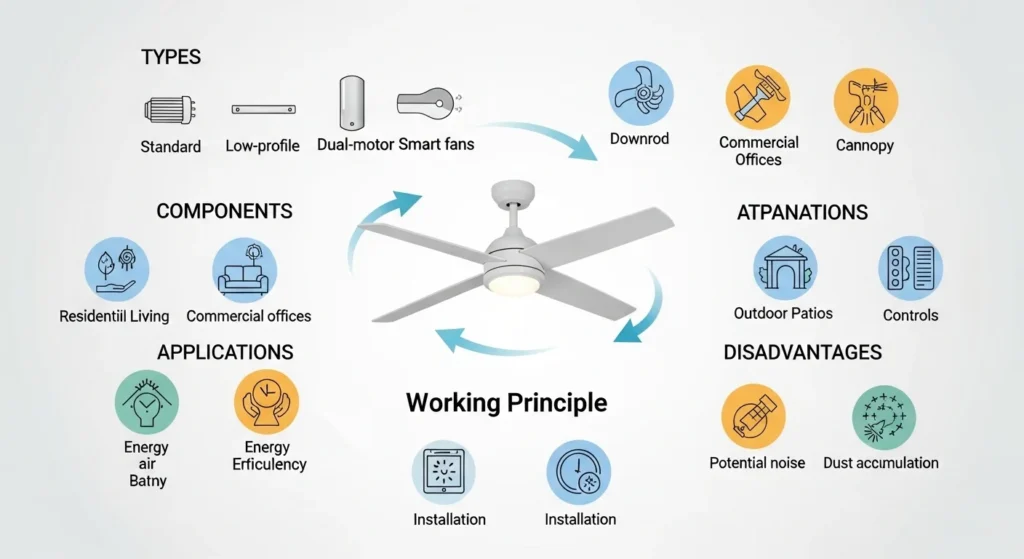
In this article, you will learn the ceiling fans working principle, types of ceiling fans, main components, advantages and disadvantages, and real-world ceiling fans applications. The goal is to explain the concept in simple language so beginners can clearly understand how this common electrical device works.
2. What is a Ceiling Fan?
A ceiling fan is an electrical device mounted on the ceiling that uses rotating blades to circulate air throughout a room.
It works by using an electric motor to spin blades that push air downward, creating airflow that cools the people in the room.
Unlike air conditioners, ceiling fans do not reduce the temperature of air. Instead, they move air around the room to create a cooling effect on the human body.
Simple Explanation
When the fan blades rotate, they push air downward and create airflow. This moving air increases evaporation of sweat from the skin, which makes people feel cooler.
Practical Example
In homes, ceiling fans are usually installed in bedrooms, living rooms, kitchens, and offices. A single fan can provide airflow for the entire room because it is installed at the center of the ceiling.
3. Ceiling Fans Working Principle
The ceiling fans working principle is based on the rotation of an electric motor connected to fan blades.
When electricity flows into the motor windings, it produces a magnetic field. This magnetic field rotates the motor shaft, which turns the blades attached to it.
As the blades rotate, they push air downward and circulate it around the room.
Step-by-Step Operation
- Electric Power Supply
Electricity enters the fan through the ceiling wiring and switch. - Motor Activation
The electric motor receives power and starts rotating. - Blade Rotation
The motor shaft rotates the blades attached to it. - Air Movement
The rotating blades push air downward. - Air Circulation
The air spreads across the room, improving ventilation and comfort.
Simple Analogy
Think of ceiling fan blades like paddles in water. When paddles move, they push water in a direction. Similarly, fan blades push air downward and create airflow.
4. Types / Classification of Ceiling Fans
Ceiling fans are available in different designs depending on their technology and applications.
Standard Ceiling Fan
This is the most common type used in homes and offices.
It usually has three or four blades and operates with a simple speed regulator.
Decorative Ceiling Fan
Decorative fans are designed for modern interior spaces.
They include stylish designs, lighting fixtures, and attractive finishes.
High-Speed Ceiling Fan
High-speed ceiling fans rotate faster and produce stronger airflow.
They are commonly used in large rooms and warm climates.
Energy Efficient Ceiling Fan
These fans use modern motors that consume less electricity.
They are designed to provide the same airflow with lower power consumption.
Smart Ceiling Fan
Smart ceiling fans include advanced features such as remote control, timer functions, and smart home integration.
They are becoming increasingly popular in modern homes.
5. Main Components of a Ceiling Fan
A ceiling fan consists of several mechanical and electrical components that work together.
Electric Motor
The motor is the heart of the ceiling fan. It converts electrical energy into mechanical rotation.
Fan Blades
Blades are responsible for pushing air downward and creating airflow.
The number, shape, and size of blades affect the fan’s performance.
Downrod
The downrod connects the fan motor to the ceiling mount.
It ensures proper distance between the ceiling and the fan blades.
Mounting Bracket
The mounting bracket attaches the fan securely to the ceiling structure.
Capacitor
The capacitor helps start and run the motor smoothly.
It also controls the speed of the fan.
Speed Regulator
The regulator allows the user to adjust the fan speed according to comfort needs.
6. Ceiling Fans Advantages
Understanding ceiling fans advantages and disadvantages helps users choose the right cooling solution.
Advantages
- Low electricity consumption
- Affordable cooling solution
- Easy installation and maintenance
- Improves air circulation
- Works well with air conditioning systems
- Provides cooling for an entire room
- Long service life with proper maintenance
These benefits make ceiling fans one of the most economical cooling devices.
7. Disadvantages / Limitations
Despite their benefits, ceiling fans also have some limitations.
- They do not reduce room temperature like air conditioners
- Performance depends on room size and ceiling height
- Improper installation can cause vibration or noise
- Dust accumulation on blades requires regular cleaning
- Limited cooling in extremely hot environments
Understanding these limitations helps users use ceiling fans effectively.
8. Ceiling Fans Applications
There are many ceiling fans applications in residential, commercial, and industrial environments.
Home Applications
- Bedrooms
- Living rooms
- Kitchens
- Dining rooms
Commercial Applications
- Offices
- Restaurants
- Shops
- Schools
Industrial Applications
- Warehouses
- Factories
- Workshops
Modern Building Applications
- Energy-efficient buildings
- Smart homes
- Ventilated spaces
These applications show that ceiling fans remain an important part of modern ventilation systems.
9. Comparison Section
Understanding the difference between ceiling fan and table fan helps in selecting the correct fan for different situations.
| Feature | Ceiling Fan | Table Fan |
|---|---|---|
| Installation | Mounted on ceiling | Placed on table |
| Airflow Coverage | Large area | Small area |
| Portability | Fixed installation | Portable |
| Power Consumption | Moderate | Low |
| Usage | Whole room cooling | Personal cooling |
Both fans serve different purposes depending on the cooling requirement.
10. Selection Guide
Choosing the right ceiling fan requires considering several important factors.
Room Size
Larger rooms require bigger fans with larger blade spans.
Blade Size
Blade size determines airflow coverage.
Typical blade sizes range from 36 inches to 56 inches.
Motor Quality
High-quality motors ensure smooth operation and longer life.
Energy Efficiency
Energy-efficient fans reduce electricity consumption.
Noise Level
Low-noise fans are ideal for bedrooms and offices.
Design and Style
Decorative fans can improve interior aesthetics.
11. Common Problems & Solutions
Fan Not Starting
Possible causes:
- Faulty switch
- Damaged capacitor
- Motor winding problem
Solution: check electrical connections and replace faulty components.
Fan Running Slowly
Possible causes:
- Weak capacitor
- Voltage drop
- Dust buildup in motor
Solution: replace capacitor and clean the fan.
Fan Making Noise
Possible causes:
- Loose screws
- Worn bearings
Solution: tighten screws and lubricate moving parts.
Fan Wobbling
Possible causes:
- Unbalanced blades
- Improper installation
Solution: balance blades and check mounting bracket.
12. Future Trends
Ceiling fan technology is improving with modern innovations.
Brushless DC Motors
BLDC motors are more energy efficient and quieter than traditional motors.
Smart Fan Technology
Modern fans can be controlled using smartphones, remote controls, and smart home systems.
Aerodynamic Blade Design
Improved blade designs increase airflow while reducing noise.
Energy Efficient Systems
Future ceiling fans will focus on delivering maximum airflow with minimum power consumption.
13. Conclusion
Ceiling fans remain one of the most practical and energy-efficient cooling solutions used around the world. Their simple design, low electricity consumption, and ability to circulate air effectively make them essential in homes, offices, and commercial buildings.
Understanding the ceiling fans working principle, components, and ceiling fans applications is important for electrical students, engineers, and technicians. These fans demonstrate how electric motors convert electrical energy into mechanical motion to perform useful work.
Although ceiling fans cannot replace air conditioning in extremely hot climates, they significantly improve comfort by enhancing airflow. When properly selected and installed, they can provide reliable cooling for many years.
With new technologies such as energy-efficient motors, smart controls, and improved blade designs, ceiling fans will continue to evolve and remain a key part of modern ventilation systems.