
Imagine you are charging your mobile phone. The battery stores electrical energy and releases it when needed. Similarly, in electrical circuits, a device called a capacitor stores and releases electrical energy. This storage ability is measured using a concept called capacitance.
In real-life electrical systems, capacitance plays a very important role. From power supply units to motor starters, and from electronic circuits to industrial control systems, capacitors are everywhere. Without understanding capacitance, it is impossible to design or troubleshoot modern electrical systems.
The Capacitance Formula helps engineers calculate how much charge a capacitor can store for a given voltage. It is a basic but powerful concept in electrical engineering.
In this article, you will learn:
- What capacitance really means
- How the capacitance formula works
- Types of capacitors
- Applications in real systems
- Advantages, disadvantages, and troubleshooting tips
By the end, you will clearly understand the Capacitance Formula and its real-world importance in electrical engineering.
2. What is Capacitance?
Definition:
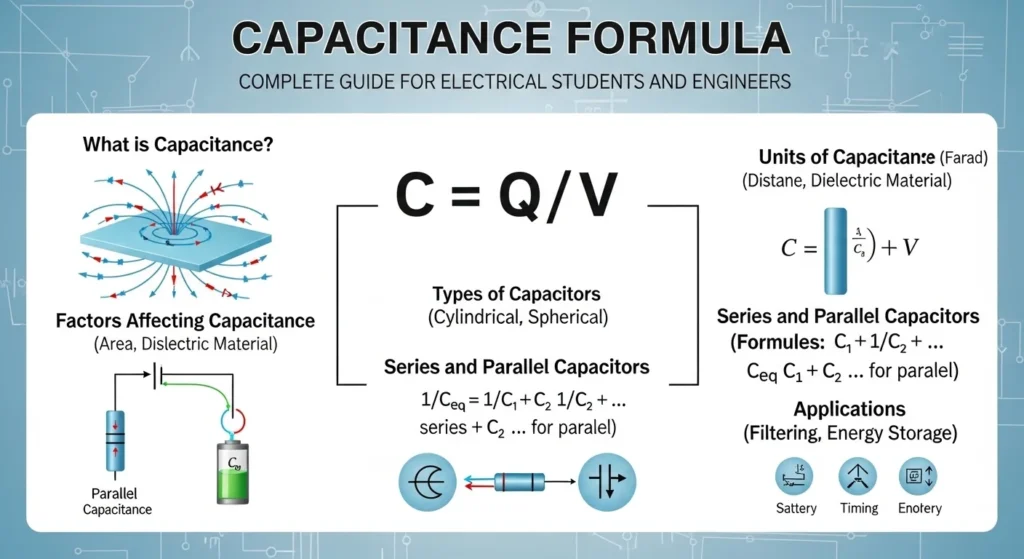
Capacitance is the ability of a device (capacitor) to store electric charge when voltage is applied.
Simple Explanation:
A capacitor is like a small rechargeable energy storage device that stores electrical energy in an electric field.
Basic Capacitance Formula:
C = \frac{Q}{V}
Where:
- C = Capacitance (Farad, F)
- Q = Electric charge (Coulombs)
- V = Voltage (Volts)
Practical Example:
If a capacitor stores 10 Coulombs of charge at 5 Volts:
- C = 10 ÷ 5 = 2 Farads
Real-Life Idea:
Think of a water tank:
- Charge (Q) = water stored
- Voltage (V) = water pressure
- Capacitance = size of tank
This is the basic idea behind the Capacitance Formula.
3. Working Principle of Capacitance
The working principle of capacitance is based on electric field storage between two plates.
Step-by-Step Working:
- A capacitor has two conductive plates
- These plates are separated by an insulating material (dielectric)
- When voltage is applied:
- One plate gets positive charge
- Other plate gets negative charge
- Energy is stored in the electric field between them
Simple Analogy:
Think of two water tanks separated by a rubber sheet:
- Water pressure builds on one side
- Rubber stores energy by stretching
- When released, energy flows back
Key Points:
- More area = more capacitance
- Less distance = more capacitance
- Better dielectric = higher storage
This is the basic capacitance formula working principle used in all capacitor-based systems.
4. Types / Classification of Capacitors
Capacitors are classified based on structure and material.
4.1 Ceramic Capacitors
- Small size
- Used in electronic circuits
- Stable and reliable
4.2 Electrolytic Capacitors
- High capacitance value
- Polarized (positive/negative terminal)
- Used in power supplies
4.3 Film Capacitors
- High accuracy
- Used in audio and industrial circuits
- Long life
4.4 Tantalum Capacitors
- Compact and stable
- Expensive but reliable
- Used in advanced electronics
4.5 Variable Capacitors
- Capacitance can be adjusted
- Used in tuning circuits like radios
5. Main Components of a Capacitor
A capacitor is made of simple but important parts:
5.1 Conductive Plates
- Store electric charge
- Usually made of aluminum or other metals
5.2 Dielectric Material
- Insulating layer between plates
- Examples: air, ceramic, paper, plastic
5.3 Terminals
- Connect capacitor to circuit
- Allow current flow into/out of capacitor
5.4 Encapsulation
- Protects internal structure
- Improves durability
6. Advantages of Capacitance
- Stores electrical energy efficiently
- Provides voltage stability in circuits
- Helps in power factor correction
- Removes noise from electrical signals
- Fast charge and discharge capability
These are key reasons why the Capacitance Formula advantages and disadvantages are important in engineering.
7. Disadvantages / Limitations
- Cannot store energy for long periods
- Voltage rating limitations
- May leak charge over time
- Sensitive to temperature changes
- Large capacitors can be bulky
Despite these limitations, capacitors are widely used in modern systems.
8. Applications of Capacitance
The Capacitance Formula applications are found in almost every electrical system.
8.1 Home Applications
- Ceiling fans
- Air conditioners
- Washing machines
8.2 Industrial Applications
- Motor starting circuits
- Power factor correction
- UPS systems
8.3 Electronics
- Mobile phones
- Computers
- Radio and TV circuits
8.4 Modern Technology
- Electric vehicles
- Renewable energy systems
- Smart grids
Capacitors are essential in both low-power and high-power systems.
9. Comparison Section
Capacitor vs Battery
| Feature | Capacitor | Battery |
|---|---|---|
| Energy Storage | Electric field | Chemical energy |
| Charging Speed | Very fast | Slow |
| Discharge | Fast | Slow |
| Lifespan | Very long | Limited cycles |
| Usage | Power stability | Energy supply |
Key Difference:
- Capacitors store energy temporarily
- Batteries store energy for long duration
This is the difference between capacitor and battery.
10. Selection Guide (How to Choose Capacitor)
When selecting a capacitor:
- Check capacitance value (Farads)
- Check voltage rating
- Select correct type (electrolytic, ceramic, etc.)
- Consider temperature range
- Ensure size fits circuit design
Beginner Tip:
Always choose a capacitor with slightly higher voltage rating than required.
11. Common Problems & Solutions
Problem 1: Capacitor overheating
- Cause: Overvoltage
- Solution: Use correct voltage rating
Problem 2: Capacitor leakage
- Cause: Aging or damage
- Solution: Replace capacitor
Problem 3: Circuit not working
- Cause: Wrong polarity
- Solution: Check positive and negative terminals
Problem 4: Low capacitance reading
- Cause: Dry or damaged capacitor
- Solution: Test and replace
12. Future Trends in Capacitors
Modern engineering is improving capacitor technology.
New Developments:
- Supercapacitors with high energy storage
- Nano-material based capacitors
- Flexible capacitors for wearable devices
- Fast-charging energy storage systems
Industry Direction:
- Electric vehicles using advanced capacitors
- Renewable energy storage systems
- Miniaturized electronics with high efficiency
Future capacitors will be smaller, stronger, and more efficient.
13. Conclusion
The Capacitance Formula is one of the most important concepts in electrical engineering. It helps us understand how electrical charge is stored and controlled in capacitors. From simple electronic devices to complex industrial systems, capacitance plays a vital role in ensuring stability and performance.
We studied the formula, working principle, types, components, applications, advantages, and limitations of capacitors. We also explored real-world troubleshooting and future advancements in capacitor technology.
For electrical students and technicians, mastering capacitance is essential for understanding circuit design, power systems, and modern electronics. It builds a strong foundation for advanced electrical engineering concepts.
In short, capacitance is not just a formula—it is a core principle that powers modern electrical and electronic systems.