
Imagine a situation where outdoor lights in a building must turn ON every evening and turn OFF early in the morning. If someone had to do this task manually every day, it would be inconvenient and sometimes forgotten. To solve this problem, electrical engineers use a device called a timer switch. This device automatically controls electrical equipment based on a preset time schedule.
A timer switch is an important component used in electrical automation. It allows devices such as lights, motors, pumps, heaters, and fans to operate at specific times without human intervention. This improves convenience, reduces electricity consumption, and increases the efficiency of electrical systems.
For electrical students, engineers, technicians, and beginners, understanding timer switches is essential. These devices are widely used in residential, commercial, and industrial installations. They also play an important role in modern smart systems and energy management solutions.
In this article, you will learn about the timer switch working principle, different types of timer switches, main components, advantages and disadvantages, and practical timer switch applications. The explanation is written in simple and clear language so that beginners can easily understand how timer switches operate in real-world electrical systems.
2. What is a Timer Switch?
A timer switch is an electrical control device that automatically turns electrical equipment ON or OFF at a specific time or after a preset time delay.
In simple words, a timer switch works like a clock that controls an electrical circuit. Instead of manually switching a device, the timer switch performs the switching operation automatically according to the programmed timing.
Timer switches can be used to control many electrical appliances such as lighting systems, motors, pumps, heaters, and ventilation fans.
Practical Example
For example, street lights in many cities turn ON automatically in the evening and turn OFF in the morning. This operation is usually controlled by a timer switch installed in the electrical control panel.
3. Timer Switch Working Principle
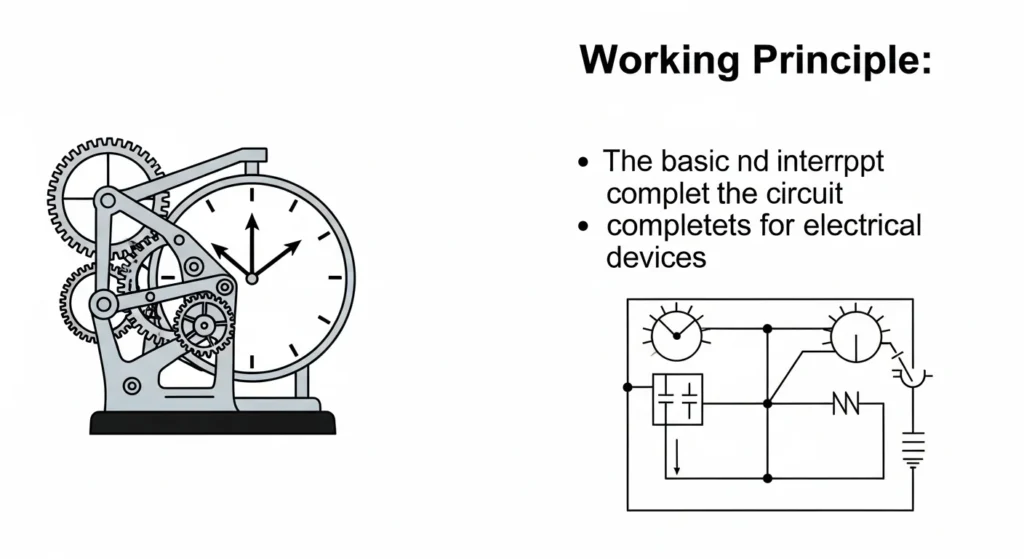
The timer switch working principle is based on controlling electrical contacts using a time-based mechanism.
A timer switch contains a timing circuit that measures the passage of time. When the preset time is reached, the switch contacts change their position and either allow electricity to flow to the load or disconnect it.
Step-by-Step Operation
- Power Supply
Electrical power is supplied to the timer switch. - Time Setting
The user sets the desired time interval or schedule. - Timing Process
The internal mechanism measures the set time period. - Contact Switching
When the preset time is completed, the switch contacts change position. - Load Operation
The connected device turns ON or OFF according to the timer setting.
Simple Analogy
You can think of a timer switch like a kitchen timer used for cooking. When the set time finishes, it triggers an action. In a similar way, a timer switch triggers electrical switching.
4. Types / Classification of Timer Switch
Timer switches are available in several types depending on their design and applications.
Mechanical Timer Switch
Mechanical timer switches use gears, springs, and rotating dials to measure time. The user sets the required time by turning a dial.
These timers are simple, reliable, and commonly used in household appliances.
Digital Timer Switch
Digital timer switches use electronic circuits and microcontrollers. They provide more accurate timing and allow users to program multiple ON and OFF schedules.
Many digital timers include LCD displays and push buttons for programming.
Programmable Timer Switch
Programmable timers allow users to create detailed schedules for daily or weekly operations. They are widely used in automation systems and commercial lighting systems.
Countdown Timer Switch
A countdown timer switch turns a device OFF after a specified time period.
For example, a bathroom exhaust fan may run for 10 minutes and then stop automatically.
Astronomical Timer Switch
Astronomical timers automatically adjust switching times based on sunrise and sunset.
They are commonly used in street lighting and outdoor lighting systems.
5. Main Components of a Timer Switch
A timer switch contains several important electrical and mechanical components.
Timing Mechanism
This component measures time. Mechanical timers use gears, while digital timers use electronic circuits.
Switching Contacts
The contacts open or close the electrical circuit to control the connected load.
Control Interface
Mechanical timers use rotating dials, while digital timers use buttons and display screens.
Power Supply Circuit
This circuit provides electrical power to the timer’s internal components.
Microcontroller
In digital timer switches, the microcontroller controls the timing functions and switching operations.
6. Timer Switch Advantages
Understanding timer switch advantages and disadvantages helps users decide when to use these devices.
Advantages
- Automatic control of electrical equipment
- Saves electrical energy
- Reduces manual operation
- Improves convenience in daily tasks
- Provides precise time control
- Useful for automation systems
- Increases safety by controlling equipment operation
7. Disadvantages / Limitations
Despite their advantages, timer switches also have some limitations.
- Mechanical timers may become less accurate over time
- Digital timers require proper programming
- Some timers need battery backup
- Incorrect settings may cause unwanted switching
- Advanced timers may be more expensive
8. Timer Switch Applications
There are many timer switch applications in different electrical systems.
Residential Applications
- Outdoor lighting control
- Water heater scheduling
- Bathroom exhaust fan control
- Garden irrigation systems
Commercial Applications
- Office lighting control
- Advertising signboards
- Store display lighting
Industrial Applications
- Motor control systems
- Conveyor belt operation
- Industrial machine timing control
Public Infrastructure
- Street lighting systems
- Traffic signal systems
- Public building lighting control
These applications demonstrate the importance of timer switches in modern electrical systems.
9. Comparison Section
Understanding the difference between timer switch and manual switch helps beginners select the correct switching device.
| Feature | Timer Switch | Manual Switch |
|---|---|---|
| Operation | Automatic | Manual |
| Time Control | Yes | No |
| Energy Saving | High | Depends on user |
| Convenience | Very convenient | Requires manual control |
| Applications | Automation systems | Basic electrical control |
Both switches are useful but serve different purposes in electrical installations.
10. Selection Guide
Selecting the correct timer switch depends on several factors.
Load Capacity
The timer switch must support the electrical load connected to it.
Type of Timer
Mechanical timers are suitable for simple tasks, while digital timers provide more advanced control.
Programming Options
Advanced timers allow multiple schedules and flexible timing control.
Installation Type
Timer switches may be wall-mounted, panel-mounted, or plug-in types.
Durability
Industrial environments require more robust timer switches.
11. Common Problems & Solutions
Timer Not Working
Possible causes include no power supply or loose wiring.
Solution: check power connections and wiring.
Timer Not Switching Load
This may happen due to damaged contacts or incorrect programming.
Solution: inspect contacts and reset the timer.
Timer Losing Time
Weak batteries in digital timers or worn mechanical parts may cause timing errors.
Solution: replace batteries or repair the timing mechanism.
Incorrect Timing Operation
This problem usually occurs due to incorrect programming.
Solution: reset the timer and program it again.
12. Future Trends
Timer switches are evolving with modern electrical technology.
Smart Timer Switches
These devices can be controlled using smartphones or remote systems.
IoT Integration
Future timer switches will connect to smart home systems through the Internet of Things.
Energy Management Systems
Timer switches will become part of advanced energy-saving solutions.
Intelligent Automation
Advanced timer systems may automatically adjust schedules based on usage patterns.
13. Conclusion
Timer switches are essential devices used to automate electrical operations based on time. They allow electrical equipment to operate automatically without manual control, improving efficiency and convenience.
Understanding the timer switch working principle, components, and timer switch applications is important for electrical students, engineers, and technicians. These devices demonstrate how timing mechanisms can control electrical circuits effectively.
Although timer switches have some limitations, their advantages such as energy saving, automation, and improved safety make them very useful in modern electrical systems. As technology continues to develop, timer switches will become smarter and more integrated with advanced automation systems.