
Imagine entering a room and pressing a switch to turn on the lights instantly. The simple click you hear is often produced by a rocker switch, one of the most common electrical switches used in homes and industrial equipment. From household appliances to industrial control panels, rocker switches are widely used because they are simple, reliable, and easy to operate.
For electrical students, engineers, and technicians, understanding how a rocker switch works is very important. Even though it looks like a simple device, it plays a crucial role in controlling electrical circuits safely and efficiently. Whether you are designing a control panel, installing home wiring, or troubleshooting equipment, knowing the details of rocker switches helps ensure proper operation and safety.
In this article, you will learn the rocker switch working principle, types, components, applications, advantages and disadvantages, and how to choose the right switch for different electrical systems. The goal is to explain everything in simple and practical language, just like a senior engineer guiding a junior technician in the field.
What is a Rocker Switch?
A rocker switch is an electrical switch used to open or close an electrical circuit by rocking a button or actuator back and forth. When one side of the switch is pressed, the circuit closes and electricity flows. When the other side is pressed, the circuit opens and the power is turned off.
In simple words, a rocker switch works like a see-saw. When one side goes down, the other side goes up. This movement changes the internal contacts and controls the flow of electricity.
Practical Example
You can find rocker switches in many everyday devices such as:
- Power strips
- Computer power supplies
- Home appliances
- Industrial control panels
- Automotive dashboards
Because of their easy operation and clear ON/OFF position, rocker switches are widely used in both low-voltage and high-voltage electrical systems.
Rocker Switch Working Principle
The rocker switch working principle is based on a mechanical movement that connects or disconnects electrical contacts inside the switch.
Step-by-Step Working Process
- User Presses the Switch
The user presses one side of the rocker switch.
- Rocking Movement Occurs
The internal actuator tilts or rocks to the opposite side.
- Internal Contacts Move
Metal contacts inside the switch either touch or separate.
- Circuit Condition Changes
- If contacts connect → current flows → device turns ON
- If contacts separate → current stops → device turns OFF
Simple Analogy
Think of a rocker switch like a bridge over a river.
- When the bridge is lowered, vehicles (electric current) can pass.
- When the bridge is raised, the path is blocked.
This simple mechanism makes rocker switches very reliable and easy to operate.
Types / Classification of Rocker Switches
Different electrical systems require different switch designs. Rocker switches are classified based on their circuit function and construction.
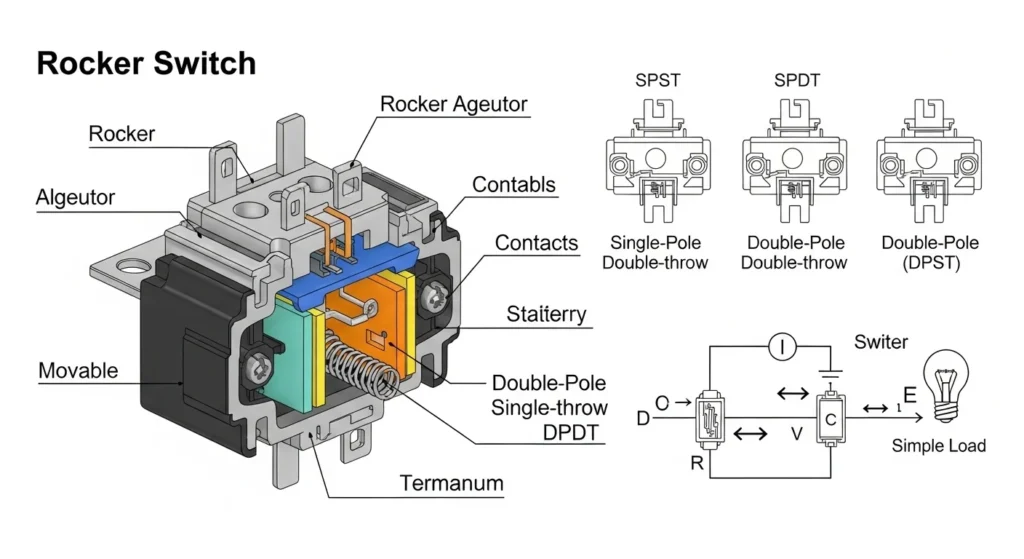
Single Pole Single Throw (SPST) Rocker Switch
This is the most basic rocker switch type.
Features:
- One input terminal
- One output terminal
- Simple ON/OFF control
It is commonly used for controlling lights, fans, and small appliances.
Single Pole Double Throw (SPDT) Rocker Switch
An SPDT rocker switch connects one input to one of two outputs.
Features:
- One input terminal
- Two output terminals
- Allows switching between two circuits
It is commonly used in control systems where one device must select between two operating modes.
Double Pole Single Throw (DPST) Rocker Switch
This switch controls two circuits at the same time.
Features:
- Two input terminals
- Two output terminals
- Turns two circuits ON or OFF together
It is commonly used in heavy appliances and industrial equipment.
Double Pole Double Throw (DPDT) Rocker Switch
This is a more advanced rocker switch used for complex electrical control.
Features:
- Two inputs and two outputs
- Allows switching between multiple circuit paths
It is commonly used in motor direction control systems.
Illuminated Rocker Switch
This type includes a built-in LED or neon light.
Benefits:
- Indicates power status
- Easy to locate in dark environments
You can often find these switches in power strips and electronic equipment.
Main Components of a Rocker Switch
A rocker switch may look simple, but it contains several important parts that allow it to operate correctly.
Actuator (Rocker)
This is the visible part that the user presses. It rocks back and forth to control the switch.
Electrical Contacts
These metal parts connect or disconnect the electrical circuit when the switch moves.
Terminals
Terminals are the connection points where electrical wires are attached.
Spring Mechanism
The spring helps the switch move quickly between positions and ensures reliable contact.
Housing
The outer body protects internal components and provides electrical insulation.
Rocker Switch Advantages and Disadvantages
Understanding rocker switch advantages and disadvantages helps engineers decide where to use them.
Advantages
- Easy to operate with simple pressing motion
- Clear ON/OFF position improves usability
- Long service life due to durable mechanical design
- Compact size suitable for many devices
- Low cost compared to advanced switching systems
- Simple installation for electrical wiring systems
Disadvantages / Limitations
- Limited to basic switching functions
- Mechanical parts may wear out over time
- Not ideal for very high current loads without special design
- Dust and moisture may affect performance if not properly sealed
Rocker Switch Applications
Rocker switch applications can be found in many electrical and electronic systems.
Home Applications
- Lighting control
- Power strips
- Kitchen appliances
- Fans and heaters
Industrial Applications
- Machine control panels
- Motor control systems
- Electrical distribution equipment
Automotive Applications
- Dashboard controls
- Lighting systems
- Auxiliary equipment
Electronic Devices
- Computer power supplies
- Audio equipment
- Laboratory instruments
Because of their reliability, rocker switches are widely used in both consumer electronics and industrial electrical systems.
Comparison: Rocker Switch vs Toggle Switch
Understanding the difference between rocker switch and toggle switch is useful when selecting switches.
| Feature | Rocker Switch | Toggle Switch |
|---|---|---|
| Operation | Pressing or rocking motion | Lever movement |
| Appearance | Flat surface | Stick-like lever |
| Durability | Good for frequent use | Very durable |
| Safety | Often enclosed | Lever exposed |
| Applications | Appliances, panels | Industrial machines |
Both switches perform similar electrical functions, but rocker switches provide a more modern and safer design.
Selection Guide: How to Choose the Right Rocker Switch
Selecting the correct switch is important for safety and performance.
Check Voltage Rating
Ensure the switch supports the system voltage.
Check Current Rating
The switch must handle the electrical load safely.
Choose the Right Switch Type
- SPST for simple ON/OFF
- DPDT for complex control
Consider Environment
Industrial environments may require waterproof or dustproof switches.
Size and Mounting
Make sure the switch fits the panel or enclosure.
Common Problems & Solutions
Problem 1: Switch Not Turning On
Possible Cause: Loose wiring or damaged contacts
Solution: Check connections and replace switch if necessary.
Problem 2: Flickering Power
Possible Cause: Worn contacts
Solution: Replace the rocker switch.
Problem 3: Switch Feels Loose
Possible Cause: Internal spring damage
Solution: Install a new switch.
Problem 4: Overheating Switch
Possible Cause: Excess current load
Solution: Use a switch with higher current rating.
Future Trends
Electrical switching technology continues to evolve.
Future rocker switches may include:
- Smart home integration
- Touch-sensitive controls
- Wireless switching systems
- Energy monitoring features
- LED indicator improvements
As automation grows, rocker switches will continue to play an important role in both traditional and modern electrical systems.
Conclusion
A rocker switch is one of the most commonly used electrical switches in modern equipment and installations. Despite its simple design, it plays a critical role in safely controlling electrical circuits in homes, industries, and electronic devices. Understanding the rocker switch working principle, types, components, applications, advantages and disadvantages is essential for electrical students, engineers, and technicians.
By learning how rocker switches operate and how to select the correct type, professionals can ensure reliable circuit control and safe electrical installations. As technology advances, rocker switches will continue evolving with improved designs and smart features, making them even more useful in modern electrical systems.