
Imagine you are standing in front of an elevator and want to go to the third floor. You simply press a small button, and the elevator responds immediately. That simple action is controlled by a push button switch. This small device plays a very important role in many electrical and electronic systems we use every day.
Push button switches are widely used in homes, industries, machines, and electronic devices. From doorbells and elevators to industrial control panels and emergency stop systems, these switches provide quick and reliable control of electrical circuits. Because they are simple, durable, and easy to operate, they are one of the most commonly used switching devices in electrical engineering.
For electrical students, technicians, and engineers, understanding push button switches is essential. Even though they appear simple, they are critical components in automation, safety systems, and machine control.
In this guide, you will learn the push button switch working principle, types, components, push button switch applications, advantages and disadvantages, and how to select the right switch for different electrical systems. The explanation is written in simple and practical language, just like a senior electrical engineer explaining the concept to a junior technician.
What is a Push Button Switch?
A push button switch is an electrical switch that controls a circuit when a button is pressed. The switch temporarily or permanently changes the electrical connection when the button is pushed.
In simple words, it is a device that connects or disconnects an electrical circuit by pressing a button.
When the button is pressed, the internal contacts either connect or disconnect. When the button is released, the contacts return to their original position depending on the switch design.
Practical Example
You can easily find push button switches in many daily applications:
- Doorbells
- Elevators
- Computer power buttons
- Industrial machine controls
- Emergency stop systems
For example, when you press a doorbell, the push button switch closes the circuit, allowing current to flow and the bell to ring.
This simple switching action makes push button switches extremely useful in both low-power and industrial electrical systems.
Push Button Switch Working Principle
The push button switch working principle is based on a mechanical action that moves internal electrical contacts.
When the button is pressed, the internal contact mechanism either closes the circuit or opens the circuit.
Step-by-Step Working Process
- Button is Pressed
The user presses the button using finger pressure.
- Internal Spring Compresses
Inside the switch, a spring compresses when pressure is applied.
- Contacts Move
The metal contacts either touch or separate.
- Circuit State Changes
- Contacts connect → Current flows → Device turns ON
- Contacts separate → Current stops → Device turns OFF
- Button Released
When the user releases the button, the spring returns the button to its original position.
Simple Analogy
Think of a push button switch like pressing a pen.
- When you press the pen, a mechanism moves inside.
- When you release it, the internal spring pushes it back.
This same concept is used inside a push button switch to control electrical circuits.
Types / Classification of Push Button Switches
Push button switches come in different designs depending on their function and application.
Normally Open (NO) Push Button Switch
This is the most common type of push button switch.
Features:
- Circuit remains open in normal condition
- Circuit closes only when button is pressed
Example: Doorbell switches.
Normally Closed (NC) Push Button Switch
This switch works opposite to the normally open type.
Features:
- Circuit remains closed in normal condition
- Circuit opens when button is pressed
Example: Emergency stop systems.
Momentary Push Button Switch
Momentary switches work only while the button is being pressed.
Features:
- Returns to original position after release
- Commonly used in control systems
Example: Elevator buttons.
Latching Push Button Switch
A latching switch stays in the same position after being pressed.
Features:
- Press once → ON
- Press again → OFF
Example: Computer power buttons.
Illuminated Push Button Switch
These switches include a built-in LED light.
Benefits:
- Indicates power status
- Easy to locate in dark environments
They are commonly used in industrial panels and modern electronic devices.
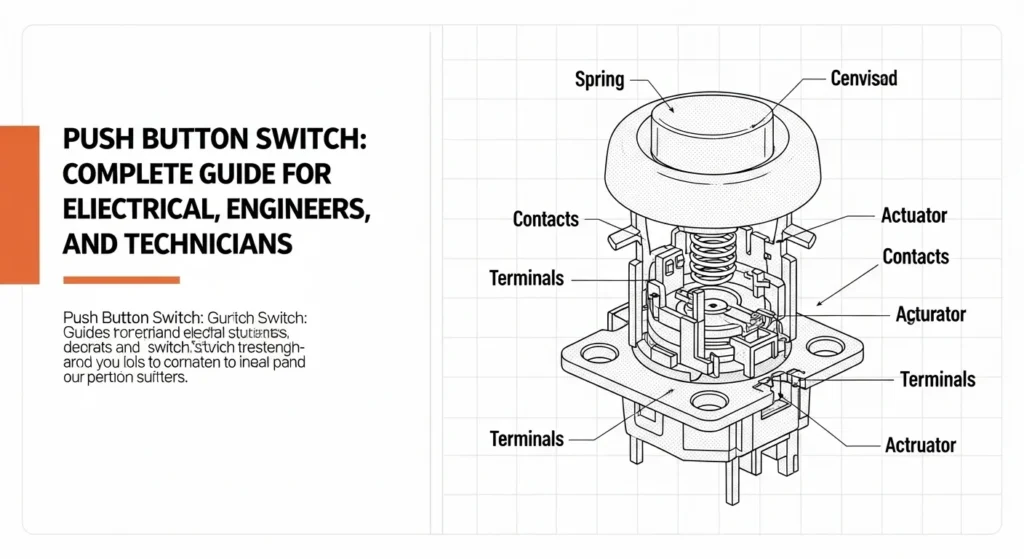
Main Components of a Push Button Switch
A push button switch consists of several internal parts that work together to control the electrical circuit.
Button (Actuator)
This is the visible part that the user presses to operate the switch.
Electrical Contacts
These metal contacts connect or disconnect the electrical circuit.
Spring Mechanism
The spring pushes the button back to its original position after release.
Terminals
These are the connection points where electrical wires are attached.
Housing
The outer body protects internal components and provides electrical insulation.
Push Button Switch Advantages and Disadvantages
Understanding push button switch advantages and disadvantages helps engineers select the right switching device.
Advantages
- Simple and easy to operate
- Quick response time
- Compact and lightweight
- Low manufacturing cost
- High reliability
- Suitable for automation systems
- Available in many designs and sizes
These benefits make push button switches ideal for both simple and complex electrical systems.
Disadvantages / Limitations
- Mechanical parts may wear out over time
- Not suitable for very high current loads without special design
- May require frequent replacement in heavy-use environments
- Dust or moisture can affect performance if not sealed properly
Despite these limitations, push button switches remain one of the most reliable switching devices.
Push Button Switch Applications
Push button switch applications can be found in many electrical systems.
Home Applications
- Doorbells
- Lighting systems
- Kitchen appliances
- Home automation devices
Industrial Applications
- Machine start/stop controls
- Emergency stop buttons
- Conveyor systems
- Control panels
Automotive Applications
- Engine start buttons
- Dashboard controls
- Horn systems
Electronic Devices
- Computer power buttons
- Calculators
- Remote control systems
- Laboratory equipment
Because of their simple operation and reliability, push button switches are widely used across many industries.
Comparison: Push Button Switch vs Rocker Switch
Understanding the difference between rocker switch and push button switch helps engineers choose the correct device.
| Feature | Push Button Switch | Rocker Switch |
|---|---|---|
| Operation | Pressing action | Rocking motion |
| Function | Often momentary | Usually ON/OFF |
| Applications | Control systems | Appliances |
| Design | Round or square button | Flat rocker surface |
| Usage | Industrial control | Household devices |
Both switches are important, but they serve different purposes depending on the electrical system.
Selection Guide: How to Choose the Right Push Button Switch
Choosing the correct switch ensures safety and reliability.
Check Voltage Rating
The switch must match the system voltage.
Check Current Rating
Ensure the switch can handle the required electrical load.
Choose the Correct Type
- Normally open for doorbells and controls
- Normally closed for safety systems
Consider Environmental Conditions
For industrial environments, choose waterproof or dustproof switches.
Panel Size and Mounting
Ensure the switch fits the equipment panel or control box.
Common Problems & Solutions
Problem 1: Button Not Working
Cause: Internal contacts damaged
Solution: Replace the switch.
Problem 2: Button Stuck
Cause: Dust or mechanical damage
Solution: Clean or replace the switch.
Problem 3: Device Not Turning On
Cause: Loose wiring connections
Solution: Check wiring terminals.
Problem 4: Intermittent Operation
Cause: Worn contacts inside switch
Solution: Install a new push button switch.
Future Trends
Electrical switching technology continues to improve.
Future push button switches may include:
- Smart control integration
- Touch-sensitive push buttons
- Wireless control systems
- LED status indicators
- Industrial automation compatibility
As industries move toward automation and smart systems, push button switches will continue evolving with improved technology and safety features.
Conclusion
The push button switch is one of the most important and widely used switching devices in electrical and electronic systems. Despite its simple design, it plays a critical role in controlling circuits in homes, industries, and modern technology.
Understanding the push button switch working principle, types, push button switch applications, advantages and disadvantages helps electrical students, engineers, and technicians design and maintain reliable electrical systems.
By selecting the correct type of push button switch and maintaining proper installation, engineers can ensure safe and efficient circuit control. As technology continues to advance, push button switches will remain an essential component in electrical engineering and industrial automation.