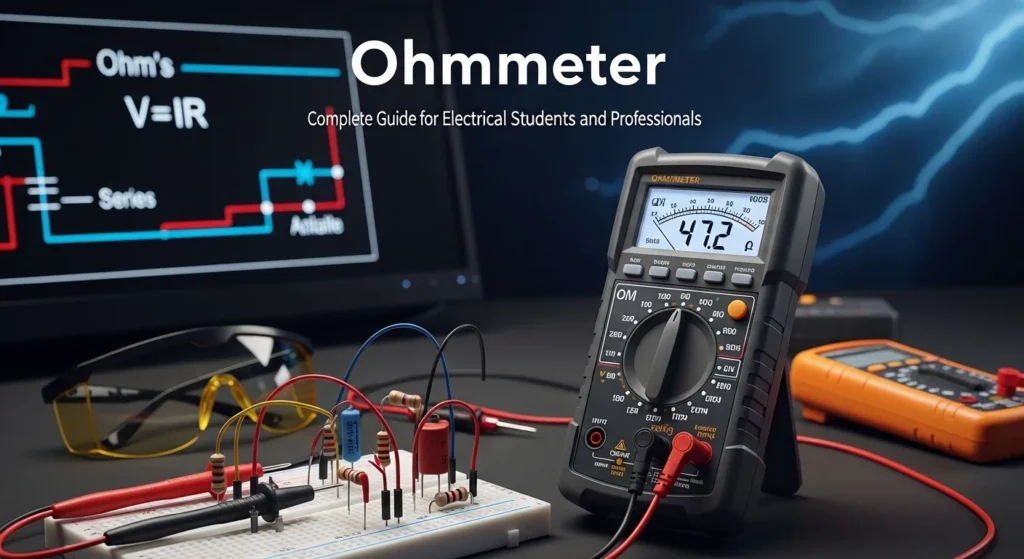

Imagine you are repairing a faulty electric fan at home. The power supply is fine, but the fan is not working. You suspect a broken wire or a damaged coil. How do you confirm it? This is where an ohmmeter becomes your best tool.
An ohmmeter helps you quickly check whether a circuit is open, closed, or has the correct resistance. It saves time, prevents guesswork, and ensures safety while troubleshooting electrical systems.
Understanding the ohmmeter working principle is essential for students, technicians, and engineers. It is one of the basic instruments used in electrical testing and maintenance. Whether you are working on small household circuits or large industrial systems, knowing how to use an ohmmeter is a fundamental skill.
In this article, you will learn everything about an ohmmeter—its definition, working, types, components, applications, advantages, and limitations. By the end, you will confidently understand how to select and use the right ohmmeter in real-world situations.
2. What is Ohmmeter?
An ohmmeter is an electrical measuring instrument used to measure the resistance of a circuit, component, or conductor.
In simple terms, it tells you how much a material resists the flow of electric current.
Simple Explanation
Resistance is measured in ohms (Ω). The higher the resistance, the more difficult it is for current to flow. An ohmmeter measures this resistance by applying a small voltage and calculating the resulting current.
Practical Example
If you test a wire with an ohmmeter:
- Low resistance → wire is good
- Infinite resistance → wire is broken
This makes the ohmmeter a powerful tool for fault detection.
3. Working Principle of Ohmmeter
The ohmmeter working principle is based on Ohm’s Law, which states:
Resistance = Voltage / Current
An ohmmeter has an internal battery that sends a small current through the component being tested.
Step-by-Step Working
- The internal battery provides voltage.
- Current flows through the unknown resistor.
- The meter measures the current.
- Resistance is calculated and displayed.
Easy Analogy
Think of water flowing through a pipe:
- Wide pipe → easy flow → low resistance
- Narrow pipe → difficult flow → high resistance
The ohmmeter checks how “narrow” or “wide” the electrical path is.
Important Points
- Always disconnect power before using an ohmmeter.
- It works only on de-energized circuits.
- Internal calibration ensures accurate readings.
4. Types / Classification of Ohmmeter
Ohmmeters are classified based on their design and application.
1. Series Ohmmeter
What is a Series Ohmmeter?
A series ohmmeter is a type of ohmmeter in which the unknown resistance is connected in series with the internal battery and measuring meter.
It is commonly used to measure medium to high resistance values and is one of the simplest forms of resistance-measuring instruments.
Series Ohmmeter Working Principle
The series ohmmeter working principle is based on Ohm’s Law:
genui{“math_block_widget_always_prefetch_v2”:{“content”:”R = \frac{V}{I}”}}
In this instrument, the current flowing through the circuit changes depending on the resistance being measured.
Step-by-Step Working
- The internal battery supplies a fixed voltage.
- The unknown resistance (Rx) is connected in series with the meter.
- Current flows through the circuit.
- The meter measures the current and converts it into resistance.
Key Concept
- Low resistance → High current → Needle moves right
- High resistance → Low current → Needle moves left
- Infinite resistance → No current → Needle at zero
Simple Understanding
Think of a road:
- Wide road (low resistance) → more cars (current) can pass
- Narrow road (high resistance) → fewer cars pass
The series ohmmeter measures how easily current flows through the “road.”
Circuit Diagram Explanation
A basic series ohmmeter includes:
- Battery (DC source)
- Galvanometer (meter movement)
- Series resistor
- Unknown resistance (Rx)
- Test leads
All components are connected in a single loop (series circuit).
Scale Characteristics
The scale of a series ohmmeter is non-linear (not uniform).
- Zero resistance is on the right side
- Infinite resistance is on the left side
This is opposite to voltmeters and ammeters.
Advantages of Series Ohmmeter
- Simple and low-cost design
- Easy to use for beginners
- Suitable for general resistance measurement
- Portable and widely available
Disadvantages of Series Ohmmeter
- Not suitable for very low resistance measurement
- Accuracy depends on battery condition
- Scale is non-linear and harder to read
- Requires zero adjustment before use
Applications of Series Ohmmeter
The series ohmmeter applications include:
- Checking continuity of wires
- Testing resistors
- Detecting open circuits
- Basic electrical troubleshooting
- Educational and training purposes
Important Note (Practical Tip)
Before using a series ohmmeter:
- Short the probes together
- Adjust the zero knob to set the meter to zero resistance
- This ensures accurate readings
Final Summary
A series ohmmeter is a simple and effective tool for measuring resistance by placing the unknown resistor in series with the circuit. It works on the principle of current variation and is widely used for basic electrical testing and troubleshooting.
If you are a beginner, mastering this type of ohmmeter will build a strong foundation in electrical measurements.
In this type:
- The unknown resistance is connected in series with the meter.
- Used for measuring medium resistance values.
Features:
- Simple design
- Common in analog meters
2. Shunt Ohmmeter
What is a Shunt Ohmmeter?
A shunt ohmmeter is a type of ohmmeter in which the unknown resistance is connected in parallel (shunt) with the measuring instrument.
It is specially designed to measure very low resistance values, where a series ohmmeter would not give accurate results.
Shunt Ohmmeter Working Principle
The shunt ohmmeter working principle is also based on Ohm’s Law, but it uses current division instead of total current variation:
genui{“math_block_widget_always_prefetch_v2”:{“content”:”I = \frac{V}{R}”}}
In this setup, current splits between the meter and the unknown resistance.
Step-by-Step Working
- The internal battery provides a constant voltage.
- The unknown resistance (Rx) is connected in parallel with the meter.
- Current divides between:
- The meter branch
- The unknown resistance branch
- The meter measures the portion of current flowing through it.
- Based on this current, resistance is calculated.
Key Concept
- Low resistance (Rx ↓) → More current bypasses meter → Needle moves left
- High resistance (Rx ↑) → Less current bypasses meter → Needle moves right
- Infinite resistance → All current flows through meter → Maximum deflection
Simple Understanding
Imagine a water system:
- Two parallel pipes (paths)
- Water prefers the easier path (low resistance)
If one pipe becomes very easy (low resistance), most water flows through it, reducing flow in the other pipe (meter). That is how a shunt ohmmeter detects resistance.
Circuit Diagram Explanation
A typical shunt ohmmeter includes:
- Battery (DC source)
- Galvanometer (meter movement)
- Shunt resistor
- Unknown resistance (Rx) connected in parallel
- Test leads
The key feature is the parallel connection of the unknown resistance.
Scale Characteristics
The scale of a shunt ohmmeter is also non-linear, but opposite to a series ohmmeter:
- Zero resistance → Left side of scale
- Infinite resistance → Right side of scale
Advantages of Shunt Ohmmeter
- Best for measuring low resistance values
- More accurate than series type for small resistances
- Useful in industrial and precision testing
- Helps in checking joints and connections
Disadvantages of Shunt Ohmmeter
- Not suitable for high resistance measurement
- Circuit design is slightly more complex
- Requires proper calibration
- Affected by battery condition
Applications of Shunt Ohmmeter
The shunt ohmmeter applications include:
- Measuring contact resistance
- Testing cable joints and connectors
- Checking busbar connections
- Industrial maintenance work
- Quality testing of electrical connections
Series vs Shunt Ohmmeter (Quick Difference)
| Feature | Series Ohmmeter | Shunt Ohmmeter |
|---|---|---|
| Connection | Series | Parallel (Shunt) |
| Best for | Medium/high resistance | Low resistance |
| Scale | Zero on right | Zero on left |
| Accuracy (low R) | Low | High |
This clearly explains the difference between series and shunt ohmmeter.
Practical Tip
Before using a shunt ohmmeter:
- Ensure the circuit is disconnected from power
- Check battery condition
- Calibrate properly for accurate readings
Final Summary
A shunt ohmmeter is an important instrument for measuring low resistance values with better accuracy. It works on the principle of current division and is widely used in industrial testing and electrical maintenance.
For students and technicians, understanding both series and shunt types is essential for mastering resistance measurement techniques.
- The unknown resistance is connected in parallel.
- Used for measuring low resistance values.
Features:
- Accurate for low resistance
- Used in specialized applications
3.Multi-Range Ohmmeter
What is a Multi-Range Ohmmeter?
A multi-range ohmmeter is an advanced type of ohmmeter that can measure resistance across multiple ranges using a selector switch.
Unlike basic ohmmeters that measure only a fixed range, this instrument allows you to measure low, medium, and high resistance values using a single device.
It is commonly found in analog multimeters and is widely used by electricians, technicians, and engineers.
Multi-Range Ohmmeter Working Principle
The multi-range ohmmeter working principle is based on Ohm’s Law, where resistance is calculated by controlling current flow:
genui{“math_block_widget_always_prefetch_v2”:{“content”:”R = \frac{V}{I}”}}
The key idea is that the meter changes its internal resistance to adjust the measurement range.
Step-by-Step Working
- The internal battery provides a constant voltage.
- The selector switch changes internal resistors.
- This adjusts the current flowing through the circuit.
- The unknown resistance (Rx) is connected.
- The meter displays resistance based on current flow.
Key Concept
- Different ranges (e.g., ×1, ×10, ×100, ×1k) are selected manually.
- Each range multiplies the reading on the scale.
- Proper range selection ensures accurate and readable results.
Simple Understanding
Think of measuring distance:
- A ruler is good for small lengths
- A measuring tape is better for long distances
Similarly, a multi-range ohmmeter lets you choose the “right scale” for resistance.
Types of Multi-Range Ohmmeter
1. Analog Multi-Range Ohmmeter
- Uses a needle (pointer)
- Requires manual reading
- Common in basic multimeters
2. Digital Multi-Range Ohmmeter
- Displays readings in numbers
- More accurate and easy to use
- Often includes auto-ranging
Main Components of Multi-Range Ohmmeter
1. Internal Battery
- Supplies voltage for measurement
2. Meter Movement / Digital Display
- Shows resistance value
3. Range Selector Switch
- Allows switching between different ranges
4. Internal Resistors
- Adjust current for each range
5. Test Leads
- Connect the instrument to the circuit
Range Settings Explained
Common range settings include:
- ×1 → Direct reading
- ×10 → Multiply reading by 10
- ×100 → Multiply reading by 100
- ×1k → Multiply reading by 1000
Example:
If the pointer shows 5 on ×10 range → Actual resistance = 50 Ω
Advantages of Multi-Range Ohmmeter
- Measures wide range of resistance values
- Flexible and versatile
- Cost-effective (one device, many uses)
- Useful for both beginners and professionals
- Common in multimeters
Disadvantages of Multi-Range Ohmmeter
- Manual range selection can cause errors
- Requires experience for correct reading (analog type)
- Battery condition affects accuracy
- Slower than auto-ranging digital meters
Applications of Multi-Range Ohmmeter
The multi-range ohmmeter applications include:
- Electrical troubleshooting
- Testing resistors and components
- Checking continuity
- Maintenance of circuits
- Educational labs and training
Comparison: Multi-Range vs Single-Range Ohmmeter
| Feature | Multi-Range Ohmmeter | Single-Range Ohmmeter |
|---|---|---|
| Measurement Range | Wide | Limited |
| Flexibility | High | Low |
| Accuracy | Better (if used correctly) | Fixed |
| Usage | Professional & general | Basic applications |
This highlights the difference between multi-range and single-range ohmmeter.
Selection Guide
For Beginners
- Choose digital multi-range ohmmeter
- Prefer auto-ranging feature
- Look for clear display
For Professionals
- Select high-precision models
- Ensure wide range coverage
- Check durability and safety features
Common Problems & Solutions
Q1: Wrong readings on meter?
Solution:
- Check selected range
- Recalibrate if analog
Q2: No display or movement?
Solution:
- Replace battery
- Check connections
Q3: Reading fluctuates?
Solution:
- Ensure firm probe contact
- Clean test leads
Practical Tip
Always start with the highest range and move down to get a more accurate reading. This prevents damage and improves measurement clarity.
Final Summary
A multi-range ohmmeter is a versatile and essential tool that allows measurement of different resistance levels using selectable ranges. It improves accuracy, flexibility, and efficiency in electrical testing.
For students and technicians, learning how to properly select ranges and interpret readings is a key skill in mastering electrical measurements.
- Provides multiple resistance ranges.
- Used for different measurement levels.
Features:
- Flexible usage
- Common in multimeters
4.Digital Ohmmeter
What is a Digital Ohmmeter?
A digital ohmmeter is an electronic instrument used to measure electrical resistance and display the result in numeric form on a digital screen.
Unlike analog ohmmeters, which use a moving needle, a digital ohmmeter provides direct, clear, and highly accurate readings. It is widely used in modern electrical and electronic testing.
Digital Ohmmeter Working Principle
The digital ohmmeter working principle is based on Ohm’s Law, where resistance is calculated using voltage and current:
genui{“math_block_widget_always_prefetch_v2”:{“content”:”R = \frac{V}{I}”}}
In digital systems, this process is handled electronically using sensors and internal circuits.
Step-by-Step Working
- A constant voltage is applied to the unknown resistor.
- The current flowing through the resistor is measured.
- The internal circuit calculates resistance using Ohm’s Law.
- The value is converted into digital form.
- The result is displayed on the screen (LCD/LED).
Key Concept
- No manual interpretation is needed
- High precision measurement
- Fast and reliable readings
Simple Understanding
Think of it like a calculator:
- You input a value (connect probes)
- The device automatically calculates and shows the answer
This eliminates human reading errors.
Types of Digital Ohmmeter
1. Basic Digital Ohmmeter
- Measures resistance only
- Simple and cost-effective
2. Digital Multimeter (DMM)
- Measures resistance, voltage, and current
- Most common type in practice
3. Auto-Ranging Digital Ohmmeter
- Automatically selects the correct range
- Very easy for beginners
4. Precision Digital Ohmmeter
- High accuracy for laboratory and industrial use
- Used in sensitive measurements
Main Components of Digital Ohmmeter
1. Power Source (Battery)
- Supplies energy to the circuit
2. Microcontroller / IC
- Processes measurements
- Calculates resistance
3. Analog-to-Digital Converter (ADC)
- Converts analog signals into digital values
4. Display (LCD/LED)
- Shows resistance reading
5. Test Leads (Probes)
- Connect the meter to the circuit
6. Range Selector (Manual or Auto)
- Selects measurement range
Advantages of Digital Ohmmeter
- High accuracy and precision
- Easy-to-read digital display
- No parallax (reading) error
- Fast measurement
- Auto-ranging feature available
- Compact and portable
Disadvantages of Digital Ohmmeter
- Requires battery power
- More expensive than analog types
- Sensitive to electrical noise
- May be damaged by high voltage
Applications of Digital Ohmmeter
The digital ohmmeter applications are very broad in modern systems.
Home Use
- Checking wires and cables
- Testing appliances
Industrial Use
- Maintenance of electrical systems
- Testing motors and transformers
Electronics
- PCB testing
- Component verification
Automotive
- Diagnosing electrical faults
Comparison: Digital vs Analog Ohmmeter
| Feature | Digital Ohmmeter | Analog Ohmmeter |
|---|---|---|
| Display | Numeric (LCD/LED) | Needle (scale) |
| Accuracy | High | Moderate |
| Ease of Use | Very easy | Requires skill |
| Reading Error | None | Possible (parallax error) |
| Speed | Fast | Slower |
This explains the difference between digital and analog ohmmeter.
Selection Guide
For Beginners
- Choose auto-ranging digital ohmmeter
- Look for large, clear display
- Prefer trusted brands
For Professionals
- Select high-precision models
- Check measurement range
- Look for safety ratings (CAT levels)
Common Problems & Solutions
Q1: Display shows “OL” or “∞”?
Solution:
- Resistance is too high or circuit is open
Q2: No display?
Solution:
- Replace battery
- Check internal fuse
Q3: Fluctuating readings?
Solution:
- Ensure proper contact
- Avoid electrical interference
Practical Tips
- Always test on a de-energized circuit
- Hold probes firmly
- Use correct range (if manual)
- Keep device calibrated
Future Trends
Digital ohmmeters are continuously improving with new technology.
Modern Innovations
- Bluetooth-enabled smart meters
- Mobile app integration
- Data logging features
- High-speed measurement systems
Industry Direction
- Automation in testing
- Integration with IoT systems
- AI-based diagnostics
Final Summary
A digital ohmmeter is a modern, accurate, and easy-to-use instrument for measuring resistance. It eliminates manual errors and provides fast, reliable results, making it ideal for both beginners and professionals.
Understanding its working principle, components, and applications helps you use it effectively in real-world electrical and electronic systems.
- Displays readings on a digital screen.
- Highly accurate and easy to read.
Features:
- No manual reading errors
- Widely used in modern systems
5.Micro-Ohmmeter
What is a Micro-Ohmmeter?
A micro-ohmmeter is a specialized instrument used to measure very low resistance values, typically in the range of micro-ohms (µΩ).
It is designed for applications where even a small resistance can affect performance, such as electrical connections, busbars, and transformer windings.
Simple Explanation
Normal ohmmeters cannot accurately measure extremely low resistance because the values are too small. A micro-ohmmeter solves this problem by using a high test current and precise measurement techniques.
Practical Example
If you want to check the resistance of a cable joint:
- A standard ohmmeter may show nearly zero
- A micro-ohmmeter gives the exact small resistance value, helping detect poor connections
Micro-Ohmmeter Working Principle
The micro-ohmmeter working principle is based on a precise method of Ohm’s Law:
genui{“math_block_widget_always_prefetch_v2”:{“content”:”R = \frac{V}{I}”}}
However, it uses a special technique called the four-wire (Kelvin) method to eliminate errors.
Step-by-Step Working
- A high current (e.g., 1A to 100A) is passed through the test object.
- Two wires supply current (current leads).
- Two separate wires measure voltage (sense leads).
- The device measures a very small voltage drop.
- Resistance is calculated accurately using Ohm’s Law.
Key Concept (Kelvin Method)
- Separates current and voltage paths
- Eliminates lead and contact resistance
- Ensures highly accurate measurement
Simple Understanding
Imagine measuring the thickness of a thin paper:
- A normal ruler is not accurate
- A precision micrometer gives exact measurement
Similarly, a micro-ohmmeter measures tiny resistance values with high precision.
Types of Micro-Ohmmeter
1. Portable Micro-Ohmmeter
- Lightweight and easy to carry
- Used in field testing
2. Bench-Type Micro-Ohmmeter
- High accuracy
- Used in laboratories
3. Digital Micro-Ohmmeter
- Displays readings digitally
- Most common type
4. High-Current Micro-Ohmmeter
- Uses large test current
- Ideal for industrial applications
Main Components of Micro-Ohmmeter
1. Current Source
- Supplies high test current
2. Voltage Measurement Circuit
- Measures small voltage drop
3. Microcontroller / Processor
- Calculates resistance
4. Kelvin Probes (4-wire leads)
- Ensure accurate measurement
5. Display Unit
- Shows resistance value
Advantages of Micro-Ohmmeter
- Extremely high accuracy
- Ideal for very low resistance measurement
- Eliminates contact resistance errors
- Reliable for critical testing
- Suitable for industrial applications
Disadvantages / Limitations
- Expensive compared to regular ohmmeters
- Requires proper handling
- Not suitable for high resistance
- Needs stable connections for accuracy
Applications of Micro-Ohmmeter
The micro-ohmmeter applications are critical in industry and maintenance.
Electrical Power Systems
- Testing transformer windings
- Checking circuit breaker contacts
Industrial Use
- Busbar and cable joint testing
- Welding quality inspection
Manufacturing
- Quality control of conductive parts
Automotive & Aerospace
- Testing bonding and grounding connections
Comparison: Micro-Ohmmeter vs Digital Ohmmeter
| Feature | Micro-Ohmmeter | Digital Ohmmeter |
|---|---|---|
| Resistance Range | Very low (µΩ) | Medium to high |
| Accuracy | Very high | High |
| Measurement Method | 4-wire (Kelvin) | 2-wire |
| Application | Industrial/precision | General use |
| Cost | High | Moderate |
This explains the difference between micro-ohmmeter and digital ohmmeter.
Selection Guide
For Beginners
- Not usually required unless working with precision systems
- Choose simple digital ohmmeter first
For Professionals
- Select based on current range (e.g., 10A, 50A, 100A)
- Ensure Kelvin probe quality
- Look for digital display and data logging
Common Problems & Solutions
Q1: Inaccurate readings?
Solution:
- Ensure tight connections
- Clean contact surfaces
Q2: Fluctuating values?
Solution:
- Avoid vibration
- Use stable probe contact
Q3: Device not working?
Solution:
- Check power supply
- Inspect leads and connections
Practical Tips
- Always clean the test surface before measurement
- Use proper Kelvin connections
- Avoid measuring in energized circuits
- Ensure firm contact
Future Trends
Micro-ohmmeters are advancing with modern technology.
Innovations
- Wireless data transfer
- Automated testing systems
- Integration with maintenance software
Industry Direction
- Smart grid testing
- Predictive maintenance
- AI-based fault analysis
Final Summary
A micro-ohmmeter is a high-precision instrument designed for measuring extremely low resistance values. It uses advanced techniques like the Kelvin method to ensure accuracy and reliability.
For engineers and technicians working in industrial and power systems, it is an essential tool for detecting small resistance issues that can lead to major failures.
- Measures very low resistance (micro-ohms).
- Used in industrial applications.
Features:
- High precision
- Used for testing connections and joints
5. Main Components of Ohmmeter
An ohmmeter consists of several key parts that work together.
1. Internal Battery
- Provides voltage for measurement
- Essential for operation
2. Meter Movement (Analog) / Display (Digital)
- Shows resistance value
- Analog uses a needle, digital uses numbers
3. Resistors
- Control current flow
- Ensure accurate readings
4. Test Leads (Probes)
- Connect the device to the circuit
- Usually red and black wires
5. Selector Switch
- Used to choose resistance range
- Found in multi-range meters
6. Advantages of Ohmmeter
The ohmmeter advantages and disadvantages section is important for practical understanding.
Advantages
- Easy to use for beginners
- Quick detection of faults
- Portable and lightweight
- Accurate measurement (especially digital)
- Useful in both home and industrial applications
- Helps in preventive maintenance
7. Disadvantages / Limitations
Despite its usefulness, an ohmmeter has some limitations.
Disadvantages
- Cannot measure resistance in live circuits
- Accuracy depends on battery condition
- Analog types may have reading errors
- Limited range in basic models
- Sensitive to temperature variations
8. Applications of Ohmmeter
The ohmmeter applications are wide and important in many fields.
Home Applications
- Checking wires and cables
- Testing switches and sockets
- Repairing appliances
Industrial Applications
- Testing motors and transformers
- Checking continuity of circuits
- Maintenance of electrical panels
Modern Technology
- PCB testing in electronics
- Automotive diagnostics
- Quality control in manufacturing
9. Comparison Section
Difference Between Ohmmeter and Multimeter
| Feature | Ohmmeter | Multimeter |
|---|---|---|
| Function | Measures resistance only | Measures voltage, current, resistance |
| Usage | Limited | Multi-purpose |
| Complexity | Simple | More advanced |
| Cost | Lower | Higher |
| Flexibility | Low | High |
The difference between ohmmeter and multimeter shows that while an ohmmeter is specialized, a multimeter is more versatile.
10. Selection Guide
Choosing the right ohmmeter depends on your needs.
Tips for Beginners
- Start with a digital ohmmeter
- Choose a model with auto-ranging
- Ensure good quality probes
For Professionals
- Select high-precision instruments
- Consider micro-ohmmeters for industrial use
- Check calibration features
Key Factors
- Accuracy
- Range
- Build quality
- Safety features
11. Common Problems & Solutions
Q1: Why is the ohmmeter showing infinite resistance?
Solution:
- Check if the circuit is open
- Ensure proper probe connection
Q2: Why are readings unstable?
Solution:
- Replace battery
- Clean probe tips
Q3: Can I use an ohmmeter on a live circuit?
Answer:
- No, it may damage the device and cause injury
Q4: Why is the reading always zero?
Solution:
- Check for short circuit
- Verify calibration
12. Future Trends
The future of ohmmeters is evolving with technology.
Modern Developments
- Smart digital meters with Bluetooth
- Integration with mobile apps
- High-precision nano-ohm measurement
Industry Direction
- Automation in testing
- AI-based fault detection
- Compact and multi-functional devices
These advancements are making resistance measurement faster and more accurate.
13. Conclusion
An ohmmeter is one of the most essential tools in electrical engineering. From simple household repairs to complex industrial maintenance, it plays a critical role in identifying faults and ensuring system reliability.
Understanding the ohmmeter working principle, types, components, and applications helps you use the instrument effectively. While it has some limitations, its advantages make it a must-have device for every electrical professional.
As technology advances, ohmmeters are becoming more accurate, user-friendly, and integrated with smart systems. For students and beginners, mastering the basics of an ohmmeter is the first step toward becoming a skilled electrical technician or engineer.
Keep practicing, explore real circuits, and build confidence with this powerful tool.