
Imagine walking into a modern office building, a supermarket, or even a school classroom where the lighting is bright, stable, and comfortable for the eyes. The lights turn on instantly without flickering, consume less electricity, and last for many years without frequent replacement. In most of these places, the lighting system is powered by LED Tube Lights.
In the past, fluorescent tube lights were the most common lighting fixtures used in homes, offices, and industries. Although they worked well for many years, they consumed more electricity, required ballasts, and contained mercury, which can harm the environment. As energy efficiency became a major concern worldwide, engineers started replacing traditional lighting systems with modern LED technology.
Today, LED Tube Lights are widely used because they provide better brightness, longer lifespan, and lower power consumption. They are also safer and more environmentally friendly compared to older lighting technologies.
For electrical students, technicians, and engineers, understanding LED lighting systems is an important skill. Knowing the LED Tube Lights working principle, types, components, and installation methods helps professionals design efficient lighting systems.
In this article, you will learn what LED Tube Lights are, how they work, their types, LED Tube Lights applications, advantages, disadvantages, and practical selection tips.
What is LED Tube Lights?
LED Tube Lights are linear lighting fixtures that use Light Emitting Diodes (LEDs) to produce illumination. They are designed to replace traditional fluorescent tube lights used in ceiling fixtures.
In simple terms, an LED tube light is a long cylindrical light fixture that contains multiple LED chips arranged along a circuit board. When electricity flows through these LED chips, they emit bright light with high efficiency.
Unlike fluorescent tubes that rely on gas discharge and mercury vapor, LED tubes operate using semiconductor technology. This makes them safer, more reliable, and more energy-efficient.
Practical Example
Consider a school classroom where fluorescent tube lights were previously used. After replacing them with LED Tube Lights, the classroom becomes brighter, electricity bills decrease, and the maintenance team no longer needs to replace lights frequently.
Because of these advantages, LED tube lights are now widely used in homes, offices, factories, and commercial buildings.
LED Tube Lights Working Principle
Understanding the LED Tube Lights working principle helps electrical learners understand how modern lighting systems operate.
LED tube lights work using semiconductor devices called LEDs that convert electrical energy directly into light.
Step-by-Step Working Process
• AC Power Input
The LED tube receives electrical power from the AC mains supply.
• Driver Circuit Operation
Inside the tube, an electronic driver converts AC voltage into regulated DC voltage required for LEDs.
• Current Regulation
The driver controls and stabilizes the current flowing to the LED chips.
• LED Light Emission
When current flows through the LED chips, electrons release energy in the form of photons, producing visible light.
• Light Diffusion
A diffuser cover spreads the light evenly across the room and reduces glare.
Easy Analogy
You can think of an LED tube light as a row of tiny electronic lamps placed in a straight line. When electricity flows through them, each small lamp lights up together, producing bright and uniform illumination.
Key Characteristics
• Instant start with no flicker
• No mercury gas
• Low heat generation
• High electrical efficiency
This modern design makes LED tube lights superior to traditional lighting technologies.
Types / Classification
LED tube lights are available in several types depending on installation methods and design structure.
Direct Wire LED Tube Lights
Direct wire LED tubes connect directly to the AC mains supply without using a ballast.
Features:
• High efficiency
• Simple wiring system
• Reliable long-term performance
These are commonly used in new lighting installations.
Plug-and-Play LED Tube Lights
Plug-and-play tubes are designed to work with existing fluorescent fixtures that already contain electronic ballasts.
Features:
• Easy replacement
• No major wiring changes
• Quick installation
They are ideal for upgrading existing lighting systems.
Hybrid LED Tube Lights
Hybrid LED tubes can work both with a ballast and with direct wiring.
Features:
• Flexible installation
• Suitable for retrofit projects
• Works in multiple fixture types
Integrated LED Tube Fixtures
Integrated fixtures combine the tube and fixture into a single unit.
Features:
• Modern design
• Easy installation
• Better heat management
These are widely used in modern buildings.
Main Components
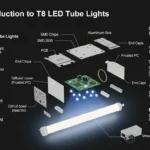
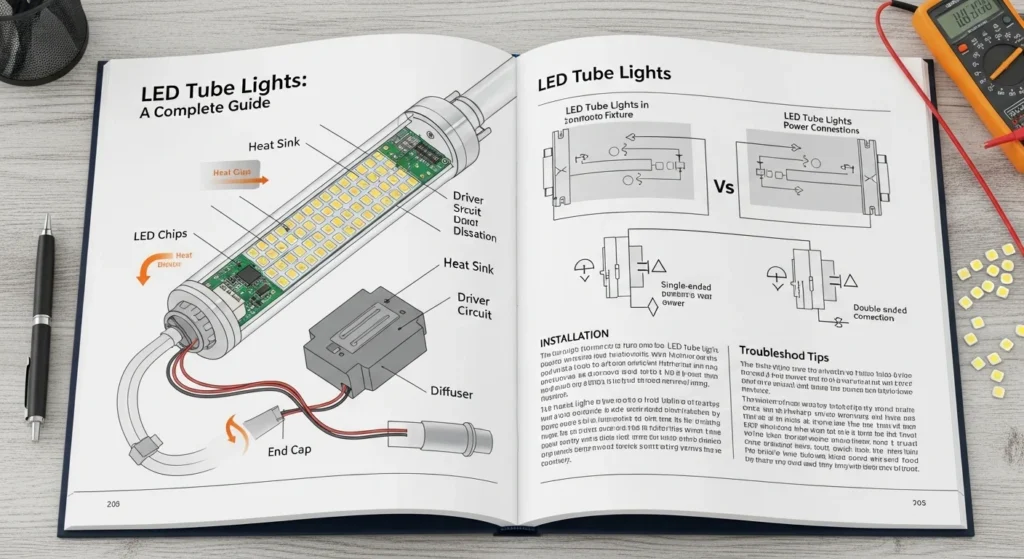
An LED tube light contains several important components that allow it to function efficiently.
LED Chips
LED chips are the primary light-producing elements.
They convert electrical energy into visible light with high efficiency.
LED Driver
The driver is an electronic circuit that converts AC voltage into controlled DC current required by LEDs.
It also protects the circuit from voltage fluctuations.
Printed Circuit Board (PCB)
The PCB holds the LED chips and distributes electrical current evenly across the lighting circuit.
Aluminum Heat Sink
The aluminum body of the tube acts as a heat sink, removing heat from the LED chips and extending their lifespan.
Diffuser Cover
The diffuser spreads light evenly and reduces glare, improving visual comfort.
End Caps
End caps connect the tube to the lighting fixture and electrical wiring system.
Advantages
Understanding LED Tube Lights advantages and disadvantages helps engineers and technicians choose the best lighting systems.
Advantages of LED Tube Lights
• Very low electricity consumption
• Long lifespan (30,000–50,000 hours)
• Instant start without flicker
• Environmentally friendly (no mercury)
• Low maintenance cost
• High brightness efficiency
• Low heat generation
• Suitable for many lighting environments
These benefits make LED tube lights one of the most energy-efficient lighting solutions available today.
Disadvantages / Limitations
Although LED tube lights offer many advantages, they also have some practical limitations.
Disadvantages
• Higher initial purchase cost compared to fluorescent tubes
• Cheap drivers may fail early in low-quality products
• Some installations require rewiring of fixtures
• Light quality varies depending on LED chip quality
Understanding these LED Tube Lights advantages and disadvantages helps technicians select reliable lighting equipment.
LED Tube Lights Applications
Because of their efficiency and reliability, LED Tube Lights applications are widely found in modern lighting systems.
Home Applications
• Kitchen lighting
• Garage lighting
• Basement lighting
• Home workshops
Commercial Applications
• Office buildings
• Shopping malls
• Supermarkets
• Schools and universities
Industrial Applications
• Factories
• Warehouses
• Production plants
• Assembly lines
Specialized Applications
• Hospitals
• Laboratories
• Parking garages
• Data centers
These widespread LED Tube Lights applications show how LED technology has transformed modern lighting systems.
Comparison Section
Difference Between LED Tube Lights and Fluorescent Tube Lights
| Feature | LED Tube Lights | Fluorescent Tube Lights |
|---|---|---|
| Energy Consumption | Very low | Higher |
| Lifespan | 30,000–50,000 hours | 8,000–15,000 hours |
| Startup Time | Instant | May flicker |
| Environmental Impact | No mercury | Contains mercury |
| Maintenance | Low | Higher |
This comparison helps electrical learners understand the difference between LED tube lights and fluorescent tube lights.
Selection Guide
Choosing the correct LED tube light is important for proper lighting performance.
Tips for Beginners
1. Check the Wattage
Common LED tube wattages include:
• 10W
• 18W
• 24W
Higher wattage produces more brightness.
2. Check Lumens
Lumens indicate brightness output. Higher lumen values provide stronger lighting.
3. Choose Color Temperature
Typical color temperatures include:
• 3000K – Warm white
• 4000K – Neutral white
• 6500K – Cool white
4. Select Installation Type
Choose between:
• Direct wire
• Plug-and-play
• Hybrid tubes
5. Choose Reliable Brands
Good quality LED drivers improve reliability and lifespan.
Common Problems & Solutions
Why is my LED tube light not turning on?
Possible reasons:
• No power supply
• Loose wiring
• Faulty driver
Solution: Check electrical connections and replace defective components.
Why is the LED tube flickering?
Possible causes:
• Voltage fluctuations
• Driver malfunction
• Poor wiring connection
Solution: Inspect wiring and replace the driver if necessary.
Why is the light dim?
Possible reasons:
• Aging LED chips
• Heat damage
• Low-quality LEDs
Solution: Replace the tube with a high-quality LED model.
Future Trends
LED lighting technology continues to improve rapidly.
Smart Lighting Systems
Future LED tube lights will integrate with smart home systems and wireless control technologies.
Higher Efficiency LEDs
New LED chips will produce more brightness while consuming less electricity.
Sensor-Based Lighting
Motion sensors and daylight sensors will automatically control lighting to save energy.
Smart Building Integration
Modern LED lighting will connect with automated building management systems for better energy efficiency.
These developments will further expand the role of LED tube lighting in modern infrastructure.
Conclusion
LED Tube Lights have become one of the most important lighting technologies used in homes, offices, and industries today. Their high efficiency, long lifespan, and low maintenance requirements make them an ideal replacement for traditional fluorescent lighting systems.
Understanding the LED Tube Lights working principle, components, installation methods, and maintenance practices is essential for electrical students and technicians. These lights offer many advantages such as lower power consumption, improved brightness, and environmentally friendly operation.
Although there are some limitations, the LED Tube Lights advantages and disadvantages clearly show that LED technology is the future of lighting systems.
As lighting technology continues to evolve, LED tube lights will remain a key component of energy-efficient electrical installations worldwide.