
Imagine walking into your room on a very hot day and switching on the air conditioner. Within minutes, the air becomes cool and comfortable. This cooling effect does not happen by magic. It is mainly due to a key component called the evaporator coil.
The evaporator coil plays a major role in removing heat from indoor air. Without it, air conditioners and refrigerators cannot perform their cooling function. That is why every technician and electrical student must clearly understand how it works.
Learning the evaporator coil working principle helps in installation, maintenance, and troubleshooting of cooling systems. It also helps improve system efficiency and reduce energy loss.
In this article, you will learn the definition, working, types, components, advantages, disadvantages, and applications of an evaporator coil. By the end, you will be able to understand and handle this component with confidence in real-life situations.
2. What is Evaporator Coil?
An evaporator coil is a part of an air conditioning or refrigeration system that absorbs heat from the surrounding air.
Simple Explanation
It contains a cold fluid called refrigerant. When warm air passes over the coil, the refrigerant absorbs heat and turns into gas. This process cools the air.
Practical Example
In a room air conditioner:
- Warm air enters the indoor unit
- It passes over the evaporator coil
- Heat is removed
- Cool air is sent back into the room
3. Working Principle of Evaporator Coil
The evaporator coil working principle is based on heat transfer and evaporation.
Step-by-Step Working
- Refrigerant enters the coil as a low-pressure liquid
- It absorbs heat from indoor air
- The refrigerant changes into gas
- Heat is removed from the air
- A fan blows cool air into the room
Key Points
- Heat flows from hot air to cold refrigerant
- Refrigerant changes state from liquid to gas
Easy Example
When water evaporates, it absorbs heat and creates a cooling effect. The evaporator coil works in the same way.
4. Types / Classification of Evaporator Coil
1. A-Coil
- A-shaped design
- Common in home air conditioners
2. Slab Coil
- Flat design
- Used in small units
3. N-Coil
- N-shaped design
- Better airflow and efficiency
4. Cased and Uncased Coils
- Cased coils are covered and protected
- Uncased coils are open and flexible for installation
5. Main Components of Evaporator Coil
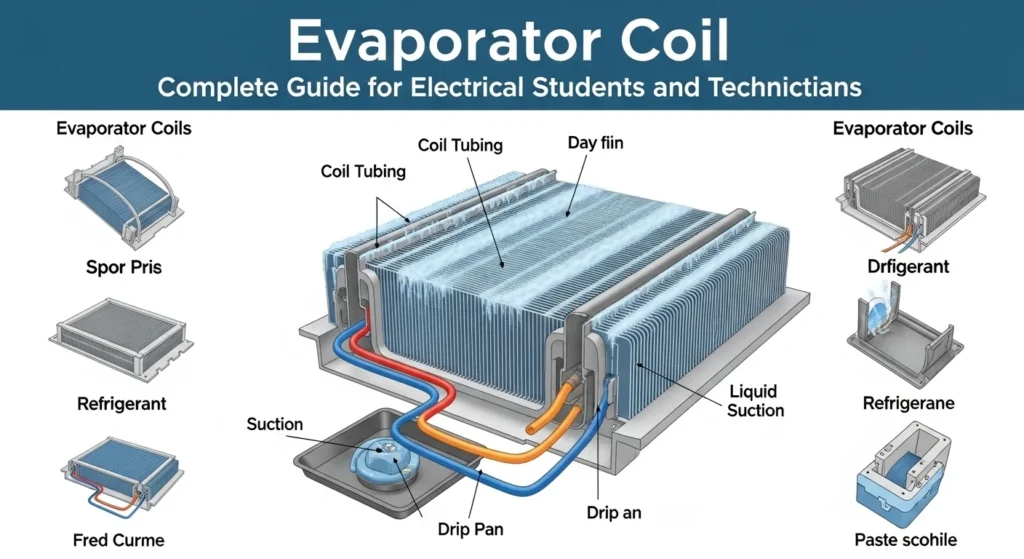
Copper or Aluminum Tubes
Carry the refrigerant and transfer heat
Fins
Increase surface area for better cooling
Refrigerant
Absorbs heat and changes state
Expansion Valve
Controls refrigerant flow and pressure
Drain Pan
Collects water formed during cooling
6. Advantages of Evaporator Coil
- Provides effective cooling
- Improves indoor comfort
- Energy efficient
- Works in different systems
- Reliable and durable
- Helps maintain temperature control
7. Disadvantages / Limitations
- Needs regular cleaning
- Can get dirty easily
- Risk of corrosion
- Refrigerant leakage issues
- Maintenance cost can be high
8. Applications of Evaporator Coil
Home Use
- Air conditioners
- Refrigerators
- Freezers
Industrial Use
- Cold storage
- Food processing plants
- Cooling systems in factories
Modern Use
- Data center cooling
- Smart HVAC systems
- Vehicle air conditioning
9. Comparison Section
Difference Between Evaporator Coil and Condenser Coil
| Feature | Evaporator Coil | Condenser Coil |
|---|---|---|
| Function | Absorbs heat | Releases heat |
| Location | Indoor unit | Outdoor unit |
| Temperature | Cold | Hot |
| Process | Liquid to gas | Gas to liquid |
10. Selection Guide
For Beginners
- Choose the correct size
- Prefer copper coils
- Check compatibility with AC unit
For Professionals
- Match system capacity
- Check airflow design
- Consider durability and efficiency
Tips
- Always ensure proper installation
- Keep the coil clean
- Use quality materials
11. Common Problems & Solutions
Poor Cooling
- Clean the coil
- Check refrigerant level
Coil Freezing
- Improve airflow
- Clean air filters
Water Leakage
- Clean drain pipe
- Check drain pan
Noise Issue
- Inspect fan
- Tighten loose parts
12. Future Trends
- Use of eco-friendly refrigerants
- Smart HVAC systems
- Better coil materials with anti-corrosion coating
- Energy-efficient designs
13. Conclusion
The evaporator coil is a very important part of cooling systems. It absorbs heat from the air and helps maintain a comfortable temperature. Understanding the evaporator coil working principle makes it easier to install, maintain, and troubleshoot HVAC systems.
Although it requires proper care and maintenance, its advantages make it essential in modern cooling technology. With the righ tknowledge and practice, you can easily work with evaporator coils in real-life applications.