
When you switch on a camera flash, you often notice a small delay before it fires. That delay happens because the capacitor inside the circuit is charging. Similarly, in electric vehicles, power supplies, and electronic devices, capacitors are constantly charging and discharging to regulate energy flow.
Understanding the Capacitor Charging Equation is essential for anyone working in electrical or electronics engineering. It helps explain how voltage builds up across a capacitor over time when connected to a power source. Without this knowledge, designing timing circuits, filters, and energy storage systems becomes difficult.
This topic is especially important for students, technicians, and engineers because it forms the foundation of transient analysis in circuits. It also connects directly with real-world systems like RC circuits, signal processing, and power electronics.
In this article, you will learn:
- What capacitor charging means in simple terms
- The capacitor charging equation and how it works
- Step-by-step working principle
- Types of charging behavior
- Real-world applications and troubleshooting
- Advantages, limitations, and future trends
By the end, you will clearly understand how capacitors charge in practical electrical systems.
2. What is Capacitor Charging Equation?
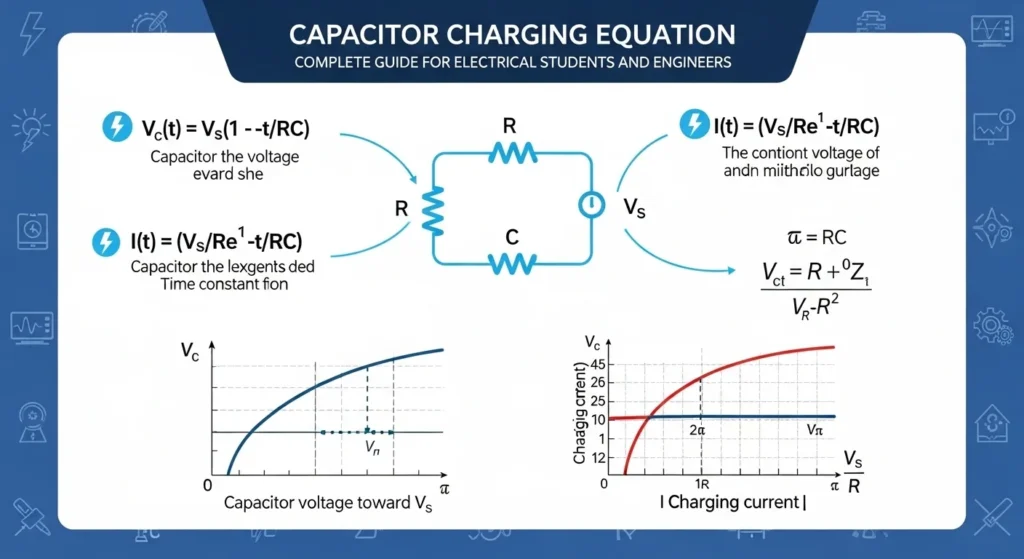
The Capacitor Charging Equation describes how the voltage across a capacitor increases with time when it is connected to a DC voltage source through a resistor.
Definition:
It is a mathematical expression that shows the change in capacitor voltage during the charging process in an RC circuit.
Capacitor Charging Voltage Equation
VC(t)=VS(1−e−RCt)
🔹 Where:
- VC(t) = Voltage across capacitor at time t
- VS = Supply voltage
- R = Resistance (Ohms)
- C = Capacitance (Farads)
- t = Time (seconds)
- RC = Time constant tau
Standard Charging Current Equation
I(t)=RVSe−RCt:
V_C(t) = V_s \left(1 – e^{-\frac{t}{RC}}\right)
Where:
- V_C(t) = Voltage across capacitor at time t
- V_s = Supply voltage
- R = Resistance (Ohms)
- C = Capacitance (Farads)
- t = Time (seconds)
- RC = Time constant (τ)
Practical Example:
If a 10V supply is connected with R and C:
- At t = 0 → capacitor voltage = 0V
- After time increases → voltage rises gradually
- After long time → capacitor reaches 10V
This is the essence of the Capacitor Charging Equation.
3. Working Principle of Capacitor Charging
The working principle is based on the gradual accumulation of electric charge on capacitor plates.
Step-by-Step Process:
- When switch is ON, current starts flowing
- Capacitor begins storing charge
- Voltage across capacitor slowly increases
- Charging speed decreases over time
- Finally, capacitor becomes fully charged
Simple Analogy:
Think of filling a water tank:
- At start, water flows fast (empty tank)
- As tank fills, flow slows down
- When full, flow stops completely
Key Points:
- Initial current is maximum
- Current decreases with time
- Voltage increases exponentially
- Charging depends on RC time constant
This is the basic capacitor charging equation working principle used in circuit analysis.
4. Types / Classification of Charging Behavior
Capacitor charging behavior can be classified based on circuit conditions.
4.1 Ideal Charging (Theoretical)
- No resistance in circuit
- Instant charging (not practical)
- Used for theory only
4.2 RC Circuit Charging (Practical)
- Real-world condition
- Includes resistor and capacitor
- Exponential charging curve
4.3 Non-Linear Charging
- Occurs in complex circuits
- Includes semiconductor effects
- Used in advanced electronics
5. Main Components in Charging Circuit
5.1 Voltage Source (Vs)
- Provides energy to circuit
- Usually DC supply
5.2 Resistor (R)
- Controls charging speed
- Limits current flow
5.3 Capacitor (C)
- Stores electrical energy
- Key energy storage component
5.4 Switch
- Starts and stops charging process
- Used for control operation
6. Advantages of Capacitor Charging
- Smooth energy storage process
- Protects circuit from sudden current surge
- Used in timing applications
- Improves signal stability
- Helps in controlled energy transfer
These points show importance of the Capacitor Charging Equation advantages and disadvantages in engineering systems.
7. Disadvantages / Limitations
- Charging takes time (not instant)
- Energy loss in resistor
- Sensitive to temperature changes
- Not suitable for long-term storage
- Exponential behavior can be complex
Despite limitations, it is widely used in electronics.
8. Applications of Capacitor Charging
The Capacitor Charging Equation applications are found in many electrical systems.
8.1 Electronics
- Camera flash circuits
- Timing circuits
- Oscillators
8.2 Industrial Systems
- Motor start circuits
- Power conditioning
- Control systems
8.3 Power Electronics
- Inverters
- UPS systems
- Energy buffers
8.4 Modern Technology
- Electric vehicles
- Renewable energy storage
- Smart electronic devices
9. Comparison Section
Capacitor Charging vs Discharging
| Feature | Charging Process | Discharging Process |
|---|---|---|
| Energy Flow | Into capacitor | Out of capacitor |
| Voltage | Increases over time | Decreases over time |
| Current | Starts high, decreases | Starts high, decreases |
| Equation Type | Exponential growth | Exponential decay |
Key Difference:
- Charging stores energy
- Discharging releases energy
This is the difference between charging and discharging of capacitor.
10. Selection Guide (Practical Tips)
When designing charging circuits:
- Choose correct capacitor value
- Select proper resistor for timing control
- Ensure voltage rating is sufficient
- Consider temperature stability
- Match RC time constant with application
Beginner Tip:
Use larger resistance for slow charging and smaller resistance for fast charging.
11. Common Problems & Solutions
Problem 1: Capacitor not charging
- Cause: Open circuit or faulty capacitor
- Solution: Check connections and replace capacitor
Problem 2: Charging too slow
- Cause: High resistance value
- Solution: Reduce resistor value
Problem 3: Overheating resistor
- Cause: Excess current flow
- Solution: Use higher wattage resistor
Problem 4: Incorrect voltage reading
- Cause: Measurement error
- Solution: Use calibrated multimeter
12. Future Trends in Capacitor Charging
Modern electrical systems are improving capacitor charging methods.
New Technologies:
- Ultra-fast charging supercapacitors
- AI-based power control systems
- Wireless energy charging systems
- Smart adaptive RC circuits
Industry Direction:
- Faster energy storage systems
- High-efficiency power electronics
- Compact electronic devices
Future systems will focus on speed, efficiency, and smart control.
13. Conclusion (120–150 words)
The Capacitor Charging Equation is a fundamental concept in electrical and electronics engineering. It explains how voltage builds up across a capacitor over time when connected to a power source through a resistor. This exponential behavior is essential for understanding timing circuits, energy storage systems, and electronic signal control.
We explored the formula, working principle, types of charging, components involved, and real-world applications. We also studied advantages, limitations, troubleshooting methods, and future trends in capacitor technology.
For electrical students and engineers, mastering this concept is very important because it forms the foundation of transient circuit analysis. It helps in designing efficient and reliable electrical systems used in industries and modern electronics.
In short, capacitor charging is not just theory—it is a real-world process powering countless electrical devices around us.