
Imagine walking into a modern restaurant where soft lighting shines under the tables, around the ceiling edges, and even near water fountains. The lighting looks stylish, bright, and safe even in humid areas. Most of the time, this lighting is created using Waterproof LED Strips.
Lighting technology has improved significantly in recent years. Traditional bulbs and tubes are slowly being replaced by LED-based lighting because LEDs are more energy-efficient, durable, and flexible. However, in places like kitchens, bathrooms, swimming pools, outdoor gardens, and industrial environments, moisture and water can damage normal lighting systems. This is where Waterproof LED Strips become extremely useful.
These special LED strips are designed with protective coatings that prevent water, dust, and humidity from damaging the electronic components. Because of this protection, they can work safely in both indoor and outdoor environments.
In this article, you will learn everything about Waterproof LED Strips, including their definition, working principle, types, components, advantages and disadvantages, applications, and future technology trends. The explanation is written in simple language so that electrical students, technicians, and beginners can easily understand the topic.
2. What is Waterproof LED Strips?
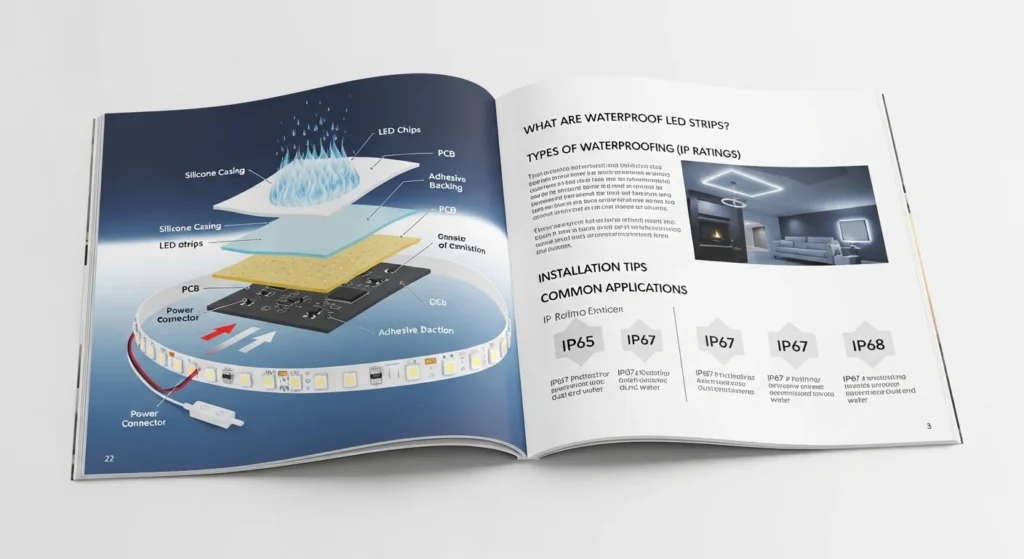
Waterproof LED Strips are flexible lighting strips that contain multiple LED lights mounted on a thin circuit board and protected with waterproof materials such as silicone or epoxy coating.
These strips are designed to resist water, moisture, dust, and humidity. Because of this protection, they can be installed in areas where normal LED strips would fail.
In simple words, a waterproof LED strip is just like a normal LED strip but with an extra protective layer that prevents water from entering the electronic circuit.
Practical Example
Consider installing lighting around a swimming pool or in a bathroom ceiling. A normal LED strip may get damaged due to water exposure. However, Waterproof LED Strips continue working safely because their components are sealed against moisture.
This makes them ideal for outdoor decoration, architectural lighting, marine applications, and industrial environments.
3. Waterproof LED Strips Working Principle
The Waterproof LED Strips working principle is based on the operation of light-emitting diodes (LEDs) powered through a low-voltage electrical supply.
The process works as follows:
- Power Supply Input
The strip receives low-voltage DC power, usually 12V or 24V. - Current Flow in Circuit
Electricity flows through copper tracks on the flexible printed circuit board (PCB). - LED Illumination
When current passes through the LED semiconductor, electrons release energy in the form of light. - Resistors Control Current
Small resistors on the strip regulate the current to protect LEDs from damage. - Waterproof Protection Layer
A silicone or epoxy coating protects the circuit from water, dust, and humidity.
Simple Analogy
Think of the LED strip like a small road with many streetlights. Electricity travels along the road, and each LED lights up when power reaches it. The waterproof layer acts like a protective roof that shields the lights from rain.
4. Types / Classification of Waterproof LED Strips
Waterproof LED strips are available in different types depending on their protection level and application.
IP65 Waterproof LED Strips
These strips are coated with a thin silicone layer that protects them from dust and light water splashes.
Common uses include:
- Kitchen lighting
- Indoor decoration
- Furniture lighting
- Wall and ceiling designs
IP67 Waterproof LED Strips
IP67 strips are enclosed in a thicker silicone tube. They can resist temporary water exposure.
Typical applications include:
- Outdoor lighting
- Garden decoration
- Architectural lighting
- Balcony illumination
IP68 Waterproof LED Strips
These strips offer the highest level of protection. They are fully sealed and can operate under water.
Common uses include:
- Swimming pool lighting
- Fountain decoration
- Marine lighting
- Aquarium illumination
5. Main Components
Understanding the main components of Waterproof LED Strips helps technicians install and maintain them properly.
1. Light Emitting Diodes (LEDs)
LEDs are the main light-producing components. They convert electrical energy into visible light efficiently.
2. Flexible Printed Circuit Board (FPCB)
This thin circuit board connects all LEDs and electronic components together while allowing the strip to bend easily.
3. Current Limiting Resistors
These resistors control electrical current flowing through LEDs to prevent overheating.
4. Waterproof Coating
Silicone, epoxy, or polyurethane coating protects the circuit from moisture and environmental damage.
5. Adhesive Backing
Most LED strips include adhesive tape on the back so they can be easily installed on surfaces.
6. Connectors
Connectors allow the strip to connect with power supplies and controllers.
6. Advantages
There are many reasons why waterproof LED strips are widely used in modern lighting systems.
Waterproof LED Strips advantages include:
- Energy efficient and low power consumption
- Long lifespan (often 30,000–50,000 hours)
- Flexible and easy to install
- Safe low-voltage operation
- Resistant to water, dust, and humidity
- Suitable for indoor and outdoor use
- Available in multiple colors and brightness levels
- Low heat generation compared to traditional lights
These benefits make them a preferred lighting solution in many industries.
7. Disadvantages / Limitations
Although waterproof LED strips offer many benefits, they also have some limitations.
Waterproof LED Strips disadvantages include:
- Higher cost than standard LED strips
- Waterproof coating may reduce heat dissipation
- Cutting or modifying sealed strips can damage waterproof protection
- Low-quality products may lose waterproof ability over time
- Installation requires proper sealing at connection points
Understanding these limitations helps technicians choose the correct product for each application.
8. Applications
Because of their durability and flexibility, Waterproof LED Strips applications are found in many environments.
Home Applications
- Bathroom mirror lighting
- Kitchen cabinet lighting
- Balcony decoration
- Outdoor patio lighting
Commercial Applications
- Restaurant interior lighting
- Hotel decoration
- Shopping mall displays
- Advertising boards
Industrial Applications
- Factory safety lighting
- Machine illumination
- Warehouse lighting
Outdoor and Landscape Applications
- Garden lighting
- Swimming pool decoration
- Fountain lighting
- Building façade lighting
9. Comparison Section
Many beginners often ask about the difference between waterproof LED strips and normal LED strips.
| Feature | Waterproof LED Strips | Normal LED Strips |
|---|---|---|
| Water Protection | Yes | No |
| Suitable for Outdoor Use | Yes | No |
| Moisture Resistance | High | Low |
| Installation Areas | Indoor and outdoor | Mostly indoor |
| Cost | Higher | Lower |
| Durability | More durable | Less durable |
This comparison shows why waterproof LED strips are preferred in environments where moisture or water exposure is possible.
10. Selection Guide
Choosing the correct waterproof LED strip is important for proper performance and safety.
Here are some useful tips for beginners:
1. Check the IP Rating
Choose IP65, IP67, or IP68 depending on the level of water exposure.
2. Select the Correct Voltage
Most LED strips operate on 12V or 24V DC. Ensure compatibility with the power supply.
3. Consider Brightness
Brightness is measured in lumens. Select the brightness according to the application.
4. Choose LED Density
Higher LED density means smoother and brighter lighting.
5. Verify Quality of Waterproof Layer
High-quality silicone coating ensures longer lifespan.
6. Ensure Proper Power Supply
Always use a stable LED driver or adapter designed for LED strips.
11. Common Problems & Solutions
Even though waterproof LED strips are reliable, some issues may occur during operation.
Problem 1: LED Strip Not Turning On
Possible Causes
- Power supply failure
- Loose wiring connections
Solution
Check the power supply and ensure proper wiring.
Problem 2: Uneven Brightness
Possible Causes
- Voltage drop
- Long strip length
Solution
Use power injection or shorter strip segments.
Problem 3: Waterproof Layer Damage
Possible Causes
- Improper cutting
- Physical damage
Solution
Seal exposed areas using waterproof silicone.
Problem 4: Flickering Lights
Possible Causes
- Low-quality power supply
- Poor electrical connections
Solution
Replace the power supply and check wiring connections.
12. Future Trends
Lighting technology continues to evolve rapidly, and Waterproof LED Strips are also improving.
Some important future trends include:
Smart Lighting Integration
LED strips will increasingly connect with smart home systems and mobile apps.
Higher Energy Efficiency
Future LEDs will produce more light while consuming less power.
Advanced Waterproof Materials
New protective materials will improve durability and heat management.
Color Changing Technology
RGB and addressable LED strips will become more advanced for decorative lighting.
Flexible and Ultra-Thin Designs
Manufacturers are developing thinner and more flexible LED strips for modern architectural lighting.
These innovations will make waterproof LED strips even more popular in the coming years.
13. Conclusion
Waterproof LED strips have become an important part of modern lighting systems because they provide durability, efficiency, and flexibility. Unlike standard LED strips, they are specially designed with protective coatings that prevent water, dust, and humidity from damaging the electrical components.
Throughout this article, we discussed the Waterproof LED Strips working principle, types, components, advantages and disadvantages, and various applications. We also explored the difference between waterproof LED strips and normal LED strips, which helps beginners understand when to use each type.
For electrical students, engineers, and technicians, learning about waterproof LED lighting is essential because these systems are widely used in residential, commercial, and industrial environments. By choosing the correct type, proper IP rating, and reliable power supply, waterproof LED strips can provide safe and long-lasting lighting solutions.
As lighting technology continues to advance, waterproof LED strips will remain a key element in modern smart lighting systems.