
Imagine walking into a modern living room where soft light glows from behind the television, under the kitchen cabinets, and along the ceiling edges. The lighting looks stylish, energy-efficient, and evenly distributed. In many modern homes, offices, and commercial spaces, this lighting effect is created using LED strip lights.
LED strip lights have become one of the most popular lighting solutions in recent years. They are flexible, energy-efficient, easy to install, and suitable for many different environments. Because of these advantages, electricians, engineers, interior designers, and homeowners use them in both decorative and functional lighting applications.
For electrical students and technicians, understanding LED strip lighting technology is important. These lighting systems are widely used in residential, commercial, automotive, and industrial environments.
In this article, you will learn the complete concept of LED strip lights, including the LED strip lights working principle, types, main components, advantages, disadvantages, and practical LED strip lights applications. You will also learn how to choose the right LED strip light and solve common installation problems.
What are LED Strip Lights?
LED strip lights are flexible circuit boards with multiple small light-emitting diodes (LEDs) mounted on them. These strips produce bright light when connected to a power supply.
In simple terms, LED strip lights are long, thin lighting strips that contain many small LED bulbs placed closely together on a flexible board.
The strip is usually covered with adhesive backing so it can be easily installed on surfaces such as walls, ceilings, furniture, and cabinets.
Practical Example
A common example is under-cabinet kitchen lighting. Instead of installing several individual bulbs, a technician can install one LED strip along the cabinet edge to provide smooth and continuous illumination.
Because of their flexibility and efficiency, LED strips are widely used in both decorative and functional lighting systems.
LED Strip Lights Working Principle
Understanding the LED strip lights working principle is important for electrical students and technicians.
LED strip lights operate using semiconductor technology similar to other LED devices.
Step-by-Step Working Process
- Power Supply Connection
The LED strip receives electrical power from a power adapter or LED driver. Most strips operate on low voltage such as 12V or 24V DC.
- Current Flow
Electric current flows through the circuit board of the strip.
- LED Activation
Each LED contains a semiconductor diode. When current passes through the diode, electrons release energy in the form of light.
- Light Emission
The LEDs emit visible light, which spreads evenly along the strip.
Easy Analogy
Think of LED strip lights like a string of small electronic lamps connected on one flexible wire. When power flows through the wire, each small lamp lights up at the same time.
Important Points
- LEDs convert electricity directly into light.
- Very little energy is lost as heat.
- This makes LED strip lighting highly efficient.
Types of LED Strip Lights
There are several types of LED strip lights used in electrical installations.
Single Color LED Strip
These strips produce one fixed color such as:
- White
- Warm white
- Red
- Blue
- Green
They are commonly used for basic lighting.
RGB LED Strip Lights
RGB strips can produce multiple colors.
RGB stands for:
- Red
- Green
- Blue
A controller mixes these colors to create many different lighting effects.
RGBW LED Strip Lights
RGBW strips include an additional white LED along with RGB LEDs.
This improves brightness and provides better white light quality.
Waterproof LED Strip Lights
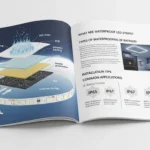
These strips are protected with a silicone coating.
They are used in:
- Outdoor lighting
- Bathrooms
- Swimming pool areas
Addressable LED Strip Lights
In this advanced type, each LED can be controlled individually.
They are used for:
- Digital lighting displays
- Smart lighting systems
- Advertising boards
Main Components of LED Strip Lights
LED strip lights consist of several important components.
1. LED Chips
These are the main light-producing elements.
They convert electrical energy into light.
Common LED chip types include:
- SMD 3528
- SMD 5050
- SMD 2835
2. Flexible Printed Circuit Board (PCB)
The PCB holds the LEDs and electrical connections.
It allows the strip to bend and fit into different shapes.
3. Resistors
Resistors regulate the electrical current flowing through the LEDs.
They protect the LEDs from excessive current.
4. Adhesive Backing
Most LED strips include a self-adhesive layer.
This makes installation easy on surfaces.
5. Power Supply / LED Driver
LED strips require a DC power supply.
The driver converts AC mains power into the correct DC voltage.
6. Controller (Optional)
Controllers allow users to change colors, brightness, and lighting effects.
They are used with RGB or smart LED strips.
Advantages of LED Strip Lights
There are many reasons why LED strip lights are widely used today.
LED Strip Lights Advantages
- Energy efficient and low power consumption
- Long lifespan compared to traditional lighting
- Flexible design for easy installation
- Compact size suitable for narrow spaces
- Produces less heat
- Available in multiple colors and brightness levels
- Suitable for decorative and functional lighting
- Easy to cut and extend
These advantages make LED strips popular among electricians and lighting designers.
Disadvantages / Limitations
Despite their benefits, LED strip lights also have some limitations.
LED Strip Lights Disadvantages
- Initial cost can be higher than traditional lighting
- Require proper power supply and drivers
- Brightness may decrease over long distances
- Heat management may be needed in high-power strips
- Cheap low-quality strips may fail quickly
Understanding these LED strip lights advantages and disadvantages helps technicians choose the right product for each installation.
LED Strip Lights Applications
LED strip lighting has a wide range of uses.
Home Applications
- Under-cabinet kitchen lighting
- Bedroom ceiling decoration
- TV backlighting
- Staircase lighting
Commercial Applications
- Retail store displays
- Hotel interior lighting
- Restaurant decoration
Industrial Applications
- Machine lighting
- Control panel lighting
- Factory inspection areas
Modern Technology Applications
- Automotive interior lighting
- Gaming setups
- Smart home lighting systems
Because of their flexibility and efficiency, LED strip lights applications continue to expand in modern lighting design.
Comparison Section
Difference Between LED Strip Lights and Traditional Tube Lights
| Feature | LED Strip Lights | Traditional Tube Lights |
|---|---|---|
| Power Consumption | Low | Higher |
| Flexibility | Flexible | Rigid |
| Installation | Easy | Requires fixtures |
| Lifespan | Long | Shorter |
| Design Options | Multiple colors | Mostly white light |
| Heat Production | Low | Higher |
This table clearly shows the difference between LED strip lights and traditional lighting technologies.
Selection Guide
Choosing the right LED strip lights is important for proper performance.
Tips for Beginners
1. Choose the correct voltage
Most LED strips operate at:
- 12V
- 24V
2. Select proper brightness
Brightness depends on the LED density.
More LEDs per meter produce brighter light.
3. Check waterproof rating
For outdoor use, select strips with IP65 or higher rating.
4. Consider color options
- Single color for simple lighting
- RGB for decorative lighting
5. Buy quality power supplies
A stable LED driver ensures long life and safe operation.
Common Problems & Solutions
Q1: Why is my LED strip not turning on?
Possible causes:
- Power supply failure
- Loose connection
- Incorrect voltage
Solution: Check wiring and confirm correct power supply.
Q2: Why are some LEDs dim?
Possible reasons:
- Voltage drop
- Damaged LEDs
- Long strip length
Solution: Use power injection or shorter strip segments.
Q3: Why is the LED strip flickering?
Possible causes include:
- Faulty power adapter
- Loose wiring
- Poor quality controller
Solution: Replace the adapter or tighten connections.
Future Trends
The LED lighting industry is evolving rapidly.
Future developments include:
Smart Lighting Systems
LED strips integrated with smart home systems allow remote control through mobile apps.
Energy Efficient Chips
New LED chips provide higher brightness with lower power consumption.
Flexible and Transparent Lighting
Researchers are developing ultra-thin flexible lighting panels for modern architecture.
IoT Integrated Lighting
Internet-connected lighting systems will allow automation, scheduling, and energy monitoring.
These innovations will continue expanding the use of LED lighting in modern infrastructure.
Conclusion
LED strip lights have transformed modern lighting technology. Their flexibility, energy efficiency, and wide range of design possibilities make them one of the most useful lighting solutions today.
Understanding the LED strip lights working principle, types, components, and installation methods is essential for electrical students and technicians. These lighting systems are used in homes, commercial buildings, industries, and modern smart environments.
Although there are some limitations, the LED strip lights advantages and disadvantages clearly show that they offer significant benefits compared with traditional lighting systems.
As technology continues to improve, LED strip lighting will become even more efficient, intelligent, and widely used.
For beginners in the electrical field, learning about LED lighting systems is an important step toward mastering modern electrical installations and lighting design.