
Imagine walking into a modern office, hospital, or classroom where the lighting is bright, uniform, and comfortable for the eyes. The ceiling does not show traditional bulky fixtures or fluorescent tubes. Instead, you see sleek, flat panels that distribute light evenly across the entire room. These modern lighting systems are known as LED Panel Lights.
Over the past decade, lighting technology has rapidly evolved. Traditional lighting systems such as fluorescent tubes and incandescent bulbs are gradually being replaced by LED-based solutions. Among these innovations, LED panel lights have become extremely popular because they provide uniform illumination, energy efficiency, and modern design.
For electrical students, engineers, and technicians, understanding LED panel lights is important because they are widely used in commercial buildings, educational institutions, hospitals, and modern homes. These lighting systems combine electronics, thermal management, and optical design to produce high-quality lighting.
In this article, we will explore the LED Panel Lights working principle, different types, main components, and real-world LED Panel Lights applications. We will also discuss the LED Panel Lights advantages and disadvantages, compare them with other lighting technologies, and provide a practical selection guide for beginners.
By the end of this guide, you will clearly understand how LED panel lights work and why they are one of the most efficient lighting solutions available today.
2. What are LED Panel Lights?
LED Panel Lights are flat lighting fixtures that use multiple LEDs arranged inside a panel to provide bright, uniform, and glare-free illumination.
They are commonly installed in ceilings and are designed to replace traditional fluorescent tube lighting systems.
Simple Definition
An LED panel light is a thin, flat lighting fixture that uses LED technology to produce evenly distributed illumination across a large surface area.
Simple Explanation
Instead of using a single bulb, LED panel lights contain many small LED chips arranged inside a panel. These LEDs emit light that is distributed through a diffuser to create soft and uniform illumination.
Practical Example
LED panel lights are commonly installed in:
- Office ceilings
- Schools and universities
- Hospitals
- Shopping centers
- Conference rooms
For example, most modern offices now use LED panel lights in suspended ceilings to provide bright and comfortable lighting for employees.
3. LED Panel Lights Working Principle
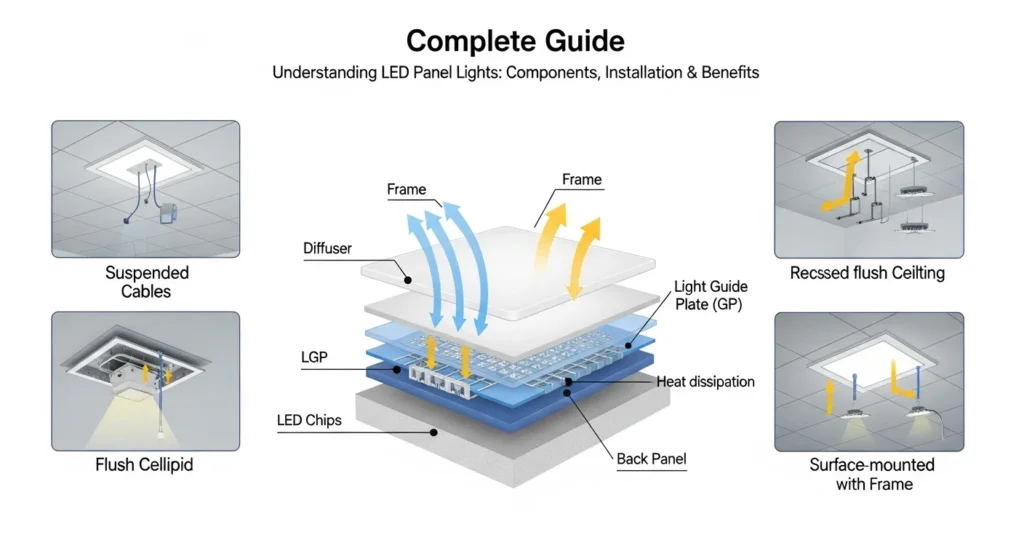
The LED Panel Lights working principle is based on LED semiconductor technology combined with optical diffusion.
Unlike traditional lighting systems that emit light from a single source, LED panel lights distribute light evenly across a wide area.
Step-by-Step Working
- Power Supply Input
The LED panel receives electrical power from the building’s AC electrical supply.
- LED Driver Circuit
An internal LED driver converts AC voltage into regulated DC current suitable for LED operation.
- Current Flow Through LED Chips
When current flows through the LED semiconductor junction, electrons release energy in the form of light.
- Light Guide Plate
The emitted light enters a light guide plate, which spreads the light across the entire panel.
- Diffuser Layer
A diffuser spreads the light evenly and reduces glare.
- Uniform Illumination
The result is smooth, uniform lighting across the panel surface.
Simple Analogy
Think of LED panel lights like a large window that spreads sunlight evenly into a room. Instead of one bright spot, the entire surface produces light.
This design provides comfortable and consistent illumination.
4. Types / Classification of LED Panel Lights
LED panel lights come in several types depending on installation method and lighting requirements.
Edge-Lit LED Panel Lights
In this design, LEDs are placed along the edges of the panel.
Features:
- Very thin design
- Uniform light distribution
- Energy efficient
Edge-lit panels are commonly used in offices.
Back-Lit LED Panel Lights
In back-lit panels, LEDs are placed directly behind the panel surface.
Features:
- Higher brightness
- Better light output
- Slightly thicker design
These panels are often used in large commercial spaces.
Surface-Mounted LED Panel Lights
These panels are mounted directly onto the ceiling surface.
Features:
- Easy installation
- Suitable for solid ceilings
- Common in homes
Recessed LED Panel Lights
These lights are installed inside suspended ceilings.
Features:
- Clean and modern appearance
- Hidden installation
- Popular in offices and commercial buildings
Smart LED Panel Lights
These advanced panels include smart features.
Features:
- Adjustable brightness
- Color temperature control
- Remote operation
Smart lighting systems are increasingly used in modern buildings.
5. Main Components
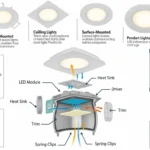
LED panel lights contain several important components that work together to produce efficient lighting.
LED Chips
LED chips are the primary light source.
They convert electrical energy directly into light with high efficiency.
LED Driver
The LED driver converts AC power into regulated DC current for the LEDs.
It ensures stable operation and protects the LEDs.
Light Guide Plate (LGP)
This transparent plate spreads light evenly across the panel.
It is responsible for the uniform illumination of LED panel lights.
Diffuser Sheet
The diffuser softens the light and reduces glare.
This improves visual comfort.
Reflector Layer
The reflector helps direct light toward the diffuser instead of allowing it to escape from the back.
Aluminum Frame
The frame provides structural support and helps dissipate heat.
6. Advantages
Understanding the LED Panel Lights advantages and disadvantages helps engineers evaluate their performance.
Advantages
- Very high energy efficiency
- Uniform and glare-free lighting
- Long lifespan (up to 50,000 hours)
- Slim and modern design
- Low maintenance requirements
- Environmentally friendly
- Reduced electricity costs
- Instant start without flickering
These benefits make LED panel lights ideal for modern lighting systems.
7. Disadvantages / Limitations
Despite their advantages, LED panel lights have some limitations.
- Higher initial purchase cost
- Poor-quality drivers may fail early
- Repairing internal components can be difficult
- Some panels require professional installation
However, their long service life usually compensates for the higher initial cost.
8. Applications
The LED Panel Lights applications are widespread across many sectors.
Residential Applications
- Living rooms
- Kitchens
- Home offices
- Hallways
Commercial Applications
- Office buildings
- Conference rooms
- Retail stores
- Shopping malls
Educational Institutions
- Schools
- Universities
- Training centers
LED panel lights provide comfortable lighting for reading and studying.
Healthcare Facilities
- Hospitals
- Clinics
- Laboratories
Uniform lighting is essential in medical environments.
Industrial Applications
- Factories
- Warehouses
- Production areas
LED panels help reduce energy consumption in large facilities.
9. Comparison Section
Understanding the difference between LED panel lights and fluorescent lights helps technicians select the right lighting technology.
| Feature | LED Panel Lights | Fluorescent Lights |
|---|---|---|
| Energy Efficiency | Very high | Moderate |
| Lifespan | Up to 50,000 hours | 10,000–15,000 hours |
| Heat Production | Low | Higher |
| Startup Time | Instant | Slight delay |
| Maintenance | Minimal | Frequent replacement |
LED panel lights clearly provide superior performance and efficiency.
10. Selection Guide
Choosing the right LED panel light requires evaluating several important factors.
Brightness (Lumens)
Higher lumens mean brighter light.
Choose brightness according to room size.
Color Temperature
Common color temperatures include:
- Warm white (3000K)
- Neutral white (4000K)
- Cool white (6000K)
Each creates a different lighting atmosphere.
Panel Size
Standard panel sizes include:
- 600 × 600 mm
- 300 × 600 mm
- 300 × 300 mm
Select the size that fits the ceiling grid.
Energy Efficiency
Choose panels with high efficiency to reduce electricity consumption.
Quality of Driver
A high-quality driver increases reliability and lifespan.
11. Common Problems & Solutions
Even advanced lighting systems may experience technical issues.
Panel Light Not Turning On
Possible causes:
- Faulty LED driver
- Loose wiring
- Power supply problem
Solution:
Check connections and replace the driver if necessary.
Flickering Light
Possible causes:
- Poor driver quality
- Voltage fluctuations
Solution:
Install a stable driver or voltage stabilizer.
Uneven Lighting
Possible causes:
- Damaged diffuser
- Faulty LED chips
Solution:
Replace the LED module or panel.
Overheating
Possible causes:
- Poor heat dissipation
- Improper installation
Solution:
Ensure proper airflow around the panel.
12. Future Trends
LED panel lighting technology continues to evolve rapidly.
Smart Lighting Integration
Future LED panels will connect to building automation systems.
Users will control brightness and color using mobile applications.
Human-Centric Lighting
Lighting systems will automatically adjust color temperature to support human circadian rhythms.
Energy Monitoring Systems
Advanced panels may include sensors that monitor energy consumption.
IoT-Based Lighting
Internet-connected lighting systems will allow remote management and automation.
These innovations will make lighting systems more intelligent and energy-efficient.
13. Conclusion
LED panel lights have transformed modern lighting systems by providing efficient, uniform, and visually comfortable illumination. Their slim design, long lifespan, and low energy consumption make them an ideal replacement for traditional fluorescent lighting.
In this article, we explored the LED Panel Lights working principle, different types, and major LED Panel Lights applications. We also examined the LED Panel Lights advantages and disadvantages and explained the difference between LED panel lights and fluorescent lights.
For electrical students, technicians, and engineers, understanding LED panel lighting technology is essential because it is widely used in modern buildings and energy-efficient lighting systems.
As technology continues to improve, LED panel lights will become even smarter and more efficient, playing a key role in the future of sustainable lighting and intelligent building systems.