
Imagine walking through your house late at night. The main lights are turned off, and the room is dark. Instead of switching on bright ceiling lights, a small soft light near the wall gently illuminates the pathway. This small but helpful device is known as an LED Night Light.
LED night lights are widely used in homes, hospitals, hotels, and many other places. They provide a soft glow that improves safety and comfort without disturbing sleep. For children, elderly people, and people waking up during the night, these lights make navigation easier and safer.
From an electrical engineering perspective, LED night lights are a perfect example of modern lighting technology. They combine energy efficiency, simple circuit design, and long life. Unlike traditional bulbs, LED-based night lights consume very little electricity while producing sufficient illumination.
In this article, we will explore the LED Night Lights working principle, types, components, and practical LED Night Lights applications. You will also learn the LED Night Lights advantages and disadvantages, how to choose the right one, common problems, and future lighting trends.
By the end of this guide, electrical students, technicians, and beginners will clearly understand how LED night lights work and why they are widely used today.
2. What is an LED Night Light?
An LED Night Light is a small lighting device that uses Light Emitting Diodes (LEDs) to produce a soft and low-intensity light during nighttime.
Its main purpose is to provide gentle illumination in dark environments without producing the brightness of standard room lighting.
Simple Definition
An LED night light is a low-power lighting device designed to provide soft illumination at night for safety, comfort, and convenience.
Simple Explanation
LED night lights are usually plugged into a wall outlet or powered by batteries. They produce a dim light that helps people see their surroundings without disturbing sleep.
Because LEDs consume very little electricity, these lights can operate continuously for long periods.
Practical Example
Common places where LED night lights are used include:
- Bedrooms
- Hallways
- Children’s rooms
- Staircases
- Bathrooms
For example, many parents place LED night lights in children’s rooms to prevent complete darkness at night.
3. LED Night Lights Working Principle
The LED Night Lights working principle is based on the ability of LEDs to convert electrical energy into light energy efficiently.
Unlike traditional bulbs that heat a filament, LEDs produce light through a process called electroluminescence.
Step-by-Step Working
- Power Supply Connection
The LED night light receives electrical power from a wall outlet or battery. - Voltage Regulation Circuit
A small internal circuit controls and reduces the voltage suitable for the LED. - Current Flow Through LED
When current flows through the LED semiconductor material, electrons move and release energy. - Light Production
This released energy appears as visible light. - Soft Illumination
Diffusers or plastic covers spread the light evenly to create a soft glow.
Easy Analogy
Think of the LED like a tiny energy converter. Instead of wasting energy as heat like traditional bulbs, it converts most of the electrical energy directly into light.
This is why LED night lights are very efficient and long-lasting.
4. Types / Classification of LED Night Lights
LED night lights come in several designs depending on their application and features.
Plug-In LED Night Lights
These lights are directly plugged into electrical outlets.
Features:
- Easy installation
- Continuous power supply
- Common in bedrooms and hallways
They are the most widely used type of LED night lights.
Battery-Powered LED Night Lights
These lights operate using batteries.
Features:
- Portable
- Useful during power outages
- Ideal for camping or travel
They provide flexibility because they do not require a power outlet.
Motion Sensor LED Night Lights
These lights turn on automatically when movement is detected.
Features:
- Energy saving
- Automatic operation
- Ideal for hallways and staircases
They are widely used for safety and convenience.
Smart LED Night Lights
Smart night lights connect to home automation systems.
Features:
- App control
- Adjustable brightness
- Voice assistant compatibility
These lights are becoming popular in modern smart homes.
Dusk-to-Dawn LED Night Lights
These lights use a light sensor to turn on automatically when it becomes dark.
Features:
- Automatic lighting
- Energy efficient
- Ideal for night-time safety
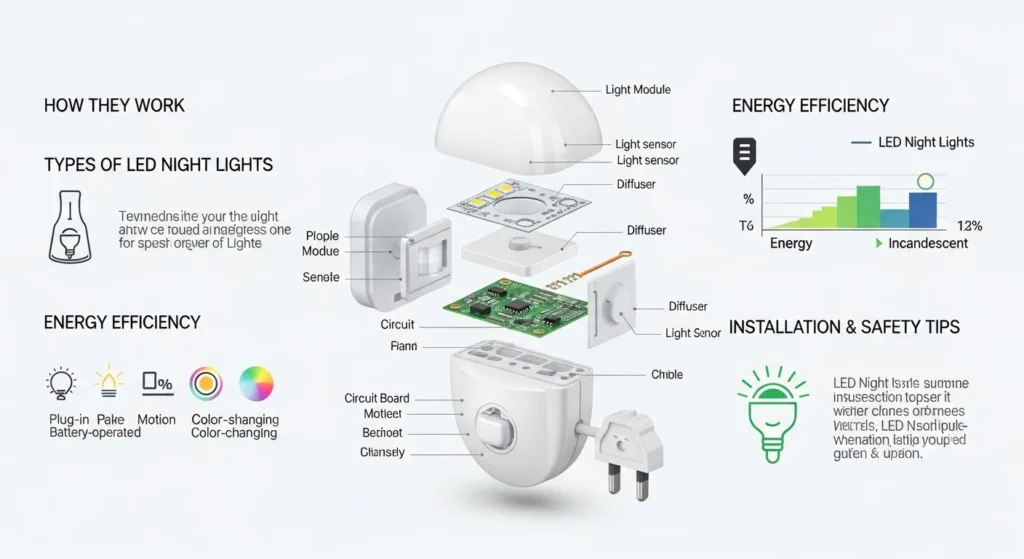
5. Main Components
LED night lights contain several simple electrical components that work together to produce light.
LED (Light Emitting Diode)
This is the main component that produces light.
LEDs are known for:
- High efficiency
- Long lifespan
- Low power consumption
Power Supply Circuit
This circuit converts AC power from the outlet into a lower DC voltage suitable for LEDs.
Resistor or Current Limiter
Resistors control the amount of current flowing to the LED to prevent damage.
Light Sensor (Optional)
Some LED night lights contain a photoresistor or light sensor.
This sensor detects darkness and turns the light on automatically.
Diffuser Cover
The plastic cover spreads the light evenly and prevents glare.
This helps create a soft and comfortable glow.
6. Advantages
Understanding LED Night Lights advantages and disadvantages helps engineers and consumers make informed decisions.
Advantages
- Very low energy consumption
- Long operational life
- Safe and cool operation
- Compact size and lightweight design
- Provides gentle illumination for nighttime safety
- Available with smart and automatic features
- Environmentally friendly compared to traditional bulbs
Because of these benefits, LED night lights have largely replaced older night lighting technologies.
7. Disadvantages / Limitations
Despite many advantages, LED night lights also have some limitations.
- Initial cost may be higher than traditional bulbs
- Cheap models may have poor light quality
- Limited brightness compared to main lighting fixtures
- Some sensors may malfunction over time
However, most of these issues can be avoided by choosing quality products.
8. Applications
The LED Night Lights applications extend beyond simple home lighting.
Home Applications
- Bedroom night lighting
- Children’s rooms
- Hallways and staircases
- Bathrooms
- Kitchens
Safety Applications
- Emergency navigation lighting
- Elderly care facilities
- Hospitals and nursing homes
Soft lighting helps prevent accidents during nighttime movement.
Commercial Applications
- Hotels
- Apartment buildings
- Office corridors
- Public restrooms
Modern Technology Applications
- Smart home lighting systems
- Motion-activated security lighting
- Energy-efficient lighting systems
These uses highlight the growing importance of LED night lighting technology.
9. Comparison Section
Understanding the difference between LED night lights and traditional night lights helps explain why LED technology is preferred.
| Feature | LED Night Lights | Traditional Bulb Night Lights |
|---|---|---|
| Power Consumption | Very low | Higher |
| Lifespan | Up to 50,000 hours | Much shorter |
| Heat Production | Very low | High |
| Efficiency | Highly efficient | Less efficient |
| Maintenance | Minimal | Frequent replacement |
LED night lights clearly offer superior performance and energy efficiency.
10. Selection Guide
Choosing the right LED night light requires considering several important factors.
Brightness Level
Select a light that provides enough illumination without being too bright.
Night lights should produce soft lighting.
Energy Efficiency
Look for LED lights with low power consumption.
This helps reduce electricity costs.
Sensor Features
Some models include useful sensors such as:
- Motion sensors
- Light sensors
- Timer controls
These features improve convenience.
Safety Certification
Always choose products that meet electrical safety standards.
This ensures safe operation.
Build Quality
Durable materials and good circuit design increase reliability and lifespan.
11. Common Problems & Solutions
Even simple lighting devices can experience issues.
LED Night Light Not Turning On
Possible causes:
- Loose plug connection
- Damaged LED
- Faulty power supply
Solution:
Check the outlet and replace the unit if necessary.
Flickering Light
Possible causes:
- Voltage fluctuations
- Poor internal circuitry
Solution:
Replace low-quality products with reliable models.
Motion Sensor Not Working
Possible causes:
- Sensor obstruction
- Sensor damage
Solution:
Clean the sensor area and test again.
Light Too Dim
Possible causes:
- Aging LED
- Low battery power
Solution:
Replace batteries or the night light unit.
12. Future Trends
Lighting technology is evolving rapidly, and LED night lights will continue to improve.
Smart Home Integration
Future night lights will connect with smart home systems for automatic lighting control.
Energy Monitoring
Advanced night lights may track power usage and optimize energy efficiency.
Adaptive Lighting
Future models may automatically adjust brightness based on time and room conditions.
IoT Integration
Internet-connected lighting devices will allow remote monitoring and control.
These innovations will make lighting systems more efficient and intelligent.
13. Conclusion
LED night lights have become an essential part of modern lighting systems. They provide a simple and energy-efficient way to illuminate spaces during nighttime without the brightness of main lighting fixtures.
In this article, we explored the LED Night Lights working principle, their types, components, and practical LED Night Lights applications. We also examined the LED Night Lights advantages and disadvantages and explained the difference between LED night lights and traditional night lights.
For electrical students and technicians, understanding these devices provides valuable insight into modern lighting technology. LED night lights demonstrate how efficient electronics can improve everyday life through safety, energy savings, and convenience.
As lighting technology continues to evolve, LED night lights will become even smarter and more efficient, playing an important role in future smart homes and automated lighting systems.