
Imagine walking into a modern office or classroom where the lighting is bright, comfortable, and evenly distributed across the entire room. There are no flickering lights, no loud buzzing sounds, and the electricity bill remains lower than expected. In many modern buildings, this efficient lighting is produced using T5 LED tube lights.
Lighting plays a very important role in homes, offices, factories, schools, and commercial buildings. Traditional fluorescent tube lights were once the most common lighting solution. However, due to their higher energy consumption and shorter lifespan, many organizations are now replacing them with LED-based lighting systems.
One of the most efficient and compact lighting options available today is the T5 LED tube light. It provides bright illumination while consuming less electrical power. Because of its slim design and high efficiency, it is widely used in offices, retail stores, kitchens, workshops, and industrial environments.
For electrical students, engineers, and technicians, understanding the T5 LED tube light working principle, components, and installation is very important. In this article, you will learn what T5 LED tube lights are, how they work, their types, T5 LED tube light applications, advantages, limitations, and how to select the right one for electrical installations.
What is a T5 LED Tube Light?
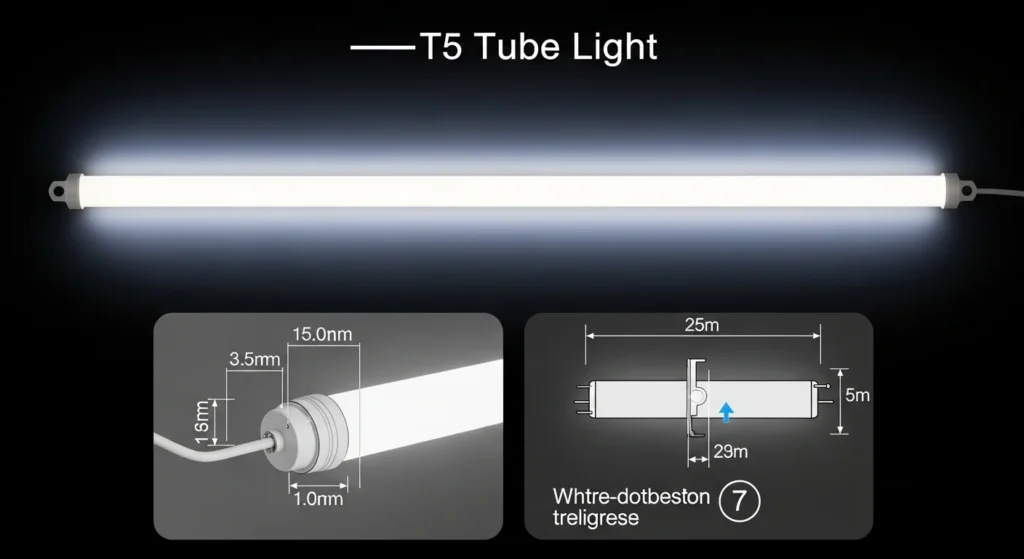
A T5 LED tube light is a slim LED-based lighting fixture designed to replace traditional T5 fluorescent tube lights. It uses light-emitting diodes (LEDs) instead of fluorescent gas technology to produce light.
The term T5 refers to the tube diameter. The letter T means tubular, and the number 5 indicates that the tube has a diameter of 5/8 inch.
In simple terms, a T5 LED tube light is a thin, energy-efficient lighting tube that provides bright illumination using LED technology.
Practical Example
Consider a small office workspace. Instead of installing large fluorescent fixtures, a technician may install several T5 LED tube lights along the ceiling. These lights provide uniform brightness while using less electricity and producing less heat.
Because of their slim design and efficiency, they are ideal for locations where space-saving and energy efficiency are important.
T5 LED Tube Light Working Principle
Understanding the T5 LED tube light working principle helps electrical students understand how modern LED lighting systems operate.
Unlike fluorescent tubes that use gas and mercury vapor, LED tubes produce light using semiconductor technology.
Step-by-Step Working Process
- Power Input
The T5 LED tube receives electrical power from the AC mains supply.
- Driver Circuit Operation
Inside the tube, an electronic LED driver converts AC voltage into regulated DC power.
- Current Regulation
The driver controls the current to protect LEDs from excessive electrical flow.
- LED Light Emission
When current flows through the LED chips, electrons release energy in the form of light.
- Light Distribution
A diffuser cover spreads the light evenly across the room.
Easy Analogy
Think of LED chips as tiny electronic lamps connected in a row inside the tube. When electricity flows through them, each lamp lights up to produce bright illumination.
Important Characteristics
- No mercury or gas is used
- Minimal heat generation
- High electrical efficiency
This is why LED tube lights are replacing older lighting technologies.
Types / Classification of T5 LED Tube Lights
T5 LED tube lights are available in several different types depending on their design and application.
Integrated T5 LED Tube Light
Integrated tubes include the LED driver and fixture in a single unit.
Features:
- Easy installation
- Lightweight design
- Direct connection to power supply
These are commonly used in homes and offices.
Retrofit T5 LED Tube Light
Retrofit tubes are designed to replace traditional fluorescent tubes in existing fixtures.
Features:
- Compatible with old lighting fixtures
- Easy upgrade from fluorescent to LED
- Energy-saving replacement
Linkable T5 LED Tube Light
Linkable tubes allow multiple tubes to be connected together in series.
Applications include:
- Long display shelves
- Workshop lighting
- Retail lighting systems
High Output T5 LED Tube Light
These tubes provide higher brightness and are used in large commercial spaces or industrial areas where strong lighting is required.
Main Components
Understanding the components of a T5 LED tube light helps technicians diagnose faults and perform maintenance.
1. LED Chips
LED chips are the main light-producing elements.
They convert electrical energy into visible light.
2. LED Driver
The LED driver converts AC voltage into regulated DC current suitable for LEDs.
It also protects the LEDs from voltage fluctuations.
3. Printed Circuit Board (PCB)
The PCB holds the LED chips and electrical connections.
It ensures stable current distribution.
4. Aluminum Heat Sink
LEDs generate a small amount of heat. The aluminum body helps dissipate this heat and protects the LEDs.
5. Diffuser Cover
The diffuser spreads light evenly and reduces glare.
It improves visual comfort in indoor environments.
6. End Caps and Connectors
These components allow the tube to connect with the power supply or fixture.
Advantages
Understanding T5 LED tube light advantages and disadvantages helps electrical professionals select suitable lighting systems.
Advantages of T5 LED Tube Light
- High energy efficiency
- Lower electricity consumption
- Longer lifespan than fluorescent tubes
- Instant start without flickering
- No mercury or hazardous gas
- Low heat production
- Slim and compact design
- Reduced maintenance cost
These benefits make T5 LED tubes ideal for modern lighting systems.
Disadvantages / Limitations
Despite their many benefits, T5 LED tube lights also have some limitations.
Disadvantages
- Higher initial cost compared to fluorescent tubes
- Low-quality products may have shorter lifespan
- Some models require compatible fixtures
- Cheap drivers may fail early
Understanding these T5 LED tube light advantages and disadvantages helps technicians choose high-quality lighting equipment.
T5 LED Tube Light Applications
T5 LED tube lights are widely used in many environments.
Home Applications
- Kitchen cabinet lighting
- Study rooms
- Closet lighting
- Ceiling lighting in small rooms
Commercial Applications
- Office lighting
- Retail stores
- Supermarkets
- Hotel corridors
Industrial Applications
- Workshop lighting
- Factory assembly lines
- Equipment rooms
Modern Technology Applications
- Server rooms
- Laboratory lighting
- Display shelves in retail stores
These T5 LED tube light applications show how versatile this lighting technology has become.
Comparison Section
Difference Between T5 LED Tube Light and T8 LED Tube Light
| Feature | T5 LED Tube Light | T8 LED Tube Light |
|---|---|---|
| Tube Diameter | 5/8 inch | 1 inch |
| Size | Slim | Larger |
| Energy Efficiency | Higher | Moderate |
| Brightness | High | High |
| Installation Space | Small spaces | Larger fixtures |
| Common Use | Cabinets, offices | Industrial lighting |
This table clearly explains the difference between T5 LED tube light and T8 LED tube light.
Selection Guide
Choosing the correct T5 LED tube light is important for effective lighting.
Tips for Beginners
1. Check the power rating
Typical ratings include:
- 8W
- 14W
- 18W
Higher wattage provides more brightness.
2. Select the correct color temperature
Common options include:
- Warm white (3000K)
- Neutral white (4000K)
- Cool white (6500K)
3. Check the lumen output
Higher lumen values provide brighter lighting.
4. Consider installation type
Choose between:
- Integrated fixtures
- Retrofit tubes
5. Buy reliable brands
High-quality LED drivers increase lifespan and reliability.
Common Problems & Solutions
Q1: Why is my T5 LED tube light not turning on?
Possible causes:
- Power supply failure
- Loose wiring
- Faulty driver
Solution: Check wiring and replace the driver if necessary.
Q2: Why is the light flickering?
Possible reasons:
- Voltage fluctuation
- Defective LED driver
- Poor electrical connections
Solution: Tighten connections or replace the driver.
Q3: Why is the brightness decreasing?
Possible causes:
- Aging LEDs
- Poor heat dissipation
- Low-quality power supply
Solution: Replace the tube with a higher quality product.
Future Trends
Lighting technology continues to evolve rapidly.
Smart LED Tube Lighting
Future T5 LED tubes may include smart features such as mobile control and automation.
Higher Efficiency LED Chips
Manufacturers are developing LEDs that produce more light while consuming less electricity.
Integrated Sensors
Motion sensors and daylight sensors may be built directly into lighting fixtures.
Smart Building Integration
Future lighting systems will integrate with building automation and energy management systems.
These trends will improve lighting efficiency and user convenience.
Conclusion
The T5 LED tube light is one of the most efficient and practical lighting solutions available today. Its slim design, high brightness, and low energy consumption make it suitable for many residential, commercial, and industrial environments.
Understanding the T5 LED tube light working principle, types, components, and installation requirements is essential for electrical students and technicians. These lights provide significant advantages over traditional fluorescent tubes, including longer lifespan, lower energy consumption, and improved reliability.
Although there are some limitations, the T5 LED tube light advantages and disadvantages clearly show that LED technology is the future of lighting.
As lighting technology continues to improve, T5 LED tubes will become even more efficient, intelligent, and widely used in modern electrical installations.