
Imagine entering a modern office, classroom, or living room where the ceiling lights instantly brighten the entire space with clean, uniform illumination. Unlike older bulbs that consume more electricity and produce excess heat, these lights are efficient, long-lasting, and environmentally friendly. Most of these modern lighting systems are LED Ceiling Lights.
In the past, buildings commonly used incandescent or fluorescent lighting fixtures. These systems required more power, generated heat, and needed frequent replacement. With advancements in lighting technology, LED ceiling lights have become the preferred choice for homes, commercial buildings, and industrial facilities.
For electrical students, technicians, and engineers, understanding LED ceiling lights is important because they represent the modern direction of lighting design. These lights combine electronics, energy efficiency, and smart technology in a single system.
In this article, we will explore the LED Ceiling Lights working principle, their types, components, and real-world LED Ceiling Lights applications. You will also learn the LED Ceiling Lights advantages and disadvantages, how to select the right lighting system, and the difference between LED ceiling lights and traditional ceiling lights.
By the end of this guide, you will clearly understand how LED ceiling lights operate and why they are widely used in modern electrical installations.
2. What are LED Ceiling Lights?
LED Ceiling Lights are lighting fixtures installed on ceilings that use Light Emitting Diodes (LEDs) as the primary light source.
These lights are designed to provide bright, uniform illumination while consuming significantly less electricity than traditional lighting technologies.
Simple Definition
An LED ceiling light is a ceiling-mounted lighting fixture that uses LED technology to produce efficient and long-lasting illumination.
Simple Explanation
Unlike traditional bulbs that rely on heated filaments or gas discharge, LED ceiling lights use semiconductor devices that convert electrical energy directly into light.
Because LEDs are highly efficient, these lights produce more brightness with less power consumption.
Practical Example
LED ceiling lights are commonly installed in:
- Living rooms
- Offices
- Schools
- Shopping malls
- Hospitals
For example, modern homes often use LED panel ceiling lights that distribute light evenly across the entire room.
3. LED Ceiling Lights Working Principle
The LED Ceiling Lights working principle is based on electroluminescence, where electrical energy is converted directly into light.
Step-by-Step Working
- Electrical Power Supply
The ceiling light receives power from the building’s electrical system, usually AC mains power.
- Driver Circuit Operation
Inside the light fixture, an LED driver converts AC voltage into low-voltage DC current suitable for LEDs.
- Current Flow Through LED Chips
When current flows through the LED semiconductor, electrons recombine with holes and release energy.
- Light Generation
This released energy appears as visible light.
- Light Distribution
Diffusers and reflectors inside the fixture spread the light evenly across the room.
Simple Analogy
Think of an LED as a tiny light-producing engine. Instead of wasting energy as heat like traditional bulbs, it efficiently converts electricity into light.
This is why LED ceiling lights are extremely energy-efficient.
4. Types / Classification of LED Ceiling Lights
LED ceiling lights come in different designs depending on installation requirements and lighting needs.
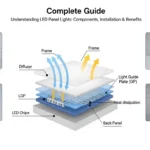
LED Panel Ceiling Lights
These are flat lighting panels installed in ceilings.
Features:
- Uniform light distribution
- Modern appearance
- Common in offices and commercial buildings
They are widely used in suspended ceilings.
LED Flush Mount Ceiling Lights
These lights are mounted directly against the ceiling surface.
Features:
- Compact design
- Ideal for rooms with low ceilings
- Popular in residential homes
LED Recessed Ceiling Lights
These lights are installed inside the ceiling cavity.
Features:
- Minimal visible fixture
- Clean and modern appearance
- Often used in luxury interiors
LED Surface Mount Ceiling Lights
These fixtures are mounted directly onto the ceiling surface.
Features:
- Easy installation
- Suitable for concrete ceilings
- Used in homes and commercial spaces
Smart LED Ceiling Lights
These lights integrate with smart home systems.
Features:
- Remote control
- Adjustable brightness
- Color-changing capability
They are increasingly used in modern automated homes.
5. Main Components
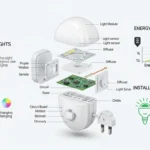
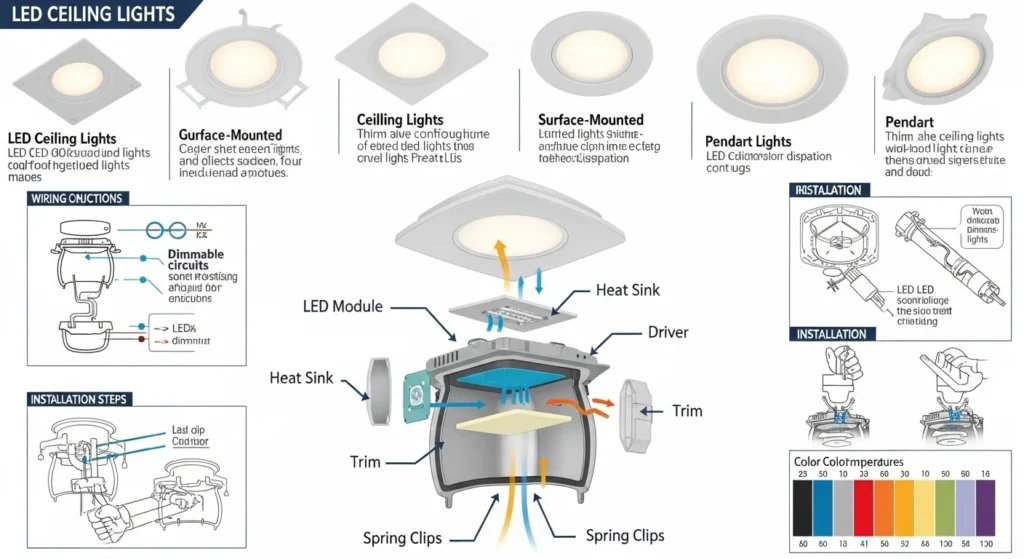
LED ceiling lights consist of several electrical and mechanical components.
LED Chips
These semiconductor devices generate light when current flows through them.
LED chips are the main source of illumination.
LED Driver
The driver converts AC voltage into regulated DC current required by the LEDs.
It ensures stable and safe operation.
Heat Sink
LEDs generate small amounts of heat.
Heat sinks help dissipate this heat and maintain safe operating temperatures.
Diffuser
The diffuser spreads the light evenly and reduces glare.
It also improves visual comfort.
Housing or Frame
This outer structure supports and protects the internal components.
It also helps with heat management.
6. Advantages
Understanding the LED Ceiling Lights advantages and disadvantages helps in choosing the right lighting system.
Advantages
- Very high energy efficiency
- Long lifespan (often more than 50,000 hours)
- Low heat production
- Uniform light distribution
- Reduced electricity costs
- Environmentally friendly
- Available in many modern designs
- Compatible with smart home systems
These advantages make LED ceiling lights ideal for modern buildings.
7. Disadvantages / Limitations
Although LED ceiling lights are highly beneficial, they also have some limitations.
- Higher initial cost compared to traditional lights
- Poor-quality drivers may fail early
- Installation may require professional assistance
- Some models are difficult to repair
Despite these limitations, their long-term benefits usually outweigh the drawbacks.
8. Applications
The LED Ceiling Lights applications cover many areas of modern life.
Residential Applications
- Living rooms
- Bedrooms
- Kitchens
- Hallways
- Bathrooms
Commercial Applications
- Offices
- Shopping malls
- Restaurants
- Hotels
- Conference rooms
Industrial Applications
- Factories
- Warehouses
- Workshops
- Production areas
Public Infrastructure
- Schools
- Hospitals
- Airports
- Libraries
LED ceiling lighting improves visibility while reducing energy consumption in these environments.
9. Comparison Section
Understanding the difference between LED ceiling lights and fluorescent ceiling lights helps engineers choose the best option.
| Feature | LED Ceiling Lights | Fluorescent Lights |
|---|---|---|
| Energy Efficiency | Very high | Moderate |
| Lifespan | 50,000 hours or more | 10,000–15,000 hours |
| Heat Production | Very low | Higher |
| Startup Time | Instant | Slight delay |
| Maintenance | Minimal | Frequent replacement |
This comparison clearly shows why LED lighting is replacing older technologies.
10. Selection Guide
Selecting the right LED ceiling light requires careful consideration.
Check Brightness (Lumens)
Higher lumens provide brighter lighting.
For example:
- Bedroom: moderate brightness
- Office: higher brightness
Color Temperature
Different lighting colors affect room atmosphere.
Common options:
- Warm white (comfortable)
- Neutral white (balanced)
- Cool white (bright)
Energy Rating
Choose lights with high efficiency to reduce electricity costs.
Build Quality
Reliable heat sinks and good driver circuits increase lifespan.
Installation Type
Ensure the light fixture matches your ceiling type.
Options include:
- Recessed
- Surface mount
- Panel installation
11. Common Problems & Solutions
Even advanced lighting systems can experience issues.
LED Ceiling Light Not Turning On
Possible causes:
- Faulty driver
- Loose wiring
- Power supply issue
Solution:
Check electrical connections and replace the driver if needed.
Flickering Light
Possible causes:
- Poor driver quality
- Voltage fluctuations
Solution:
Replace the driver or install a voltage stabilizer.
Uneven Brightness
Possible causes:
- Damaged LED chips
- Overheating
Solution:
Replace the LED module or fixture.
Overheating
Possible causes:
- Poor heat dissipation
- Blocked ventilation
Solution:
Ensure proper airflow around the fixture.
12. Future Trends
Lighting technology continues to evolve rapidly.
Smart Lighting Systems
Future LED ceiling lights will integrate fully with smart home ecosystems.
Users will control brightness, color, and schedules through apps.
Human-Centric Lighting
Lighting systems will adjust color temperature based on time of day to support human health and productivity.
Energy Monitoring
Future lighting systems may include built-in power monitoring.
This will help optimize energy usage.
IoT Integration
Internet-connected lighting systems will enable remote control, automation, and intelligent lighting management.
These developments will make lighting more efficient and adaptable.
13. Conclusion
LED ceiling lights represent one of the most important advancements in modern lighting technology. They combine energy efficiency, long lifespan, and superior lighting quality in a single solution.
In this article, we explored the LED Ceiling Lights working principle, their types, components, and practical LED Ceiling Lights applications. We also discussed the LED Ceiling Lights advantages and disadvantages and explained the difference between LED ceiling lights and fluorescent lights.
For electrical students and technicians, understanding LED ceiling lighting provides valuable knowledge about modern electrical installations. As buildings continue to adopt energy-efficient technologies, LED ceiling lights will remain a key component in both residential and commercial lighting systems.
By learning the fundamentals of LED lighting today, engineers and technicians can prepare for the future of smart, efficient, and sustainable lighting systems.