
Imagine walking into your living room in the evening and adjusting the lighting to a soft, relaxing glow without changing the bulbs. This is the convenience provided by a dimmer switch, a device that has transformed the way we control electrical lighting. For electrical students, engineers, and technicians, understanding dimmer switches is not just theoretical—it’s highly practical. Knowing how to install, troubleshoot, and select the right dimmer switch is essential for modern residential, commercial, and industrial applications.
This article will guide you through the definition, working principle, types, main components, advantages and disadvantages, applications, selection tips, troubleshooting, and future trends of dimmer switches. By the end, you will have a complete understanding of how dimmer switches operate and how to use them effectively in electrical systems.
What is a Dimmer Switch?
A dimmer switch is an electrical device that allows users to adjust the brightness of a light fixture rather than just turning it on or off. In simple terms, it controls the amount of electrical power delivered to the light bulb.
For example, instead of a room being fully bright or completely dark, a dimmer switch allows for gradual light adjustment, creating comfortable lighting conditions for reading, watching TV, or relaxing. Modern dimmers can work with LED, incandescent, and fluorescent lamps, making them versatile for different electrical installations.
Dimmer Switch Working Principle
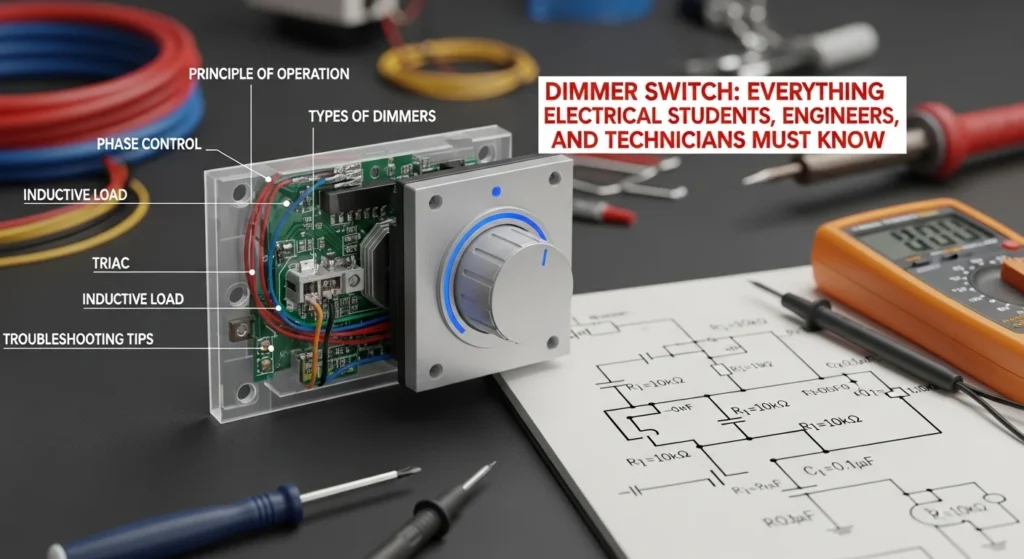
The dimmer switch working principle is based on regulating voltage and current in the lighting circuit. This can be achieved using various methods, including resistive, electronic, and triac-based controls.
Step-by-Step Explanation
- Power Control – The dimmer is connected in series with the light fixture.
- Voltage Adjustment – By adjusting the control knob or slider, the dimmer reduces or increases the voltage delivered to the light.
- Brightness Change – Reduced voltage means dimmer light; increased voltage means brighter light.
- Triac Firing (for modern dimmers) – Electronic dimmers often use a triac to rapidly switch the circuit on and off, controlling the effective power delivered.
Analogy: Think of the dimmer as a faucet. Just like a faucet controls the water flow to the sink, a dimmer controls the flow of electricity to the bulb.
Key Points:
- Reduces energy usage at lower brightness levels.
- Can extend the lifespan of the bulb.
- Provides adjustable ambient lighting.
Types / Classification of Dimmer Switches
Rotary Dimmers
Rotary dimmers feature a knob that rotates to adjust brightness. Turning clockwise increases brightness, while counterclockwise decreases it. They are simple, reliable, and widely used in residential installations.
Slide Dimmers
Slide dimmers use a sliding lever to control lighting. They are more precise than rotary types and allow for smooth adjustment, often found in modern home designs.
Push-Button Dimmers
Push-button dimmers operate with a single or dual push mechanism, often combined with memory settings to return to previous brightness levels. They are common in smart home installations.
Digital / Smart Dimmers
These are electronically controlled dimmers, compatible with LED and smart lighting systems. They can be operated via smartphone apps, remote controls, or home automation systems.
Triac-Based Dimmers
Triac dimmers are widely used for AC lighting. They switch the current on and off rapidly to reduce the effective voltage delivered to the bulb, making them energy-efficient and reliable.
Main Components of a Dimmer Switch
- Control Knob / Slider – Adjusts the brightness level manually.
- Triac / SCR (Silicon Controlled Rectifier) – Regulates the flow of AC current in modern dimmers.
- Variable Resistor / Potentiometer – Found in older dimmers, it adjusts voltage manually.
- Electronic Circuit Board – Used in smart dimmers to process signals and control power.
- Heat Sink – Dissipates heat generated by electronic components.
- Wiring Terminals – Connect the dimmer to the lighting circuit.
Advantages of Dimmer Switches
- Energy Efficiency: Reduces electricity consumption at lower brightness.
- Extended Bulb Life: Lowers stress on bulbs, increasing lifespan.
- Comfort & Ambiance: Allows customized lighting for different moods.
- Reduced Glare: Prevents harsh lighting, especially in living rooms or offices.
- Cost Savings: Energy savings reduce electricity bills.
Disadvantages / Limitations
- Compatibility Issues: Not all dimmers work with all bulb types, especially LEDs and CFLs.
- Heat Generation: Older resistive dimmers produce heat, requiring ventilation.
- Installation Complexity: Requires careful wiring; incorrect installation can damage bulbs.
- Initial Cost: Smart dimmers and advanced electronic types are more expensive.
Dimmer Switch Applications
Home Use
- Living rooms, bedrooms, dining areas for adjustable ambient lighting.
- Mood lighting for entertainment areas.
Industrial Applications
- Factories and workshops to adjust lighting intensity and save energy.
- Conference halls and auditoriums for stage lighting control.
Modern Technology
- Smart homes with app-controlled lighting systems.
- Integration with home automation for energy monitoring.
Comparison: Dimmer Switch vs Regular Switch
| Feature | Dimmer Switch | Regular Switch |
|---|---|---|
| Function | Adjustable brightness | On/Off only |
| Energy Savings | Yes | No |
| Bulb Compatibility | Needs compatible bulbs | Works with all bulbs |
| Cost | Higher | Lower |
| Applications | Residential & Industrial | Basic lighting control |
Difference between dimmer switch and regular switch lies primarily in control flexibility, energy efficiency, and application versatility.
Selection Guide: How to Choose the Right Dimmer
- Check Bulb Type Compatibility – LED, CFL, or incandescent.
- Load Rating – Ensure the dimmer can handle total wattage.
- Type of Control – Rotary, slide, push-button, or smart.
- Environment – Indoor, outdoor, or industrial usage.
- Ease of Installation – Beginners should opt for plug-and-play models.
Common Problems & Solutions
Q1: Dimmer not working with LED bulb?
- Solution: Check LED compatibility; use dimmer designed for low-wattage LEDs.
Q2: Flickering lights?
- Solution: Ensure correct wiring; check load rating; replace incompatible bulbs.
Q3: Dimmer gets hot?
- Solution: Install in ventilated box; avoid exceeding load rating.
Q4: Switch clicks but light stays dim?
- Solution: Triac or circuit board may be faulty; replace dimmer.
Future Trends
- Smart Dimmers integrated with IoT devices for app-based control.
- Energy Monitoring Features to track real-time power consumption.
- AI Integration for automatic brightness adjustment based on daylight or user preference.
- Wireless and Voice-Controlled Systems becoming more common in homes and offices.
Conclusion
Dimmer switches are no longer a luxury—they are essential for modern lighting control. From residential comfort to industrial energy savings, dimmers enhance efficiency, aesthetics, and convenience. By understanding the dimmer switch working principle, types, advantages and disadvantages, and applications, electrical students, engineers, and technicians can make informed decisions. Mastery of dimmer switches ensures safer installations, efficient energy use, and future-ready electrical systems. Continuous learning and hands-on practice will make you proficient in selecting, installing, and troubleshooting dimmers for any project.